Email MarketingReview
Million Dollar Email Templates 2.0 Review: Free Swipe File Deal
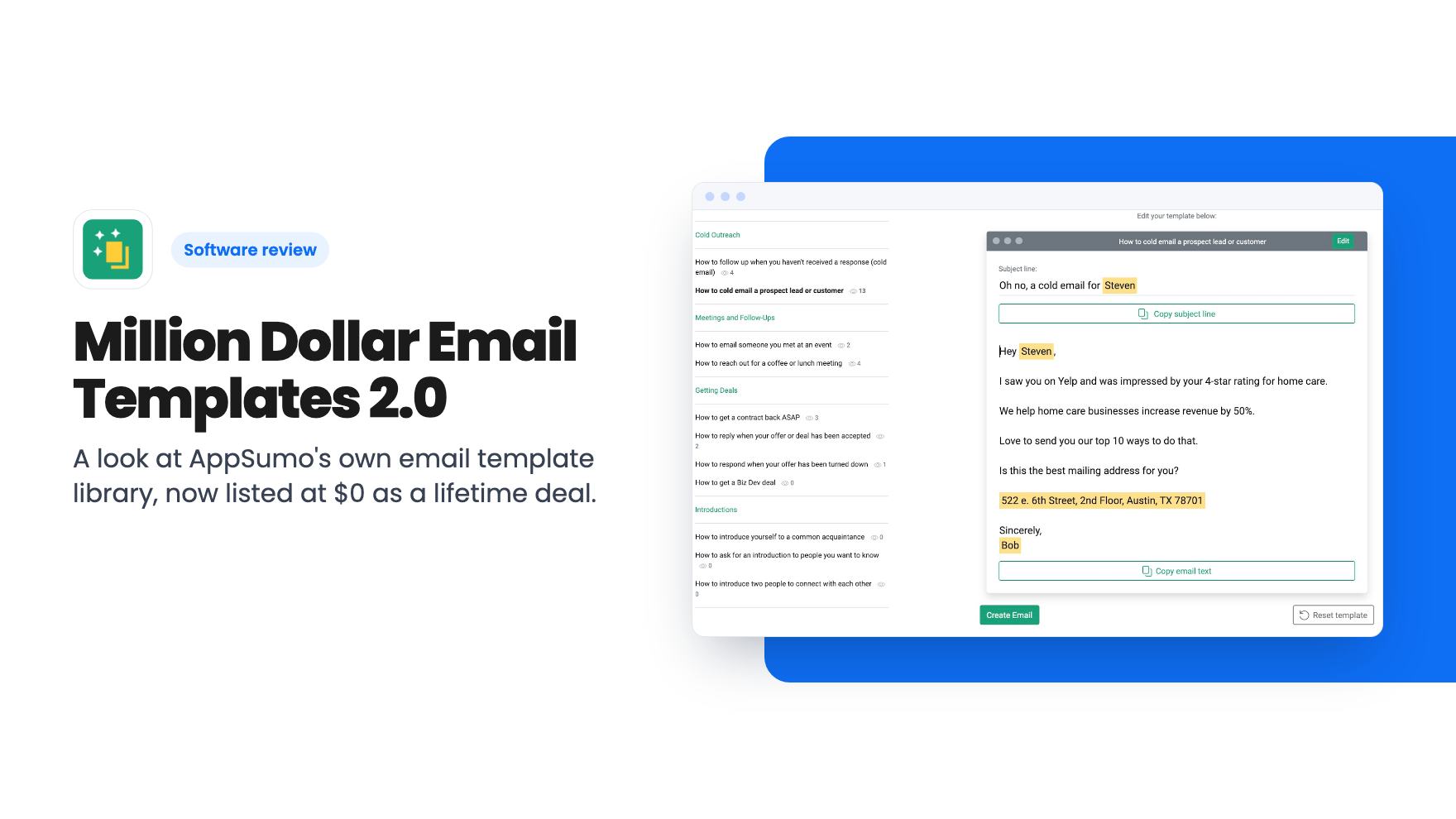
A look at AppSumo's own email template library, now listed at $0 as a lifetime deal. What you get, what's vague, and who should grab it.
BillionVerify verifies that mailboxes exist and cleans lists. LeadCop.io blocks throwaway signups on WordPress and Wix forms. Different jobs, same $49 entry price.

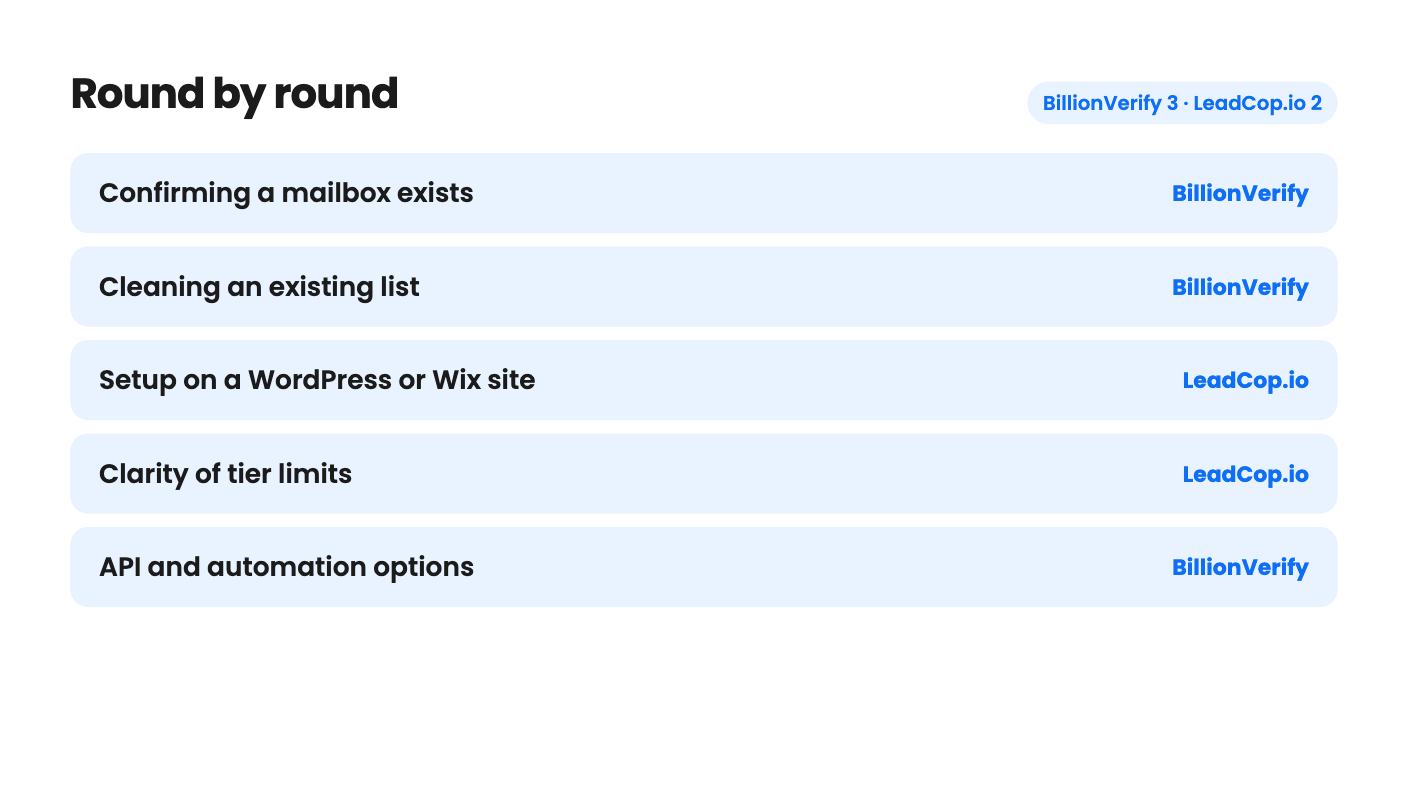
BillionVerify takes 3 rounds, LeadCop.io takes 2.
| Round | Winner | Why |
|---|---|---|
| Confirming a mailbox exists | BillionVerify | BillionVerify runs SMTP mailbox confirmation, while LeadCop's FAQ says it does no MX record verification at all. |
| Cleaning an existing list | BillionVerify | BillionVerify takes CSV uploads and exports segments; LeadCop admits you need an MX checker to scrub an old database. |
| Setup on a WordPress or Wix site | LeadCop.io | LeadCop installs with a pasted HTML snippet or a WordPress plugin, and the listing says no developer is needed. |
| Clarity of tier limits | LeadCop.io | LeadCop prints monthly validations and domain counts per tier, while BillionVerify's listing gives no credit allowance for either tier. |
| API and automation options | BillionVerify | BillionVerify lists a REST API with Python, Node.js, Go and PHP SDKs; LeadCop's listing mentions no API. |
| BillionVerify | LeadCop.io | |
|---|---|---|
| Starts at | $49 | $49 |
| List price | Not listed | $360 |
| Plan | Lifetime Deal | Lifetime Deal |
| Deal ends | Not listed | Not listed |
| Best for | Marketers, Marketing agencies, Agencies | Bloggers, Marketers, SaaS |
| Alternative to | Hunter.io, ZeroBounce | ZeroBounce |
Picture two different mornings. In one, you open your newsletter list and find a pile of throwaway addresses and a few people who typed gmial.com. In the other, you’ve sent a campaign to an old export and the bounce rate is ugly. BillionVerify and LeadCop.io both sell lifetime deals on AppSumo for email trouble, but they fix opposite ends of it. Neither listing has a demo video and we haven’t used either tool, so everything below comes from what the listings say.
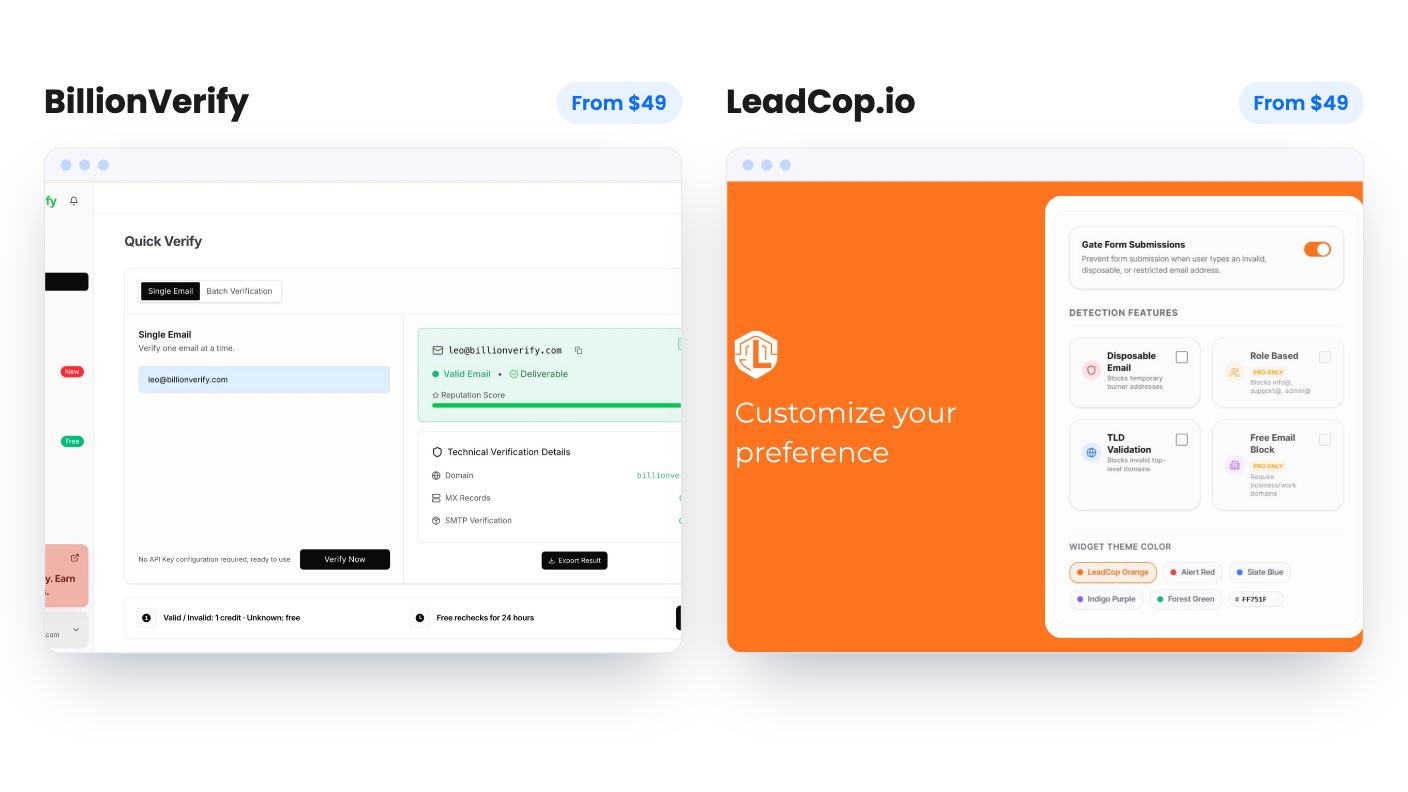
BillionVerify runs every address through a long list of checks: syntax, DNS and MX lookup, SMTP mailbox confirmation, disposable email detection, role account flags, catch-all detection and spam trap screening. The SMTP step is the one that matters. It asks the receiving mail server whether that specific mailbox exists.
LeadCop does far less, and says so. It looks for disposable, burner and 10-minute domains, role-based accounts like info@ and admin@, and common typos, prompting the visitor to fix gmial.com. It also mentions gibberish addresses and TLD validation without explaining how it judges either.
The LeadCop FAQ is upfront that it performs no MX record verification, on the grounds that mail server lookups cause form lag. A made-up address on a normal domain will pass. We respect the honesty, but it sits oddly beside the ‘keeping your lists 100% clean’ line elsewhere in the same listing.
Put simply, BillionVerify asks whether the person exists. LeadCop asks whether the address looks like junk.
LeadCop lives on your website. You paste an HTML snippet into the header or install the WordPress plugin, and the listing claims setup takes under five minutes in one place and under two in another. Wix and WordPress are the named integrations. There’s no mention of an API, a CRM connection or an email platform link.
Because it runs in the visitor’s browser, a bot posting straight to your form endpoint could skip it. The listing says nothing about server-side enforcement. For a blog lead magnet that’s probably fine. If you’re fighting automated spam, it’s a real gap.
BillionVerify gives you three routes. Single checks return status, SMTP result, MX records and reputation details. Bulk cleaning takes a CSV, shows live progress and hands back export-ready segments. The API returns JSON in under 200ms for cached results and 1 to 3 seconds for a full SMTP check, with SDKs for Python, Node.js, Go and PHP.
That 1 to 3 seconds is fine in the background and noticeable if someone is staring at a signup button. You’d likely verify after submission rather than block the form.
The BillionVerify listing contradicts itself in places. AppSumo shows four integrations (HubSpot, Integrately, Zapier, n8n), but the FAQ describes 25+ native connectors. Bulk speed is given as 50,000 and then roughly 100,000 emails per hour. If a specific connector decides the purchase, confirm it exists first.
Both deals share the same terms: lifetime access, all future plan updates, a 60-day redemption window and stacking of up to 5 codes. The difference is how much you can see before paying.
LeadCop has five tiers. Our reading of the listing, which prints the numbers from highest to lowest, is this:
If the order were reversed, the $49 tier would be the biggest, which makes no sense, so check the AppSumo page. It’s also a monthly cap, and the listing doesn’t say what happens when you hit it. Ignore the $360 to $7,200 list prices.
BillionVerify has two tiers, $49 and $98, and the listing doesn’t say what either one gives you. No credits, no total verifications, no API cap. For a product priced per email, that’s the one number you need. The $0.00 list price is a data quirk and tells you nothing.
The only pricing context is the FAQ, which says 10,000 verifications cost $10 pay-as-you-go, against $50 on NeverBounce, $60 on Emailable and $129 on ZeroBounce. At those rates, someone cleaning 10,000 addresses twice a year spends $20 annually. The $49 code only wins on steady, repeated volume, and only if the vendor survives long enough.
On clarity, LeadCop wins. On unknowns, BillionVerify has the bigger one.
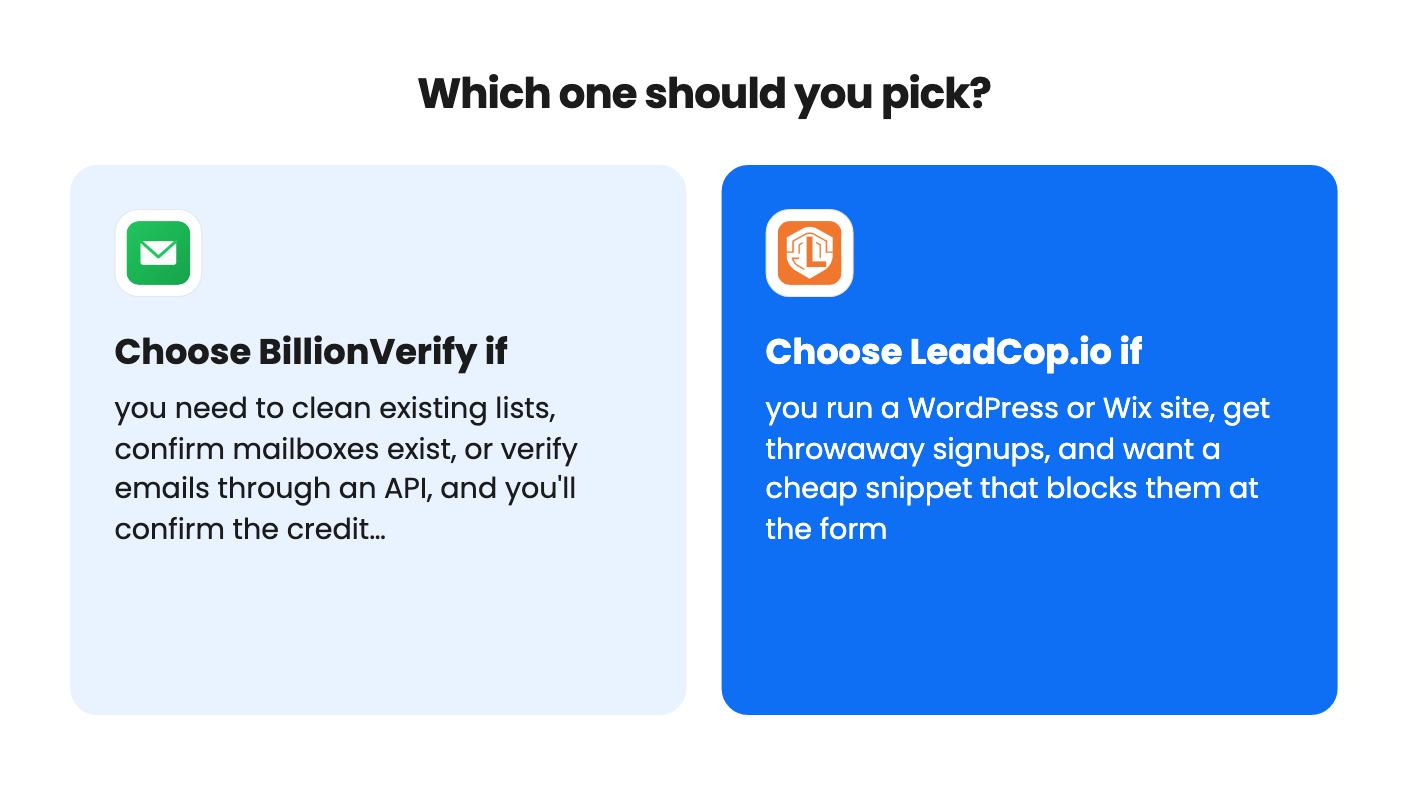
Choose LeadCop if you run a WordPress or Wix site, collect signups through a lead magnet and keep finding throwaway addresses. The $49 tier is a cheap experiment. Think about role-based blocking before you switch it on, though. If you sell to tiny companies, plenty of real buyers sign up with info@ or hello@, and the listing doesn’t say whether you can allow them.
Choose BillionVerify if you clean lists regularly, run an agency, or want verification wired into signups and automations through an API. It’s also the only one of the two that deals with a list you already own. Start with the 100 free credits, run a messy sample from your own data, and get the tier allowance in writing before buying a single $49 code.
There’s a case for skipping both. If you verify one list a year, pay-as-you-go at the quoted rates is simpler than any lifetime commitment.
Both products look young. BillionVerify’s listing gives no company history, customer count or uptime record, and verification depends on mail server reputation that a small provider can struggle to maintain. LeadCop’s listing is short, with a small feature set and no stated update schedule for its disposable-domain list, which a throwaway-email filter lives or dies on.
Data handling is another gap. BillionVerify claims encryption in transit and at rest, GDPR and CCPA compliance, and deletion of addresses after processing. LeadCop’s listing doesn’t address it, so read its privacy policy if you collect European signups.
Whichever you pick, buy the lowest tier first. The entry price is small enough that a wrong guess is cheap, and the stacking rules let you add more once the product has earned it.
No. LeadCop's FAQ says it does no MX record verification and can't scrub an old database for hard bounces. It blocks disposable domains, role addresses and typos at the form. BillionVerify checks whether the mailbox itself exists.
LeadCop's listing shows 10,000 validations per month on one domain for the entry tier, though the numbers are printed in a confusing order, so double-check. BillionVerify's listing doesn't state any allowance for either tier, so get that figure from the seller first.
LeadCop fits better if your problem is junk signups on a lead magnet, since it installs through a plugin. If you also need to clean a list you already own, BillionVerify's bulk upload covers that and LeadCop doesn't.
How this comparison was made: researched from both tools' official listings and demo videos, and written with help from AI. We have not tested BillionVerify or LeadCop.io hands-on yet. Prices and deal terms change, so check AppSumo before you buy. See our affiliate disclosure.
A look at AppSumo's own email template library, now listed at $0 as a lifetime deal. What you get, what's vague, and who should grab it.
Five AppSumo lifetime deals named as Mailchimp alternatives, grouped by what you send, with the caps and catches in each listing.
Ten email marketing lifetime deals from $29 to $79, grouped by job: sending, list cleaning, and the odd extras. Caps, catches and who should skip each one.