Email MarketingReview
Million Dollar Email Templates 2.0 Review: Free Swipe File Deal
A look at AppSumo's own email template library, now listed at $0 as a lifetime deal. What you get, what's vague, and who should grab it.
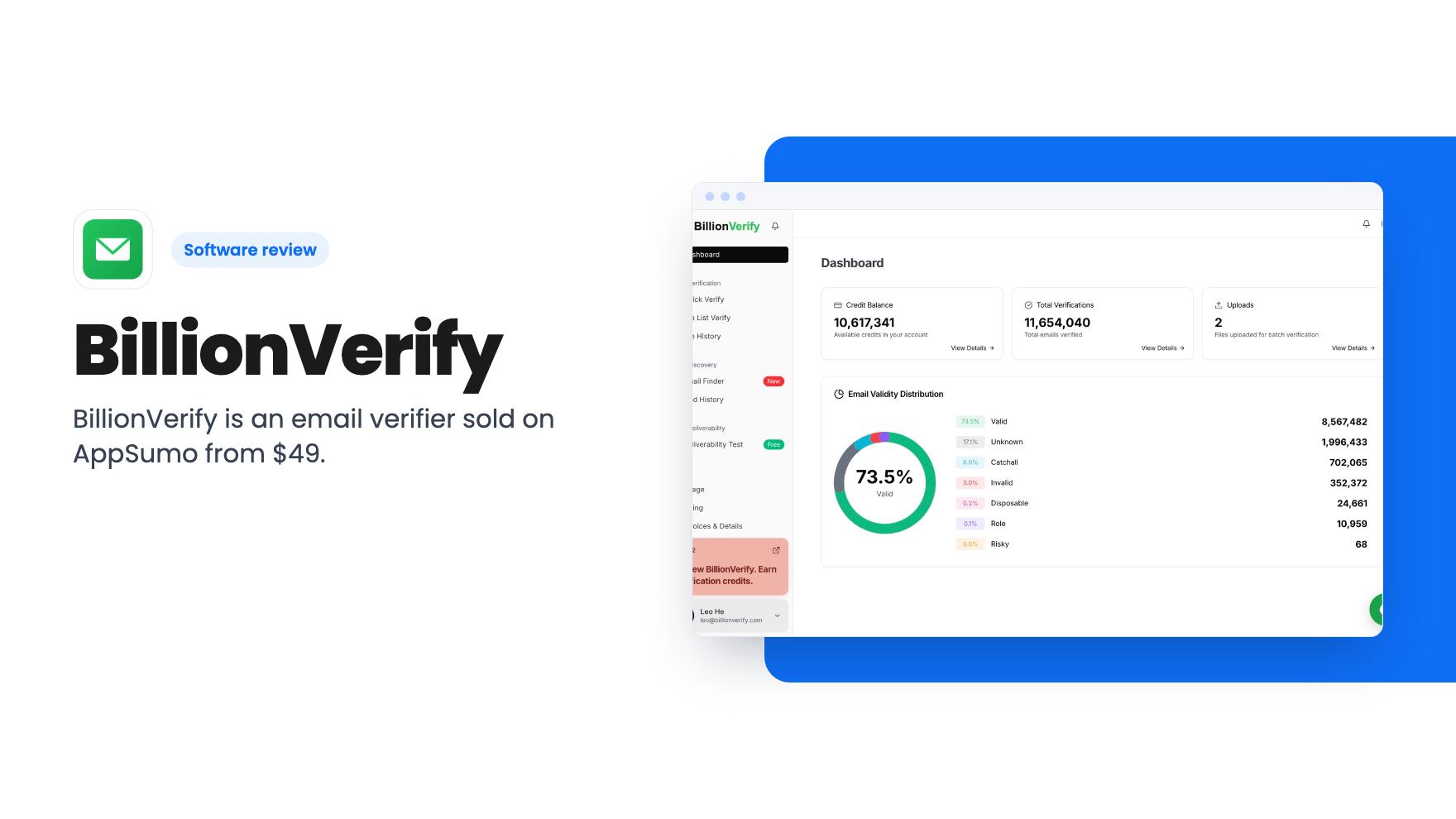
BillionVerify is an email verifier sold on AppSumo from $49. The tooling looks full, but the listing never says how many credits the lifetime tiers include.
Lifetime deal price
$490
Lifetime Deal
Our take: Worth a look if you clean lists regularly, run an agency, or want verification inside signup forms and automations. Skip it until you know the credit allowance per tier, or if you only verify a list once or twice a year, where pay-as-you-go is simpler.
Picture the morning after a campaign goes out. You sent to 8,000 addresses from a scraped list and an old newsletter export, and now the bounce rate is ugly and your sending domain is looking shaky. Nobody enjoys that, and it’s avoidable. Checking addresses before you send is cheap insurance, and BillionVerify is an email verifier now sold as a lifetime deal on AppSumo.
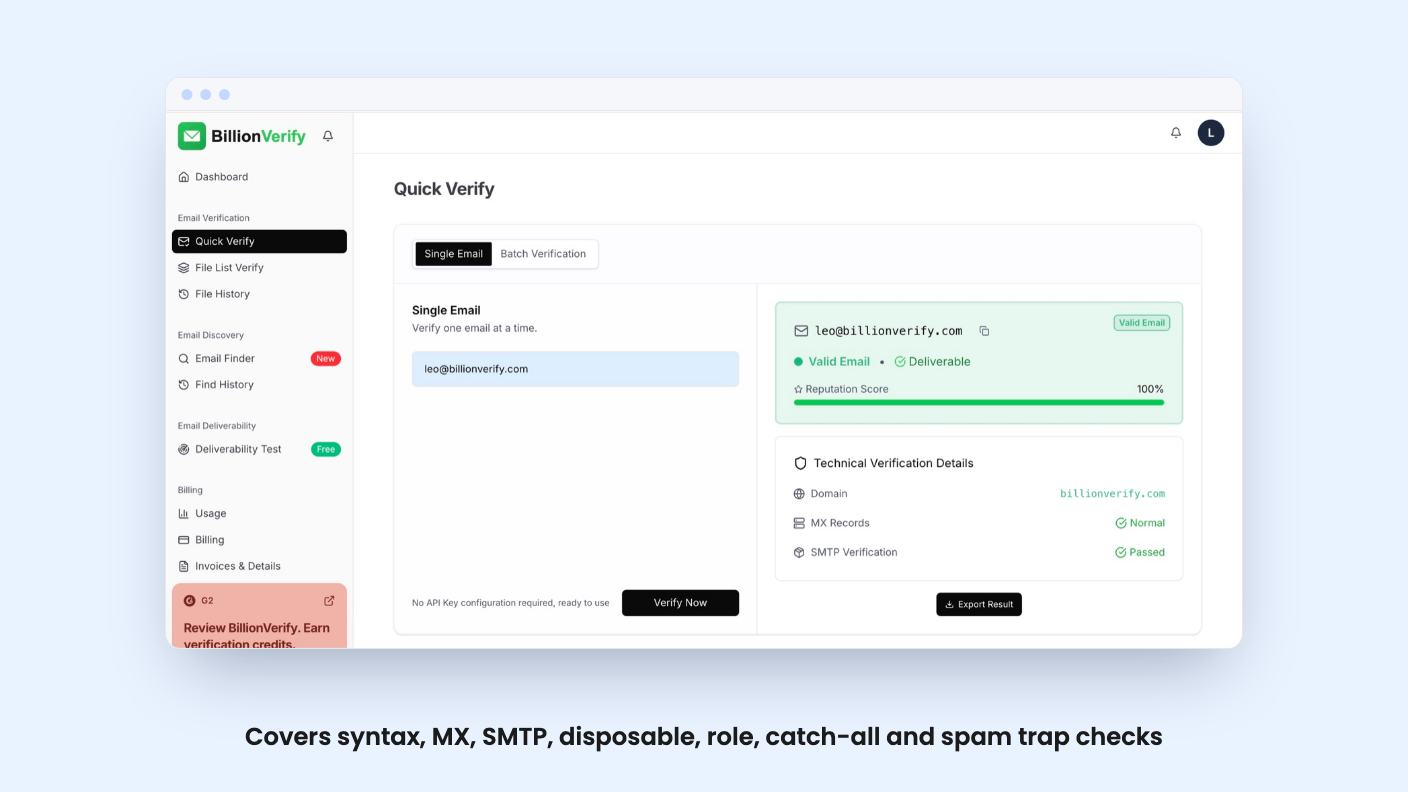
We haven’t used it hands-on, and there’s no demo video to lean on, so everything here comes from the AppSumo listing. Treat the big claims accordingly.
According to the listing, every verification runs through the same stack of checks automatically: syntax validation, DNS and MX record lookup, SMTP mailbox confirmation, disposable email detection, role account identification (info@, admin@, support@), catch-all domain detection and spam trap screening.
That’s the standard checklist for this category, and it’s good to see all of it in one request. The SMTP step is the one that matters most. It opens a connection to the receiving mail server and asks whether the specific mailbox exists, which is far more useful than confirming a domain merely looks real.
Catch-all detection deserves a mention. Some domains accept mail for any address, so a verifier can’t truly know if a person is there. The listing says BillionVerify scores these domains instead of treating them as plain good or bad. How useful that score is will depend on how it’s explained in the dashboard, and the listing doesn’t show that.
There are three ways to use it.
The single check is for one address at a time, and returns status, SMTP verification, MX records and reputation details. Handy for a quick sanity check on a lead before you reach out.
Bulk cleaning is where most small teams will spend their time. You upload a CSV, watch live progress by status, and get a validity distribution and status counts back. The listing also mentions export-ready segments for sales and marketing, so you can separate the clean addresses from the risky ones without doing it by hand in a spreadsheet.
The API is the third route. It returns structured JSON, under 200ms for cached results and 1 to 3 seconds for a full SMTP check. SDKs exist for Python, Node.js, Go and PHP. If you want to block throwaway addresses at signup, or clean contacts as they arrive from enrichment, this is the feature that justifies a verifier living inside your stack rather than being a tool you open twice a year.
One practical point: a 1 to 3 second check is fine in the background but noticeable if a user is staring at a signup form. You’d probably verify after submission, or on blur, instead of blocking the button.
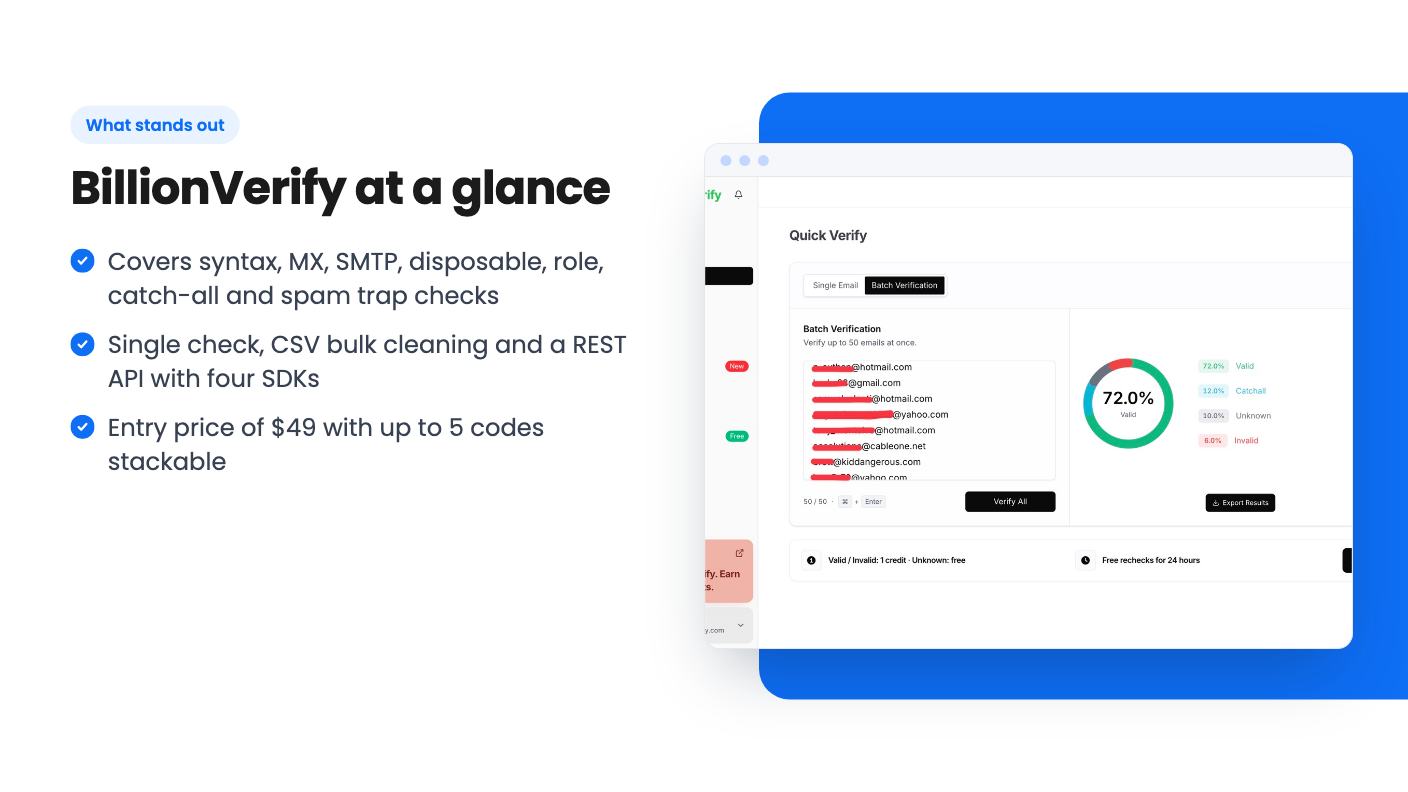
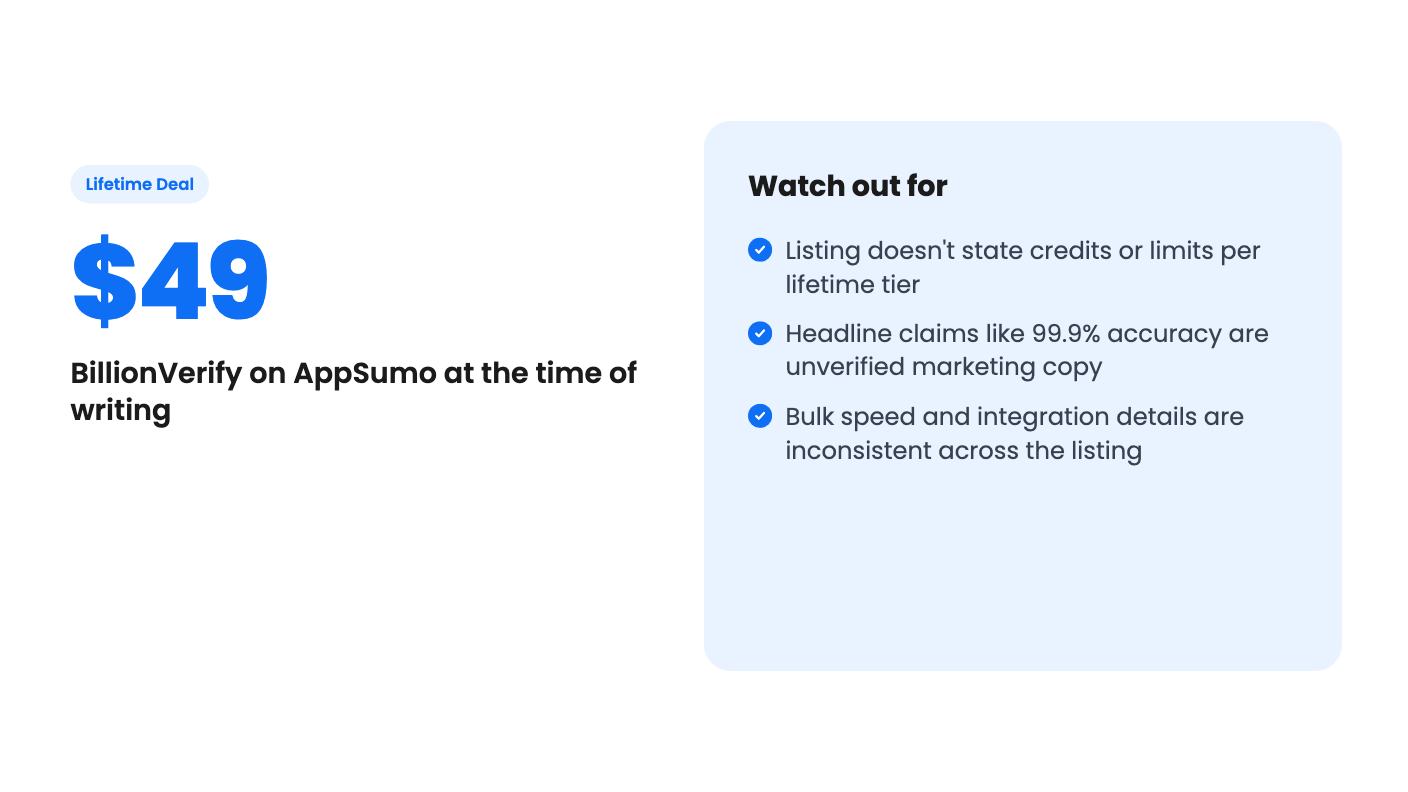
There are two tiers. Tier 1 is $49 and tier 2 is $98. Both include lifetime access, all future plan updates, and the option to stack up to 5 codes. You have to redeem within 60 days of purchase.
Here’s the problem. The listing doesn’t say what either tier actually gives you. No monthly credits, no total verifications, no cap on API calls, nothing. For a verifier, that’s the single most important number, because the product is priced per email. A lifetime deal on a metered service lives or dies on that allowance.
The stacking rule hints that each code adds capacity, which is how most deals like this work. But that’s an inference, not something the listing states. Before you spend anything, find the credit figure in the AppSumo Q&A or ask the seller directly.
The listing also shows a list price of $0.00 for both tiers, which is just a data quirk and tells you nothing about what the product costs normally. The only pricing context is in the FAQ, which says verifying 10,000 emails costs $10, against $50 on NeverBounce, $60 on Emailable and $129 on ZeroBounce, with volume discounts down to $0.00014 per email.
That comparison matters more than it looks. If pay-as-you-go is already $10 per 10,000 checks, a lifetime deal only wins if your volume is steady. Someone cleaning 10,000 addresses twice a year spends $20 annually at that rate. In that case $49 takes a couple of years to pay off, and only if the product is still around.
Some of the listing’s numbers don’t line up, and it’s worth noticing where.
None of that means the product is bad. It does suggest the listing was written fast, and that you should confirm the integration you need exists before buying. The free 100 credits are the sensible way to do that: run a small, messy sample from your own list and see how it labels the risky ones.
The listing also mentions an MCP server for Claude and Cursor and one-click Agent Skills. That’s an interesting angle for people wiring verification into AI workflows, though it’s a young area and the listing gives no detail on how it behaves.
On data handling, the listing says data is encrypted in transit and at rest, that the service is GDPR and CCPA compliant, and that email addresses are deleted after processing. Reasonable, but it’s a claim on a sales page, so read the privacy policy if you handle European contacts.
Skip this if you verify a list once or twice a year. Pay-as-you-go pricing at the quoted rates is simple, and you won’t carry the risk of a small vendor.
Skip it too if you need a long track record. The listing gives no company history, customer count or uptime record, and a lifetime deal only pays off if the service keeps running. Email verification also depends on good mail server reputation, which is hard for a young provider to maintain.
It makes more sense for agencies and marketers who clean lists every month, or developers who want verification on signups. If that’s you, start with the free credits, get the tier allowance in writing, and buy a single $49 code first. Stack more only after the numbers hold up.
The listing doesn't say. Tier 1 is $49 and tier 2 is $98, both described only as lifetime access with future plan updates and stacking of up to 5 codes. Ask the seller for the credit allowance before buying.
Yes. According to the listing, you get 100 free verification credits on signup with no credit card, and there's a homepage demo for anonymous users.
The AppSumo integrations list names HubSpot, Integrately, Zapier and n8n. The FAQ also mentions 25+ native connectors such as Mailchimp, SendGrid, Klaviyo and Salesforce, plus a REST API with Python, Node.js, Go and PHP SDKs.
How this review was made: researched from BillionVerify's official listing, and written with help from AI. We have not tested BillionVerify hands-on yet. Prices and deal terms change, so check AppSumo before you buy. See our affiliate disclosure.
A look at AppSumo's own email template library, now listed at $0 as a lifetime deal. What you get, what's vague, and who should grab it.
Five AppSumo lifetime deals named as Mailchimp alternatives, grouped by what you send, with the caps and catches in each listing.
Ten email marketing lifetime deals from $29 to $79, grouped by job: sending, list cleaning, and the odd extras. Caps, catches and who should skip each one.