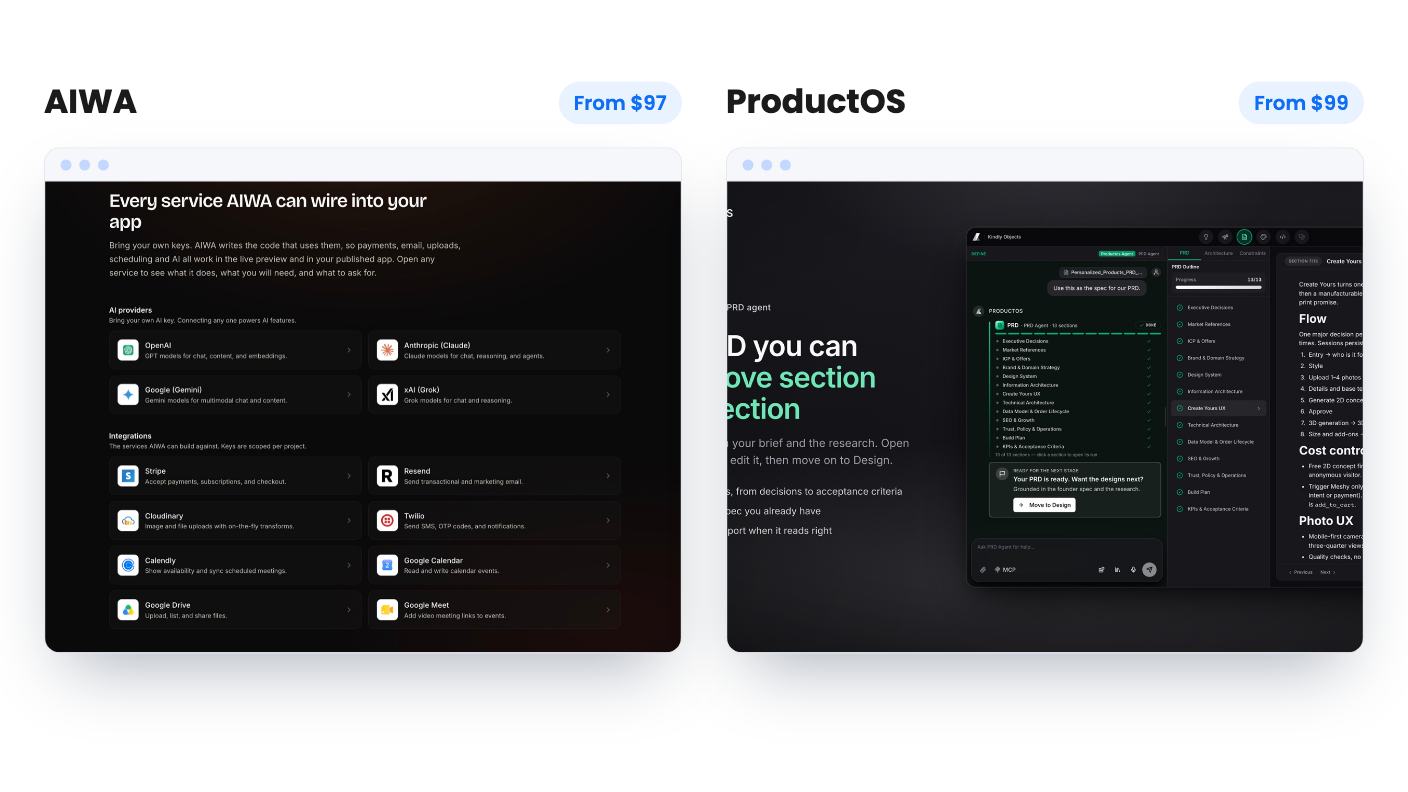
Say you have an app idea, no developer, and a budget that rules out an agency. Two AppSumo lifetime deals, priced at $97 and $99, both promise to get you from a description to running code. They go about it in very different ways, and the difference matters more than the price.
We haven’t used either one. Everything here comes from the two AppSumo listings, which are vendor marketing, and neither has a demo video to check it against.
Prompt to app versus idea to repo
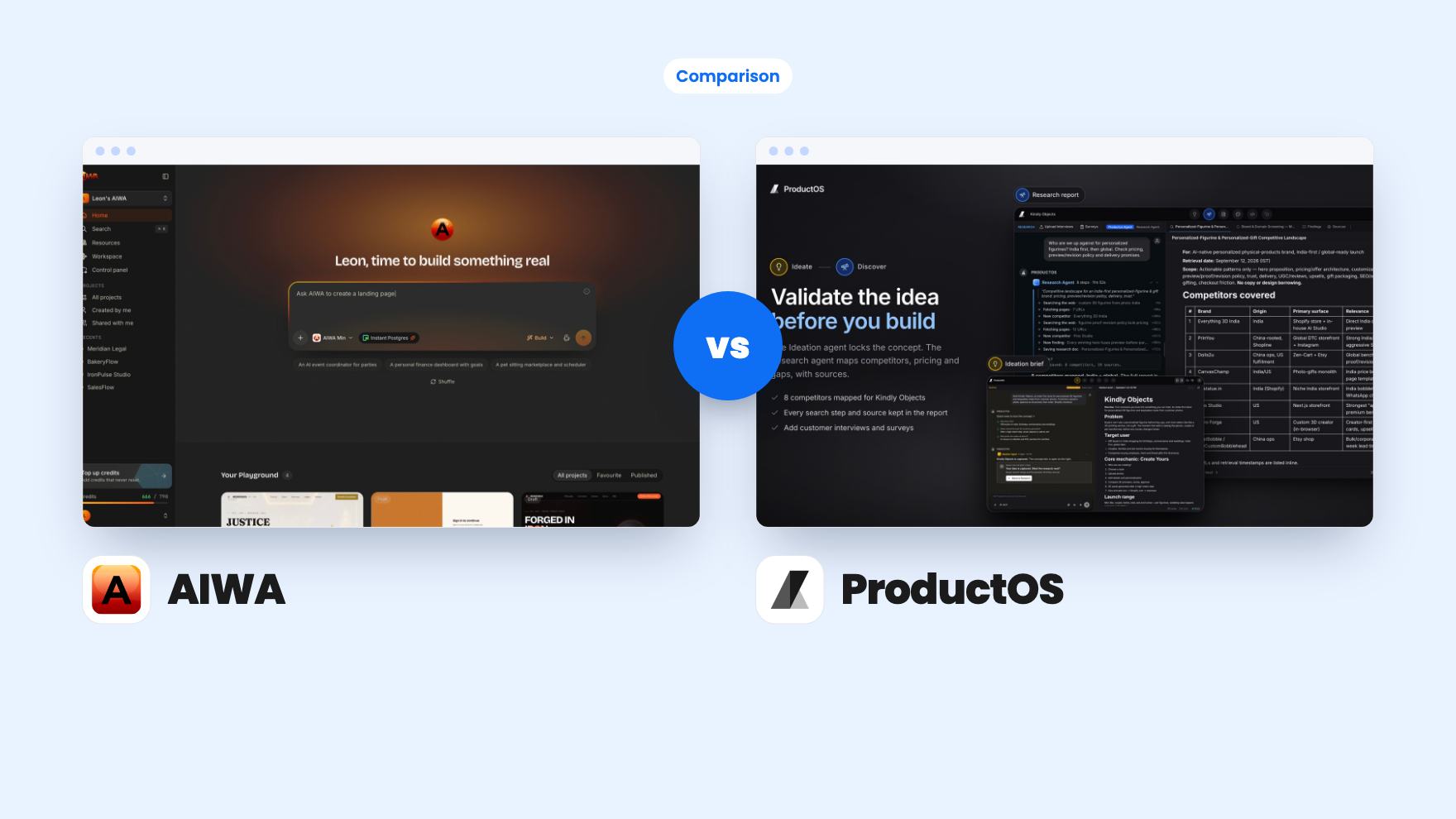
AIWA is the quick one. You describe what you want, and the listing says it plans and builds a full application from that single prompt, including the frontend, backend, user sign-in and a database. After that you change things by chatting with what it calls your AI Product Team.
ProductOS slows you down on purpose. Its Ideation agent asks a few questions and writes a brief. A Research agent then searches the web and saves a sourced report on competitors and pricing, with retrieval dates and links. A PRD agent drafts the requirements, which you approve section by section. Design comes next, and only then code.
Which of those you prefer depends on how clear your idea already is. If you know exactly what the app should do, ProductOS’s research and spec stages are extra steps you may spend credits on. If you’re still unsure who the product is for, AIWA’s one-prompt approach gives you no help with that part.
ProductOS also names its output stacks: Next.js, Expo, Astro or WordPress. AIWA doesn’t say what it generates. It mentions mobile-ready apps without explaining whether that means a responsive site or something installable. That’s a gap for anyone who cares what they’re maintaining later.
The credit math
Both tools run on prepaid credits, and this is where the two listings are most different.
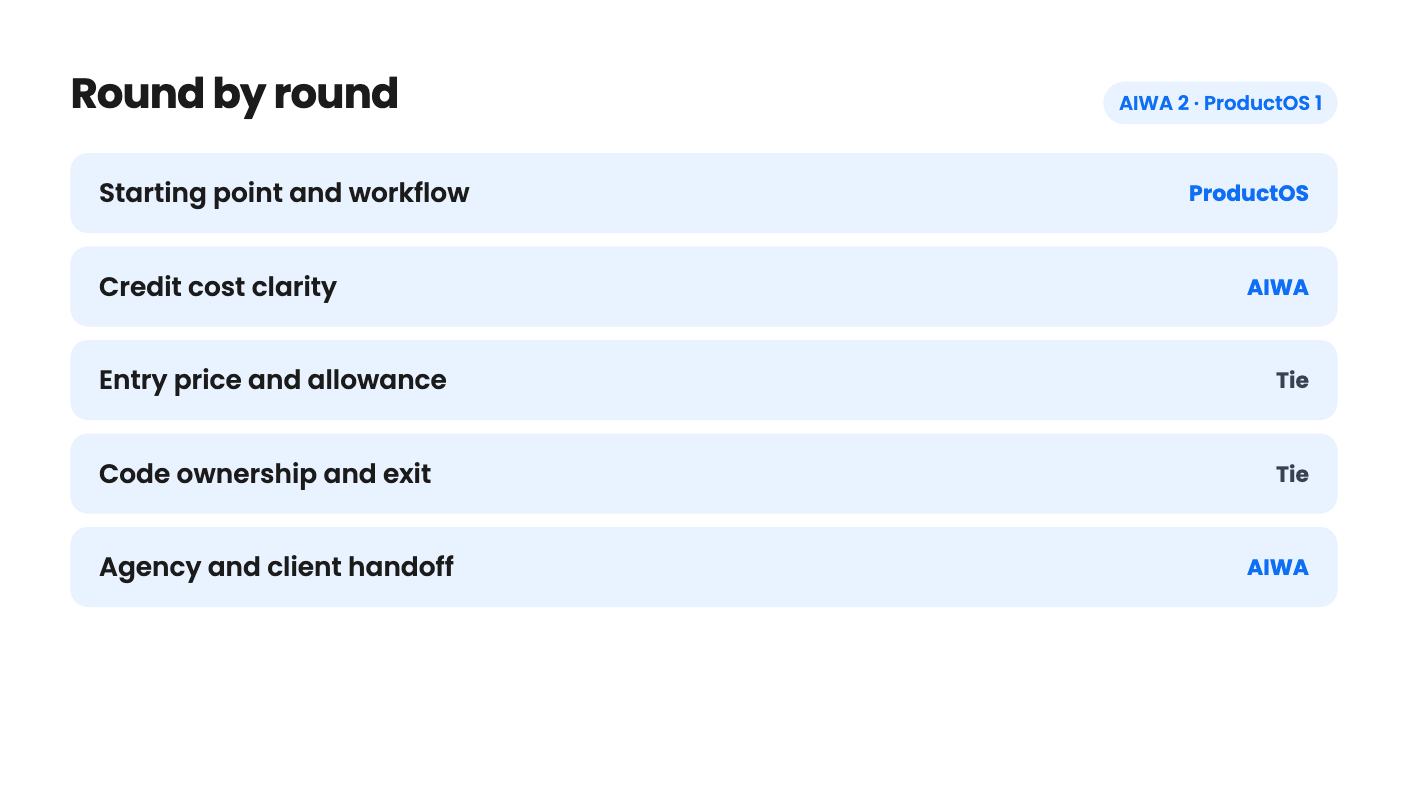
AIWA tells you the rates. A full new app costs about 40 credits, and a small edit or bug fix costs 10. Going live is free. On the $97 tier’s 250 credits, you could build two apps and still have about 17 edits left, or six apps and nothing for fixes. Since AI builders usually need several rounds of changes, expect the edit budget to matter more than the app count.
ProductOS gives you more credits, 1,000 on its $99 tier, but no rates at all. The listing says usage depends on the model, the task and how long previews run. It also says credits pay for hosting on published sites, charged monthly. A live site keeps draining the balance, and there are no recurring included credits on any tier.
So 1,000 sounds four times bigger than 250, but we can’t tell you whether it builds one app or ten. We’d treat that as a real weakness in the listing. A lifetime deal where you can’t estimate the running cost is a gamble, and it’s a bigger one here than with AIWA.
Neither listing gives top-up prices. That’s a shared gap, and you’ll want to find those numbers before you commit.
Features that matter after the first build
AIWA leans on memory. The listing calls it Project Memory in one spot and Product Memory in another, and says it keeps your rules and data in mind so new features don’t break old ones. It also says AIWA opens a browser, clicks through the app and tests the login before you see the result. Both are claims without evidence, so treat them as things to test in your first project.
ProductOS answers the same worry differently. Its Code Doctor reads the project and lists findings worst first, each with a root cause and a one-click suggested fix. You can also edit the design system before any code exists. That’s a more concrete safeguard than a promise that nothing will break, though you’d still want a developer to look over anything touching payments or customer data.
On integrations, AIWA mentions Stripe, Resend, Twilio, Calendly, GitHub and Google Calendar, which suits booking and payment apps. ProductOS lists GitHub, Claude, ChatGPT, MCP and Cursor, which points at people who already work with AI coding tools.
Both let you keep the code. AIWA offers a ZIP download or a push to GitHub, and ProductOS keeps every project in its own GitHub repo. For a lifetime deal from a young company, that’s the most reassuring line in either listing.
Tiers and limits
AIWA has two tiers:
- $97: 250 one-time credits, 50 projects a month, 2 apps a month, 2 team seats, priority support.
- $297: 1,000 one-time credits, unlimited projects and apps, 15 seats, VIP support.
The AIWA feature table doesn’t label its columns, so the mapping above is our reading. Confirm it on the AppSumo page. Client handoff, client review invites and visibility controls look limited to the top tier, which matters if you’re an agency.
ProductOS has five tiers, from $99 to $1,499. The $99 tier gets 1,000 credits, 1 concurrent agent, 1 user and 1 live product. The $199 and $399 tiers add credits and agents (2,000 and 4,000 credits) but keep one user and one live product. The $799 tier gives 8,000 credits, 5 users and 3 live products. The $1,499 tier gives 15,000 credits, 15 users and 5 live products.
That structure tells you something. For a single founder with a single project, tiers 2 and 3 are just bigger fuel tanks. Both deals ask you to activate within 60 days, allow moves between tiers and don’t allow stacking. ProductOS adds that a refund revokes the license and any unused credits.
What the listings leave out
AIWA has four AppSumo reviews averaging 4.00 out of 5. ProductOS has one, at 5.00. Neither number tells you much. Neither listing offers company history, and neither has a demo video.
AIWA’s custom domain answer is vague too. The FAQ says paid plans can connect one, and it doesn’t say whether lifetime buyers count. ProductOS says you can connect your own domain in the publish dialog, but hosting still costs credits.
AIWA’s list prices of $600 and $1,788 and ProductOS’s of $219 to $3,299 don’t help either. They’re marketing numbers, not a measure of value.
Which one to pick
Pick AIWA if you want to test a few simple internal tools or client prototypes quickly and you like knowing roughly what each build and edit costs. Agencies with simple client work may find the $297 tier’s handoff features useful, as long as they’re comfortable with a product this lightly reviewed. Skip it if you plan to build often, because two apps a month and 250 credits is a small allowance.
Pick ProductOS if your real problem is deciding what to build, and you’d value a researched brief, a PRD and a design system before any code. It suits a founder or product manager who wants a repo at the end. Skip it if you need predictable costs or free hosting, since the listing is clear that neither applies.
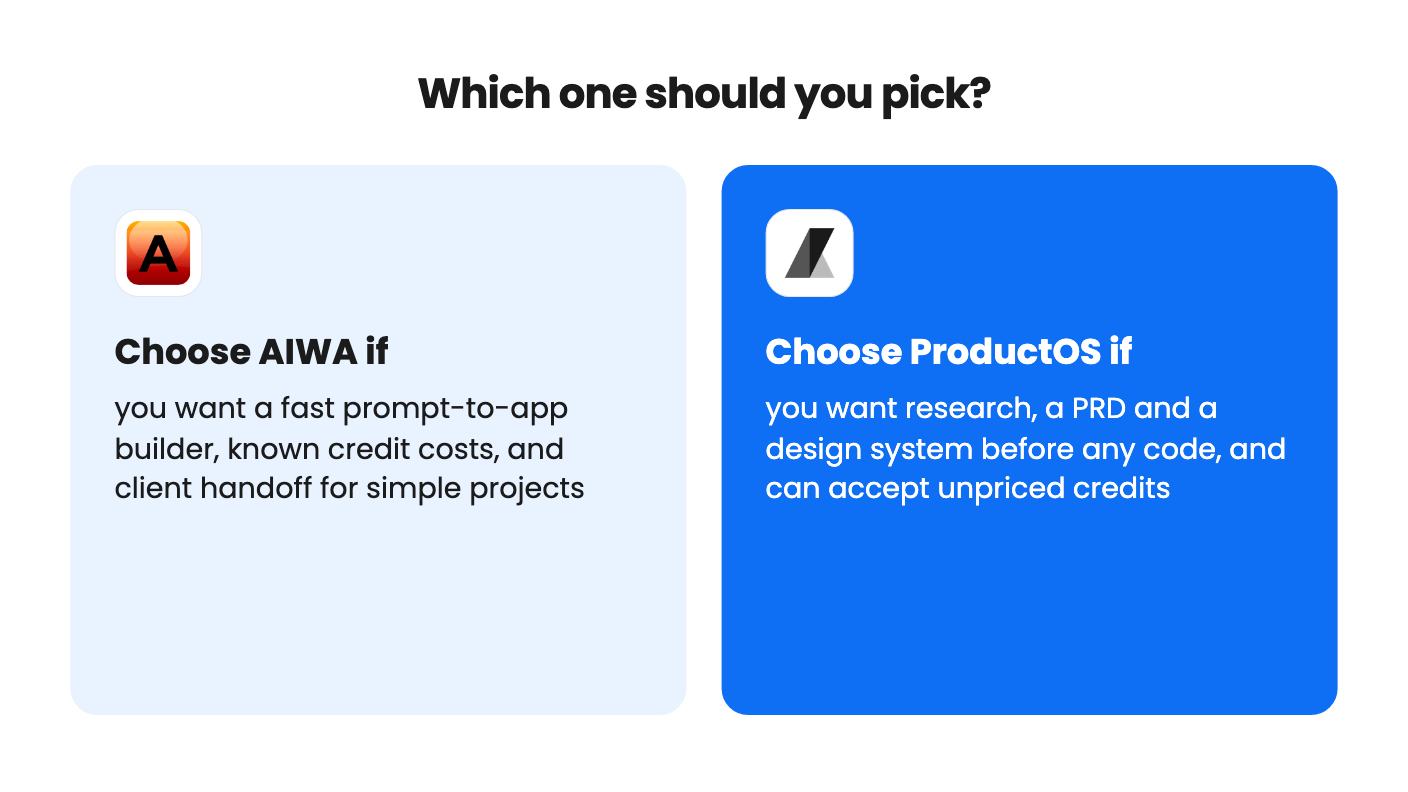
If we had to put $100 down on one, we’d lean toward AIWA for the cost transparency and ProductOS for the thinking it adds before a build. Both are cheap enough to treat as experiments, so start with one small project and watch how fast the credits fall.
How this comparison was made: researched from both tools' official listings and demo videos, and written with help from AI. We have not tested AIWA or ProductOS hands-on yet. Prices and deal terms change, so check AppSumo before you buy. See our affiliate disclosure.