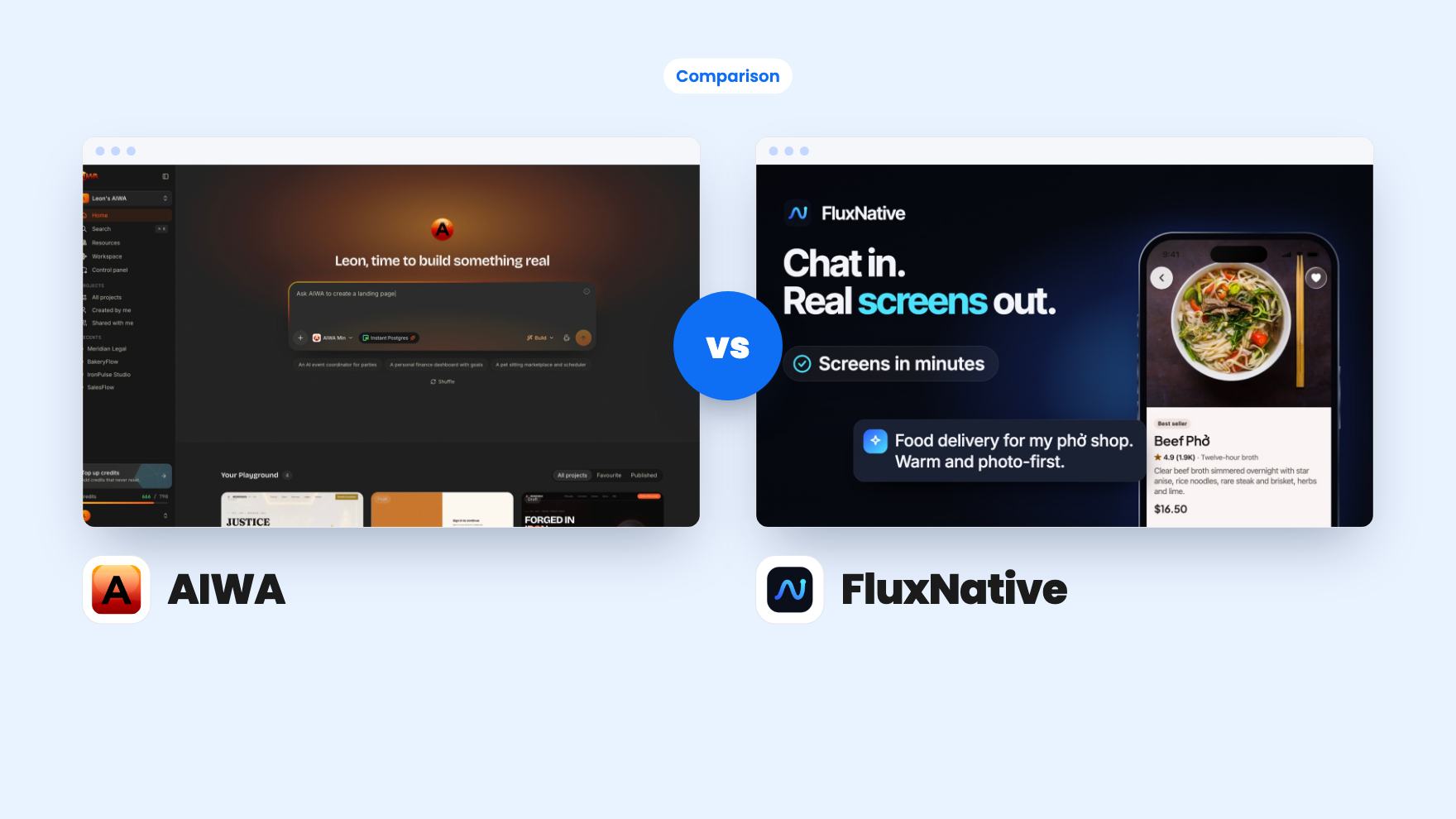
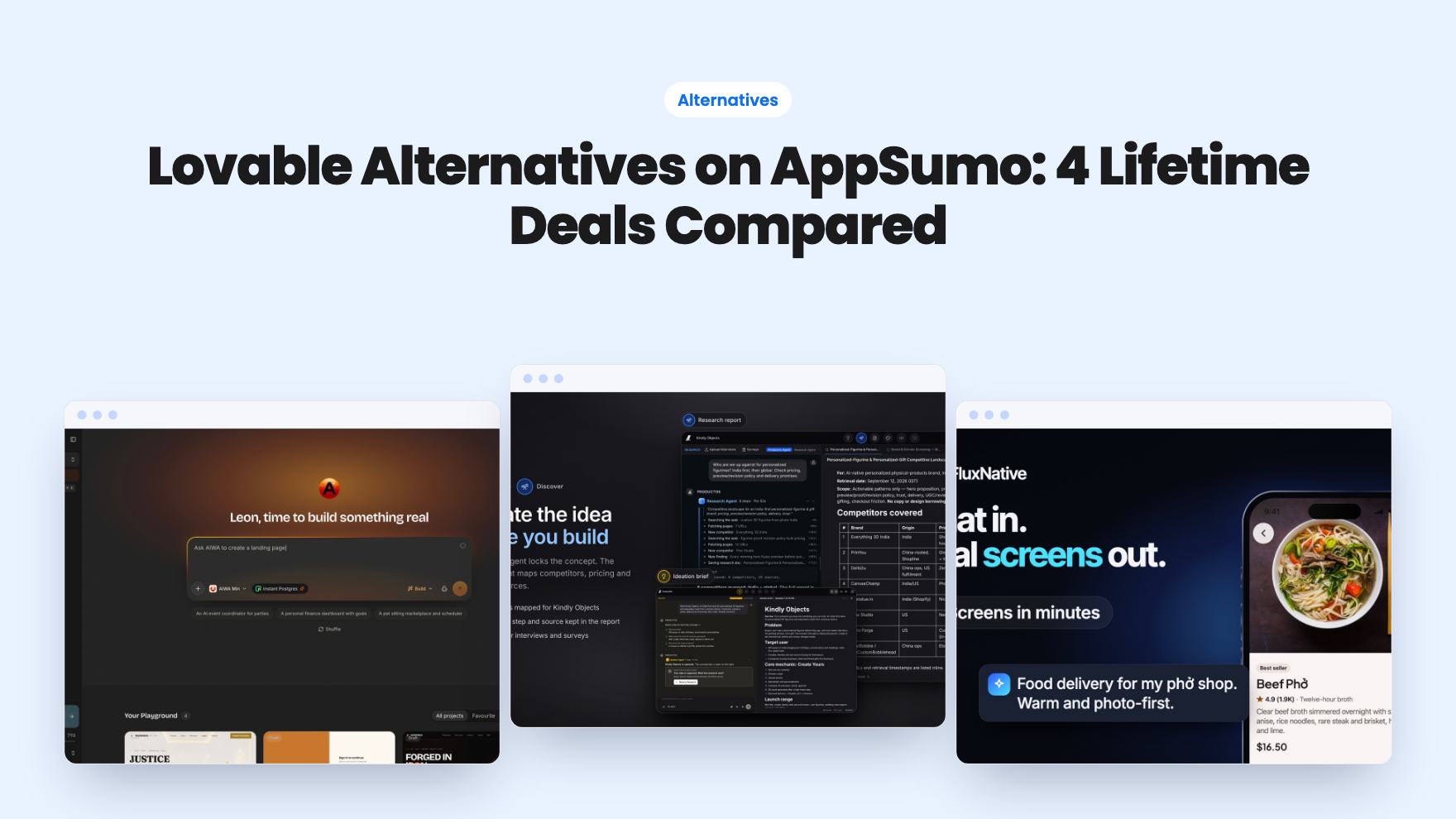
You’ve got an app idea, and the only quote you’ve seen was high enough to make you close the tab. AIWA and FluxNative both claim to fix that, and both are lifetime deals on AppSumo. They aim at different targets, though, and buying the wrong one would waste your money.
We haven’t used either. Everything below comes from the AppSumo listings, which are vendor marketing, and neither listing has a demo video.
The real difference: a browser or a phone
AIWA says it builds a complete application from one written prompt. That means the frontend, the backend, user sign-in and a database. The examples are websites, SaaS products, CRMs, marketplaces and dashboards. It also mentions mobile-ready apps but never says what that means, whether it’s a responsive site or something you could install.
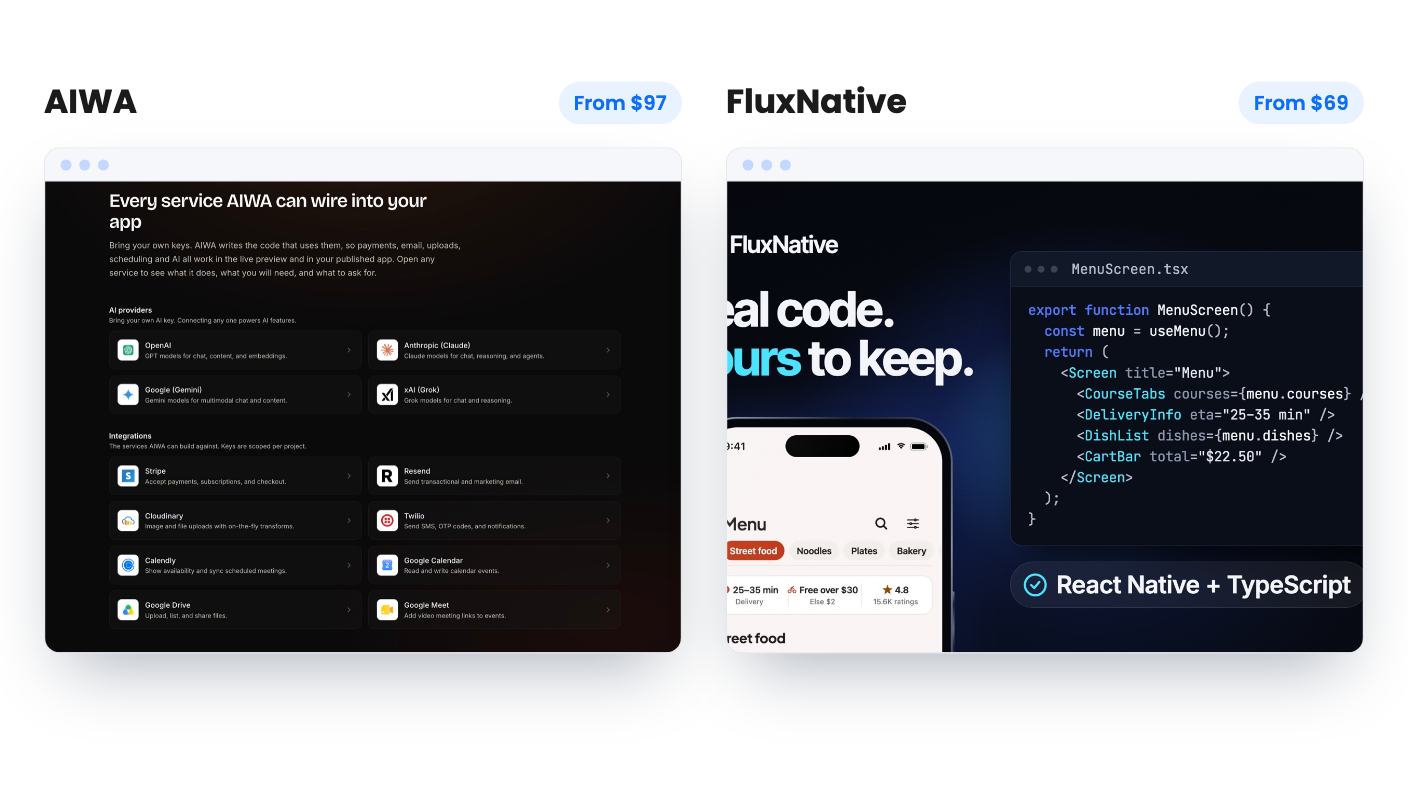
FluxNative is narrower, and it says so. It writes React Native code in TypeScript and is built around getting signed iOS and Android apps into the stores. The listing is blunt that Lovable only does web apps, which tells you where FluxNative sees itself.
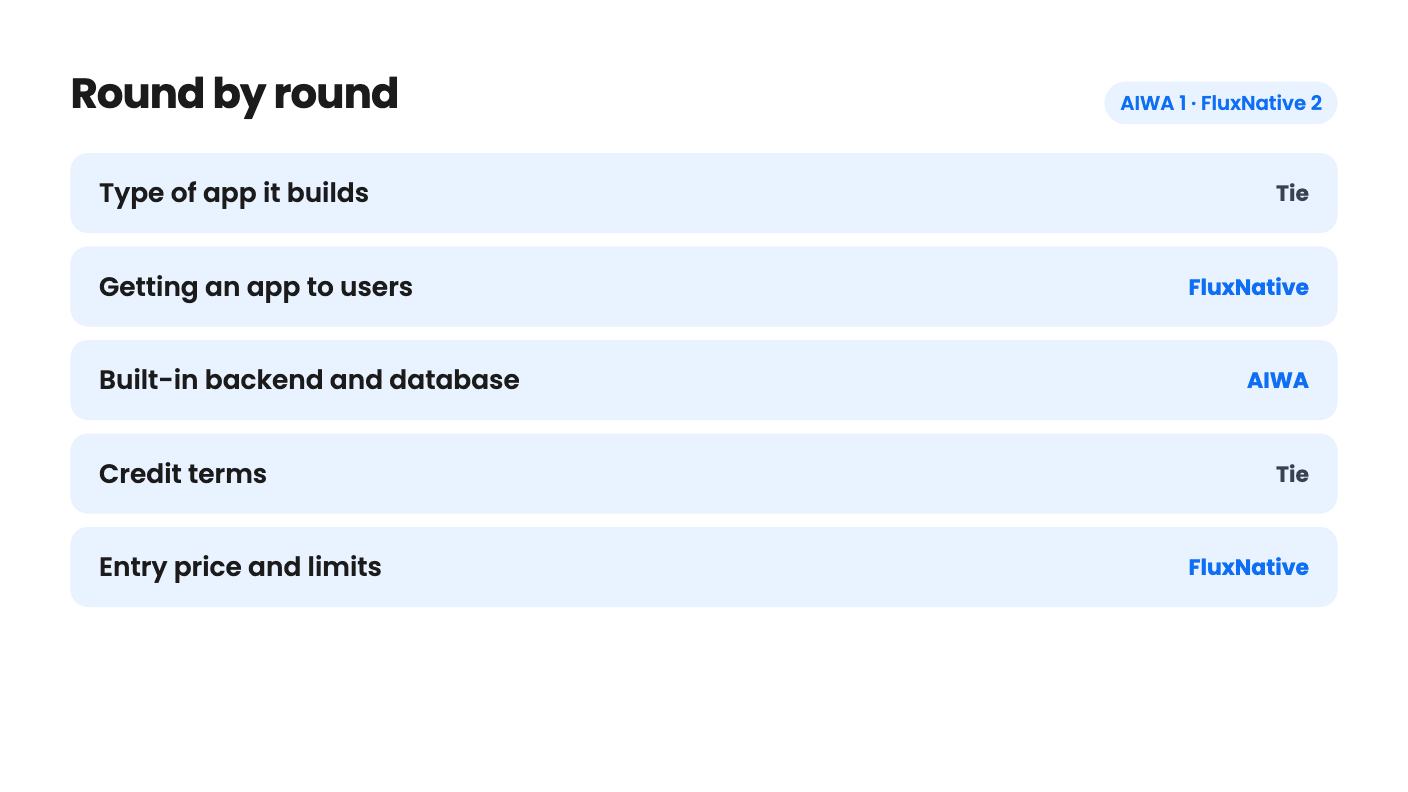
So the first question is where your customers will find you. If it’s a link in a browser, look at AIWA. If it’s the App Store, look at FluxNative. Most buyers only need one of those answers.
How you build and edit
AIWA edits happen in a chat with what it calls your AI Product Team. The big promise is persistent memory, called Project Memory in one place and Product Memory in another, so new features supposedly don’t break old ones. The listing also says it opens a browser, clicks through your app and fixes bugs before you see the result. Both are claims with no evidence behind them. Each project gets a Project Hub for users, domains, SEO and analytics, and the integrations include Stripe, Resend, Twilio, Calendly and Google Calendar.
FluxNative gives you more ways in. You can start from a prompt, screenshots or a Figma plugin, fork a template, or import an existing Expo app. Edits happen by chat and revisions are undoable, which is a practical safety net. There’s a live browser preview with a shareable link too.
The feature that changes the math is MCP support. You can point Claude Code, Cursor, Codex or another MCP client at your app, and those edits run on your own AI subscription with no FluxNative credits used. If you already pay for a coding agent, that’s a real saving. If you don’t, you’ll spend credits on every chat.
One gap to flag. FluxNative lists Supabase, Firebase, Appwrite or your own API for the backend. It doesn’t say it creates a backend for you, so expect to set one up. AIWA’s listing is clearer that the backend is part of the build.
Credits decide the real cost
Both tools run on credits, and the units aren’t comparable. Don’t match 250 against 2,500 and think you’ve learned something.
AIWA charges about 40 credits for a full new app and 10 for a small edit or bug fix. Going live is free. The $97 tier includes 250 one-time credits that never expire. That’s roughly two apps (80 credits) and 17 edits, and then you’re out. Top-ups exist on both tiers, but the listing gives no prices. That’s the biggest hole in the AIWA deal, because you can’t estimate long-term cost without it.
FluxNative publishes far more. Every tier gets 2,500 starter credits, added once at activation and valid for 90 days. There are no monthly credits. A typical chat change costs 100 to 700 credits, a new app’s first build usually 500 to 1,500, a signed Android build 200 to 250 and an iOS build 300. Failed or canceled builds are free. Top-ups are $3 per 1,000 credits and last 365 days.
By that math, an iOS build is about 90 cents. A heavy chat change might run a couple of dollars. That’s fair, but the starter balance can vanish within a few sessions, and the 90-day clock is ticking from day one. AIWA’s credits don’t expire, which is friendlier if you build slowly. FluxNative’s pricing is friendlier if you want to know what you’ll pay.
Tiers and limits
AIWA’s feature table has two unlabeled columns, so we’re reading the larger numbers as the $297 tier. Check the AppSumo page before paying.
- AIWA $97 (listed at $600): 250 credits, 50 projects a month, 2 apps a month, 2 team seats, priority support.
- AIWA $297 (listed at $1,788): 1,000 credits, unlimited projects and apps, 15 seats, VIP support. Client handoff and client review invites appear to be top-tier only.
- FluxNative Tier 1, $69 (listed at $336): 3 apps, 1 seat, 1 build at a time.
- FluxNative Tier 2, $149 (listed at $336): 10 apps, 3 seats, 2 builds at a time.
- FluxNative Tier 3, $299 (listed at $768): 30 apps, 10 seats, 2 builds at a time.
FluxNative’s tiers differ only in limits. Every tier gets the same features and the same 2,500 credits, so paying more buys room, not AI usage. Thirty apps on that balance is optimistic until you top up.
Both require activation within 60 days, both let you switch tiers, and neither stacks. FluxNative states that AppSumo’s 60-day refund applies. AIWA’s listing doesn’t mention a refund, so confirm that on the page.
Ignore the list prices. A $600 or $1,788 sticker on a lifetime deal says little about what the tool is worth to you.
What the listings leave out
AIWA’s listing text is empty. All we have is feature bullets and a vendor FAQ, plus four reviews averaging 4.00 out of 5, which is too small a sample to lean on. It doesn’t say what stack it generates or what happens if credits run out mid-build. The custom domain answer also says paid plans can connect one, without saying whether lifetime buyers count.
FluxNative shows no review figures, customer numbers or roadmap. It’s honest about the manual parts: you create the app record in each store’s console, and the first Google Play upload is done by hand. It also doesn’t mention store developer account fees, so budget for those. Apple and Google review every app, and no tool can promise approval.
The growth extras on FluxNative, such as the landing page publisher, growth agent and Flumi assistant, come with no detail on quality. Treat them as bonuses.
Which one to buy
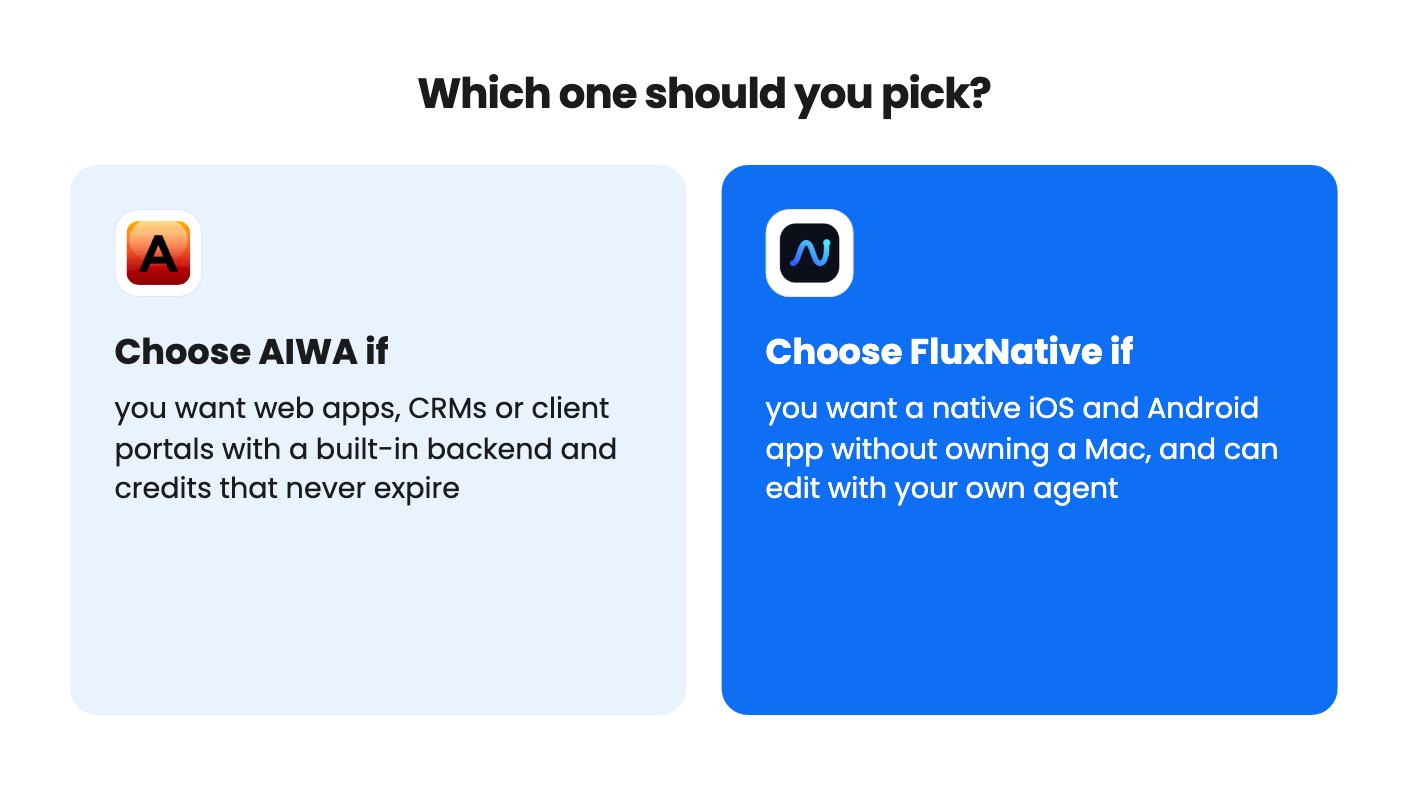
Buy AIWA at $97 if you want a web tool, like a client portal, an internal tracker or a small CRM, and you like that the credits never expire and the code is yours. Keep it to a few modest projects. Two apps a month and 250 credits is a trial, not a workshop, and the missing top-up prices make heavy use a gamble. The $297 tier only makes sense for agencies that need handoff, and it’s a bet on a product with very little public feedback.
Buy FluxNative Tier 1 at $69 if you need an app in the App Store and on Google Play and don’t own a Mac. It’s the cheaper entry, the cost model is spelled out, and the refund is stated. It works best if you’ll edit with your own coding agent and spend credits mostly on builds. Skip it if you want web apps, a predictable monthly bill, or a hands-off experience, since the store setup is real work.
Whichever you choose, activate early and build one small real project inside the window. That tells you more than either listing can.
How this comparison was made: researched from both tools' official listings and demo videos, and written with help from AI. We have not tested AIWA or FluxNative hands-on yet. Prices and deal terms change, so check AppSumo before you buy. See our affiliate disclosure.