Design & MediaAlternatives
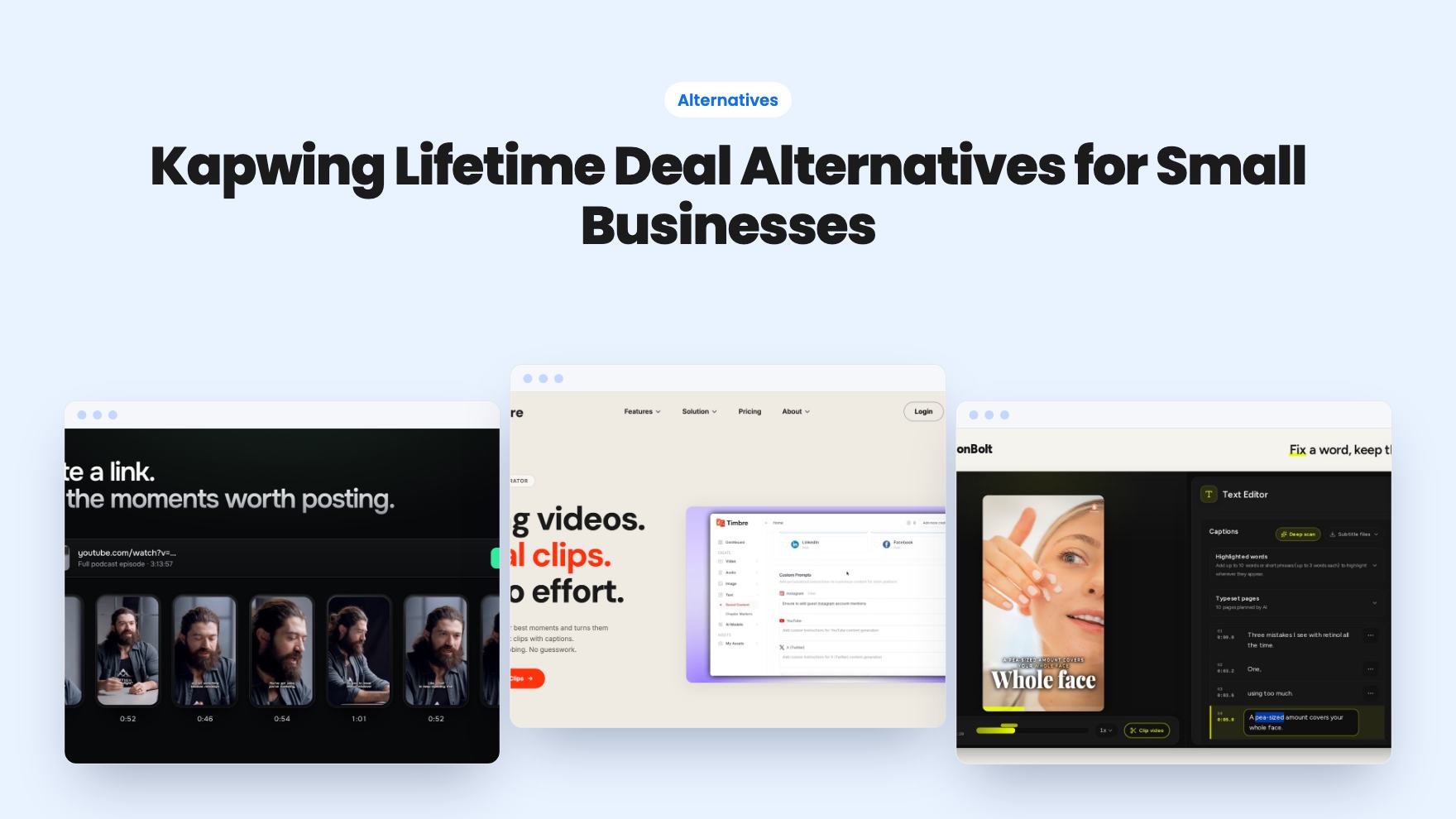
Kapwing Lifetime Deal Alternatives for Small Businesses
Five AppSumo lifetime deals that cover parts of what Kapwing does, from clip cutting to captions and dubbing. Each has caps worth knowing before you pay.
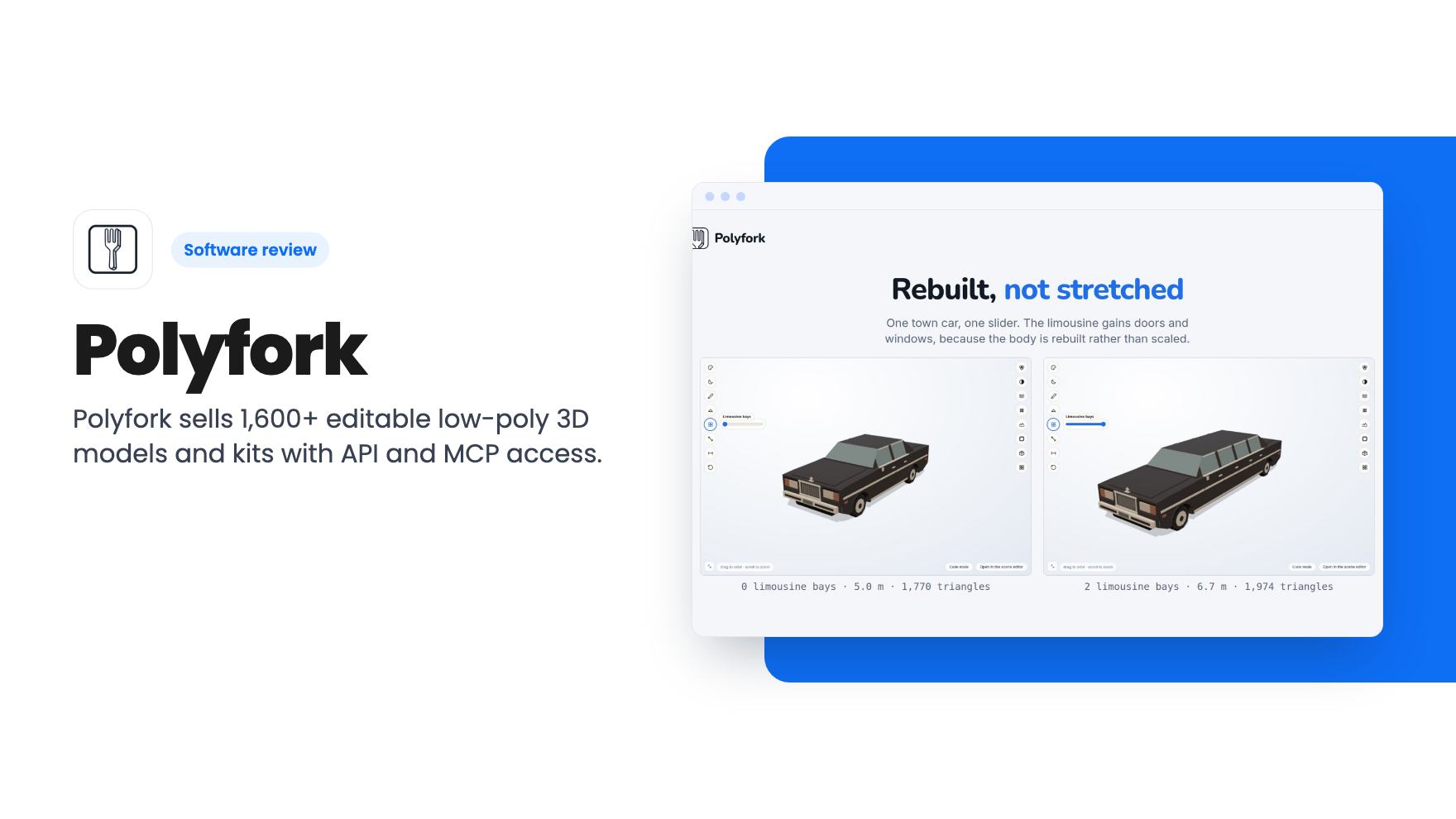
Polyfork sells 1,600+ editable low-poly 3D models and kits with API and MCP access. We look at the $99 AppSumo lifetime deal, its limits and who it suits.
Lifetime deal price
$99$12521% off
Lifetime Deal
Our take: Worth a look if you build games, web 3D scenes or AR prototypes and want a large, consistent low-poly library you can reshape and feed to an AI coding agent. Skip it if you need photoreal assets, textured models or a mature, proven marketplace, since the listing shows a young product and only two AppSumo reviews.
Say you’re building a small browser game, a product configurator or an AR demo for a client. You need forty believable props, a few characters and some ground to put them on. Stock sites charge per asset, the pieces never quite match in scale or colour, and every tweak means opening Blender. Polyfork is trying to fix that problem for a one-time $99.
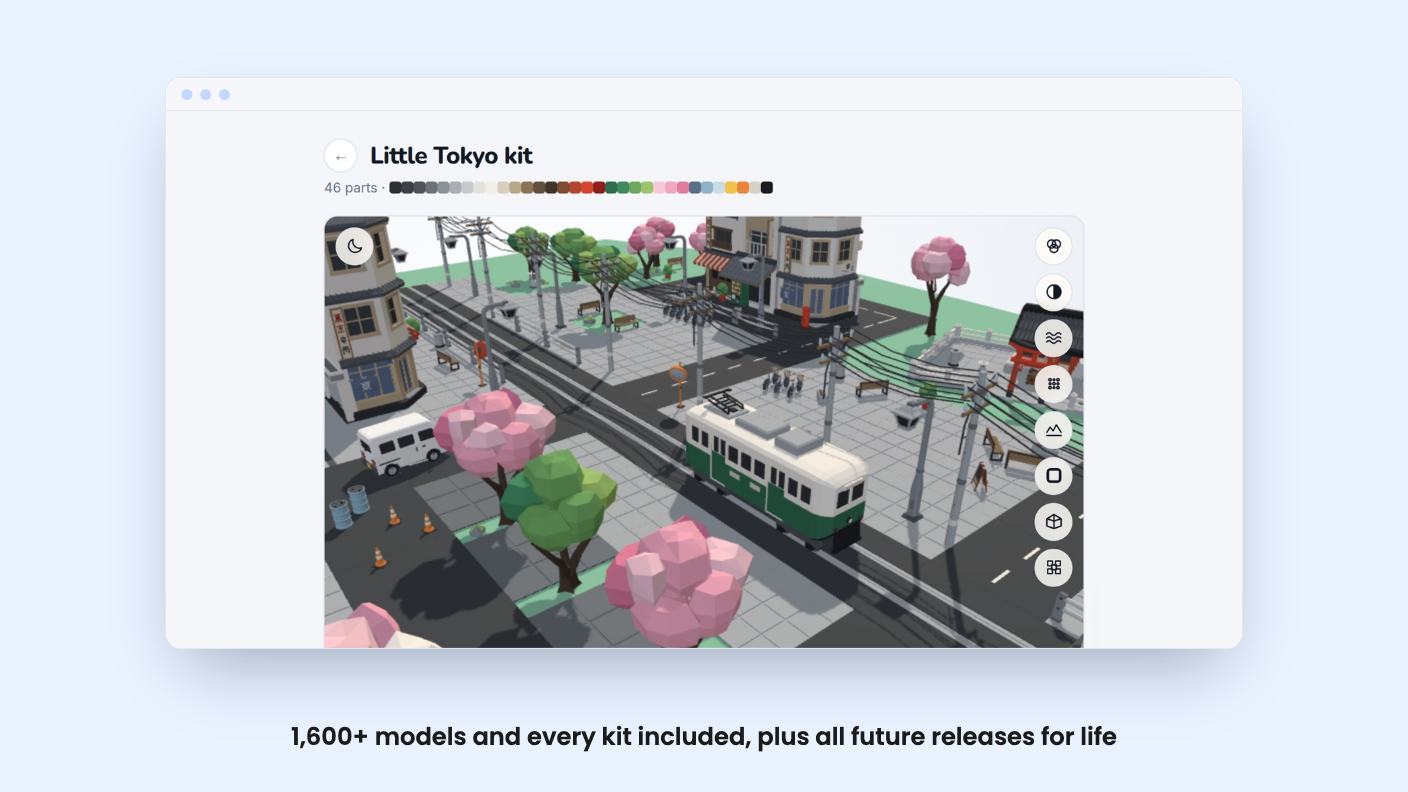
It’s a library of more than 1,600 low-poly 3D models and themed kits, and it’s aimed squarely at developers, solopreneurs and web design agencies. AppSumo lists it as an alternative to Shutterstock. That comparison is a stretch, because this is a very specific style of 3D art, not a general stock library. Keep that in mind as you read the rest.
Every asset comes as a self-contained ES module, which is a factory that returns a THREE.Group, with its adjustable settings declared. You also get the same model as GLB, FBX, USDZ and OBJ files. The zip includes a README that lists every knob, the licence, and an index.html so you can serve the folder and see it render.
That covers three.js users, Unity and Unreal users, Maya users and iOS AR work in one download. The listing says palettes travel as named materials, so nothing should arrive white in Unity or Blender. We can’t confirm that without trying it, but it’s the right thing to promise.
The style is the catch. According to the listing, everything is flat-shaded vertex colors on one material, with no textures. That keeps scenes light, and it gives the kits a consistent look. It also means you won’t find photoreal assets here. If your project needs realistic materials, this isn’t it.
The headline feature is remixing. Drag a slider and the mesh rebuilds in the browser. The listing gives examples: a town car becomes a stretch limousine with extra doors, a farmhouse gains a second and third storey, a tram gets more passenger bays.
You can also pick a curated palette or click a single part to recolour it. When you’re happy, the variant is baked on demand as a GLB, with the other formats available too.
For three.js users there’s a neater option. You import the ES module with one line, with no loader and no await, and the knobs stay live at runtime. That could suit a configurator where visitors change a product on the page. The listing doesn’t say how heavy the modules are or how they behave on weaker devices, so check that before you commit to a customer-facing build.
Kits are where the library gets practical. The listing names Little Tokyo, Pirate Cove, Cozy Farm and Hospital. Every part in a kit shares one palette, one scale and one shape language, and parts snap together on a grid so tiles meet edge to edge.
Terrain is part of it too. Thirteen kits ship a terrain program so far, and terrain from different kits joins on a shared 64m grid with no visible seam. One FAQ answer says every kit ships a terrain program, while the feature list says 13 so far. That’s a small inconsistency, and it’s worth asking about if terrain matters to you.
Then there are characters. You can start from any of 63 rigged humanoids and swap garments in fourteen slots, including hat, coat, legs, feet, belt and held items. Age, build and expression can change, and the listing says the model rebuilds in about 14 milliseconds. Because the skeleton never moves, Mixamo clips should play on whatever you build without retargeting. Each character stays under 4,000 triangles.
Moving parts like lids, wheels and doors are separate named groups with pivots at the hinge or axle. A one-line rotation animates them, according to the listing.
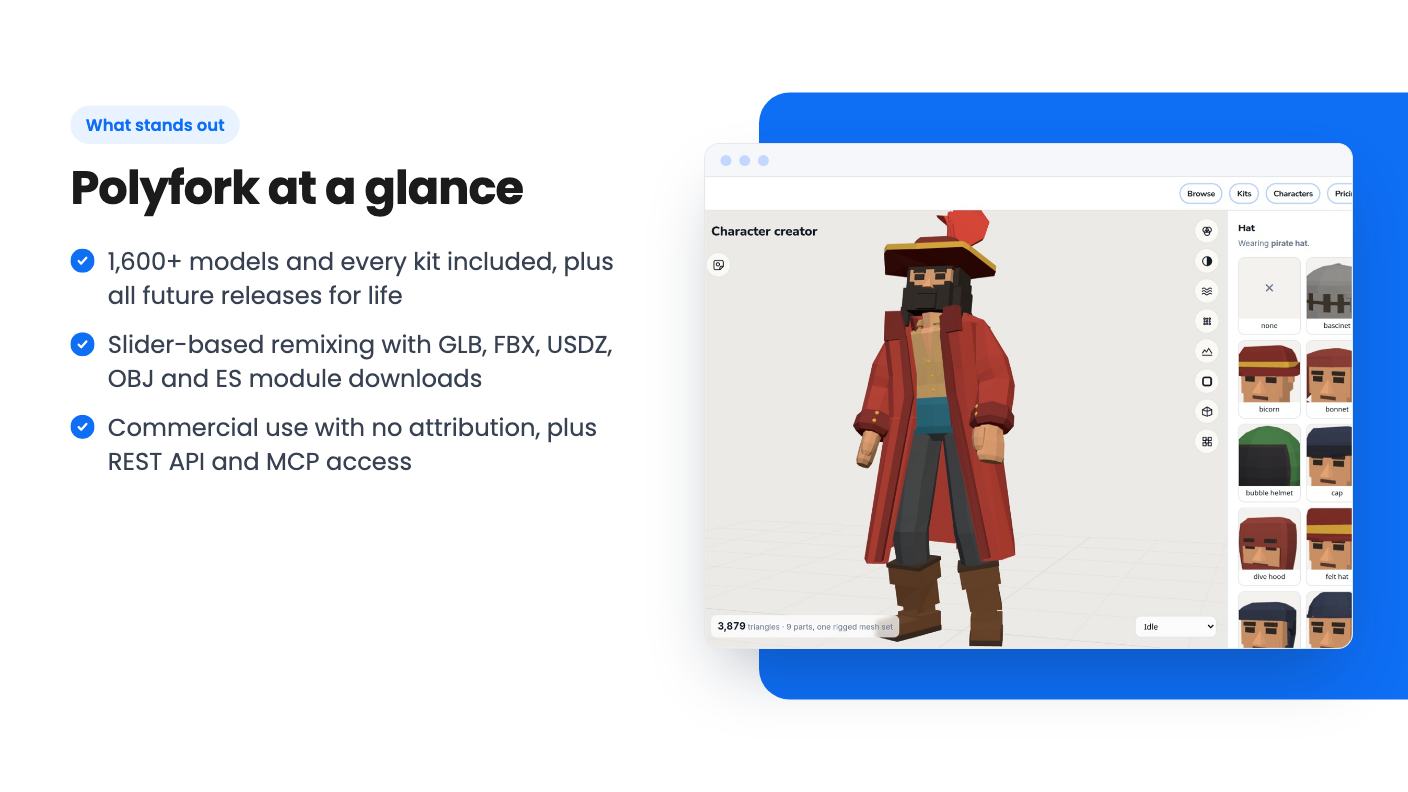
This is the part that feels most current. You can connect the catalogue over MCP with one command, so Claude Code, Cursor or Codex can search assets, compare renders and fetch files on their own. There’s also a REST API that returns plain JSON over HTTPS, and no key is needed to browse.
Every asset states its real size in meters, its origin on the ground, its hex palette and its triangle count. Each model’s knobs are published as typed, described JSON. In practice, that means an agent can plan a layout with arithmetic instead of guessing at scale.
It’s a smart design, and it could save real time if you already work with a coding agent. We haven’t seen it run, and the listing has no demo video, so we can’t say how well agents handle it in a real project.
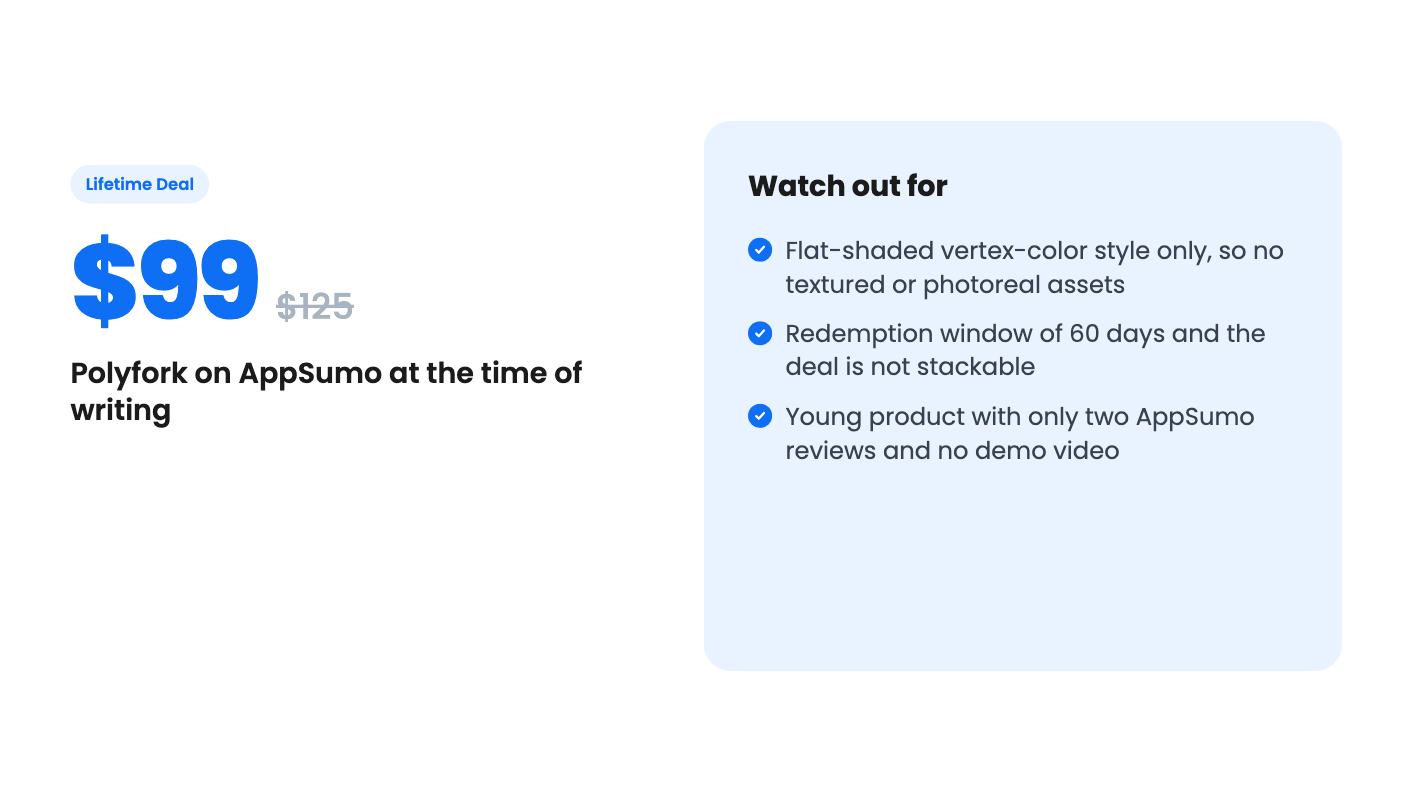
The AppSumo price is $99, down from a $125 list price. It’s a single tier. You get all 1,600+ models, every kit, every future model and kit for life, remix baking, all five download formats, character creator editing and downloads, API and MCP access, an own CDN path, and commercial use with no attribution.
The terms are plain. You must redeem within 60 days, and the deal isn’t stackable. The licence bars reselling or redistributing the assets themselves, and bars using them to build or train a commercial asset generator.
There’s a Pro subscription behind this, and the listing says what happens if you cancel it: downloaded assets stay yours under the same licence, but the CDN, remix baking and new assets stop. The listing doesn’t spell out what that means for lifetime owners, so ask whether any ongoing limits apply. It also doesn’t state the Pro monthly price, so we can’t tell you how much the lifetime seat saves over time. Students and people in lower-income countries can get Pro for $50 for two years through an application.
The $99 price is fair on paper. Still, there are only two AppSumo reviews, both five stars, and that’s too small a sample to lean on. The catalogue is also still growing, which cuts both ways: lifetime owners get every new release, but kit coverage is uneven today.
Skip Polyfork if your work needs realistic, textured 3D. Skip it if you need a deep catalogue of one narrow subject, since the library is wide and stylised. And skip it if you never touch 3D at all, because the value here depends on having a use for GLB files or three.js modules.
If you do build games, web 3D, AR prototypes or client demos in a low-poly style, it’s an easy deal to consider. Check the licence limits, redeem inside 60 days, and try the free browsing first. Since no key is needed to browse the API, you can judge the catalogue before you pay.
Yes. The listing says commercial use is included with no attribution, covering games, apps, client work, courses and commercial products. You can't resell or redistribute the assets themselves, or use them to build or train a commercial asset generator.
According to the listing, each asset comes as a self-contained ES module plus GLB, FBX, USDZ and OBJ files. The zip also includes a README listing every knob, the licence and an index.html that renders the model when you serve the folder.
Yes. You must redeem your code within 60 days of purchase. The deal is also not stackable, so you can't buy several codes to add more to one account.
How this review was made: researched from Polyfork's official listing, and written with help from AI. We have not tested Polyfork hands-on yet. Prices and deal terms change, so check AppSumo before you buy. See our affiliate disclosure.
Five AppSumo lifetime deals that cover parts of what Kapwing does, from clip cutting to captions and dubbing. Each has caps worth knowing before you pay.
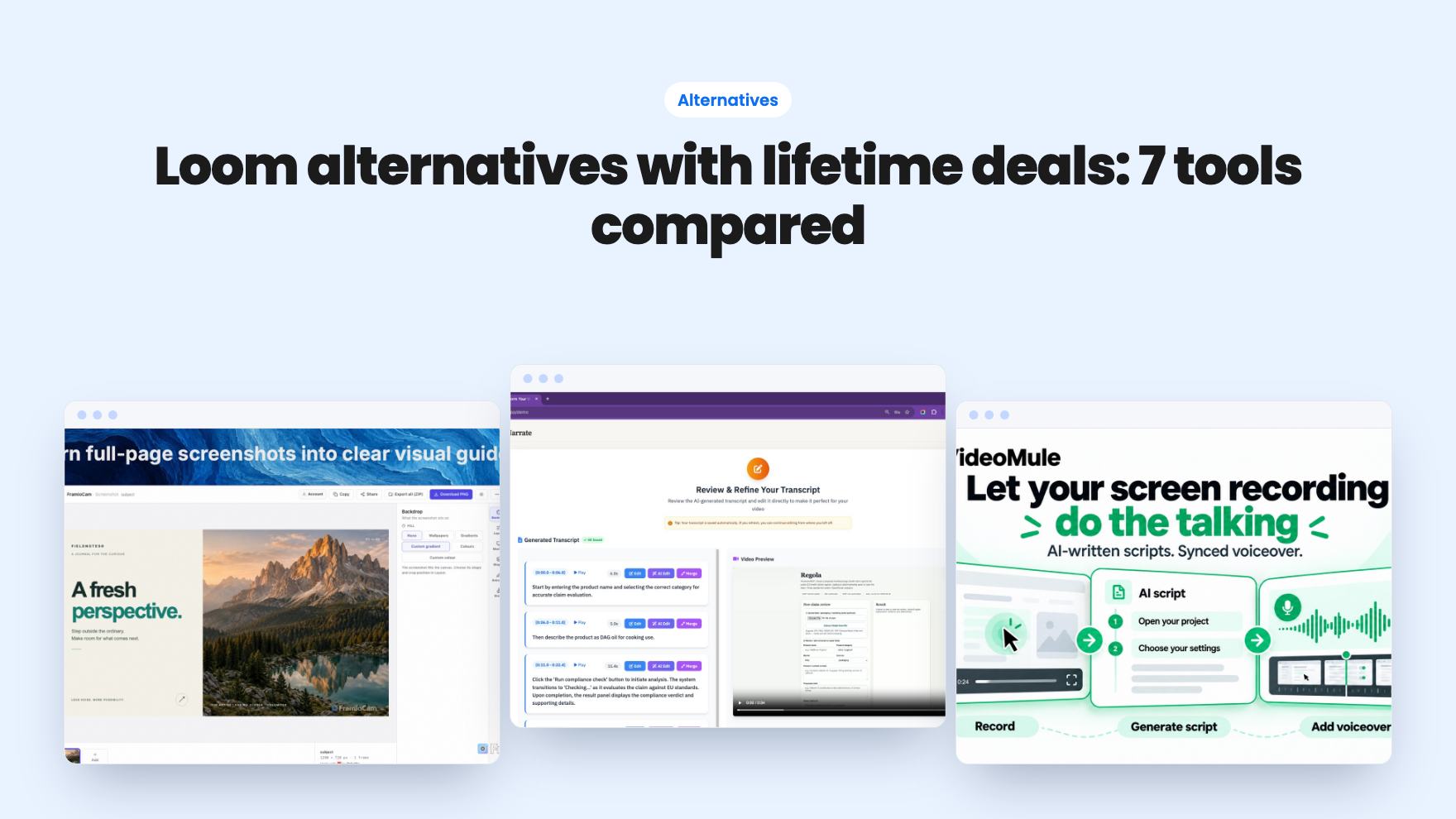
Seven AppSumo lifetime deals named as Loom alternatives, grouped by job: narrated tutorials, plain recording, interactive demos and personalized outreach video.
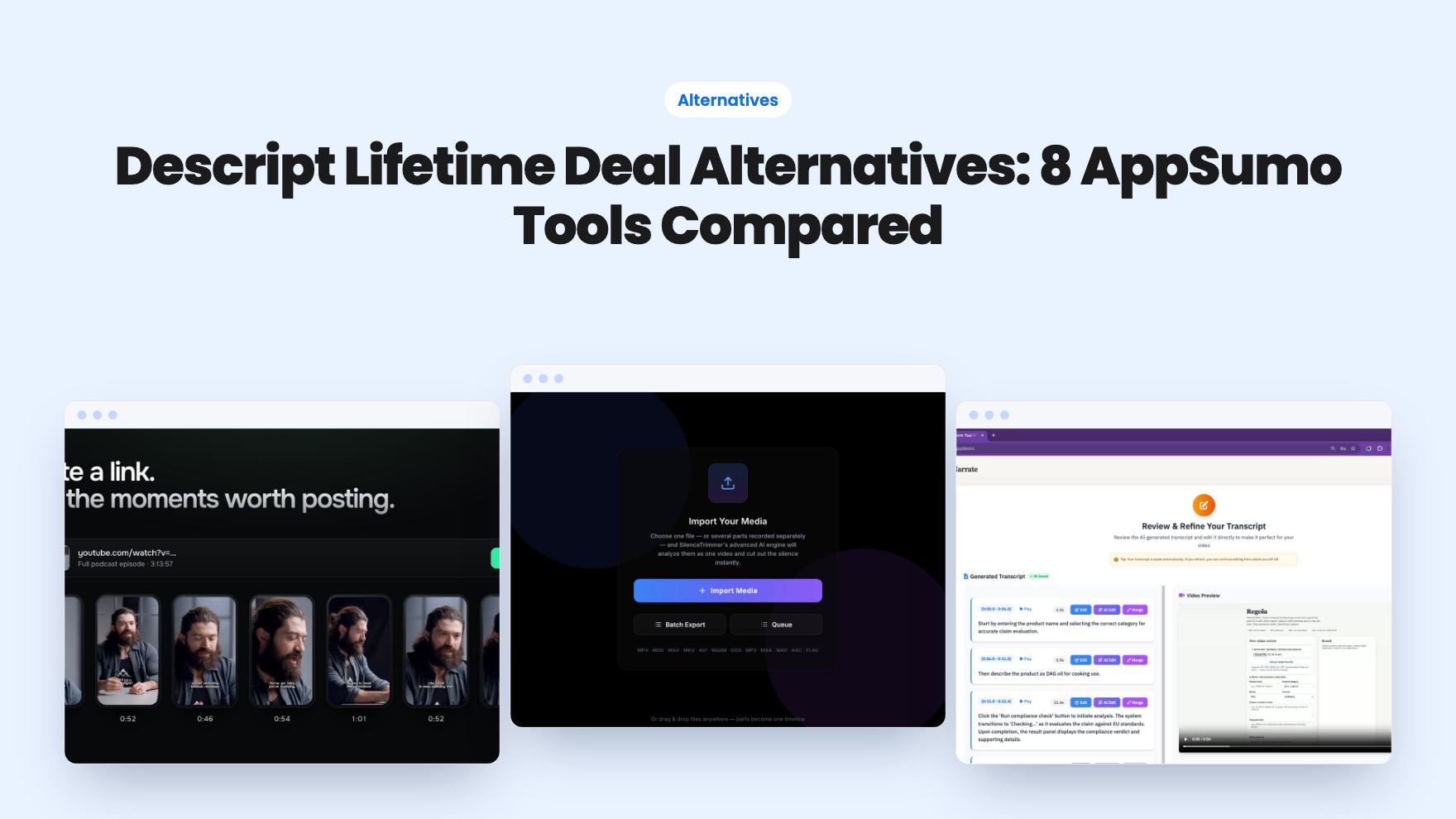
Eight AppSumo lifetime deals named as Descript alternatives, grouped by the job you need done, with the caps and gaps each listing shows.