Email MarketingReview
Million Dollar Email Templates 2.0 Review: Free Swipe File Deal
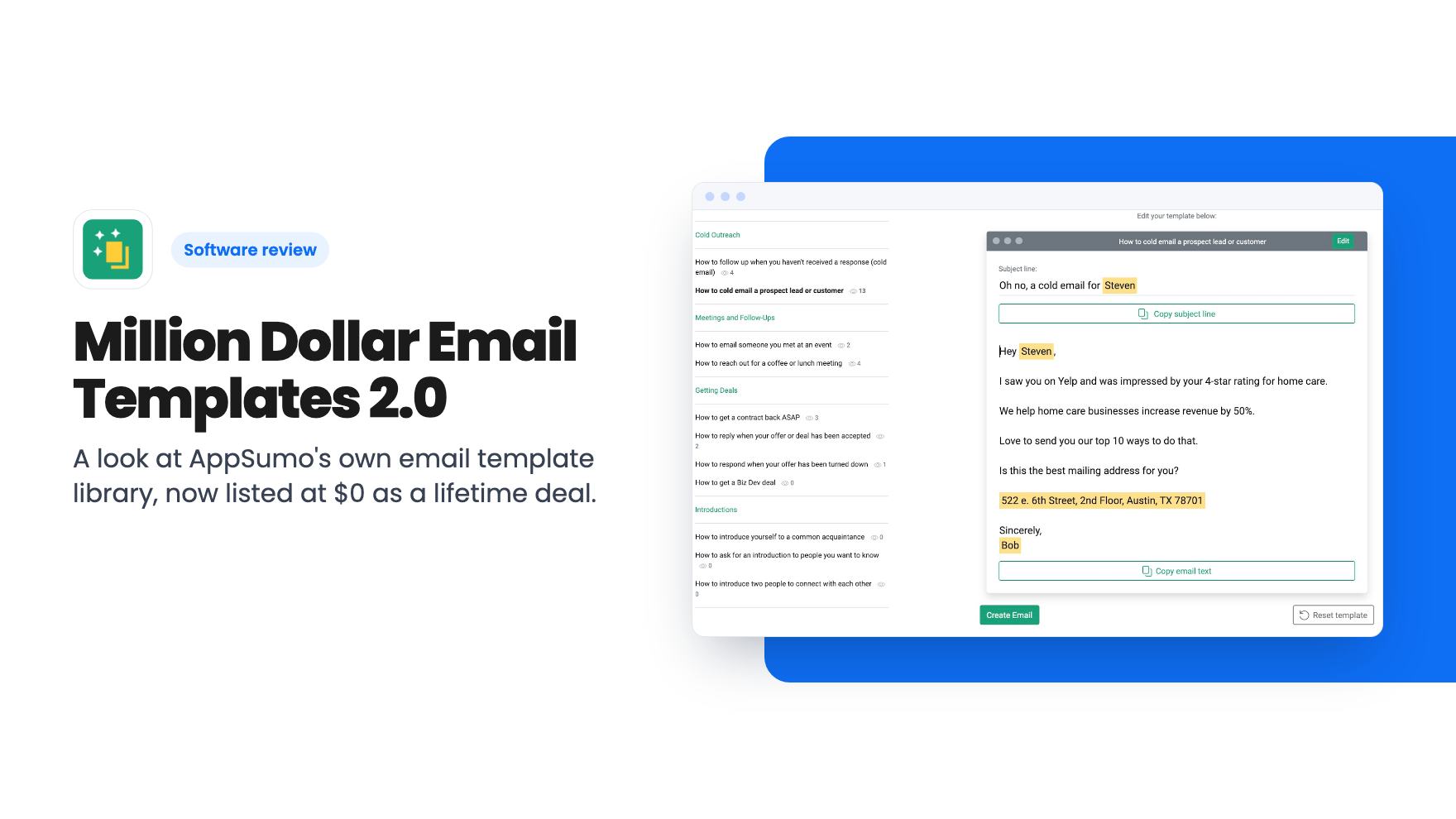
A look at AppSumo's own email template library, now listed at $0 as a lifetime deal. What you get, what's vague, and who should grab it.
Two cold email lifetime deals compared on verification, sending limits, API access and tier caps, so you can pick the one that fits how you send.
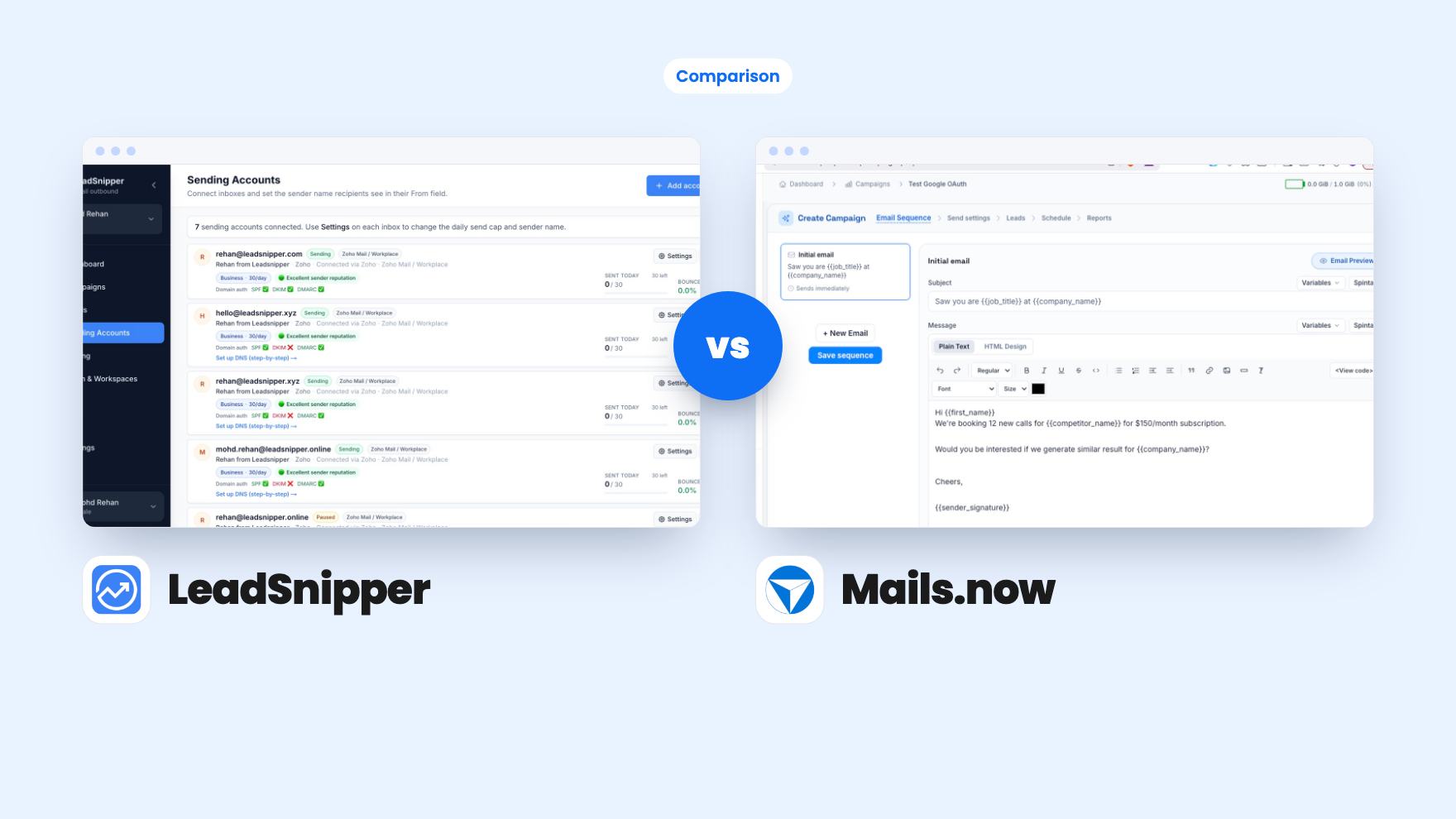
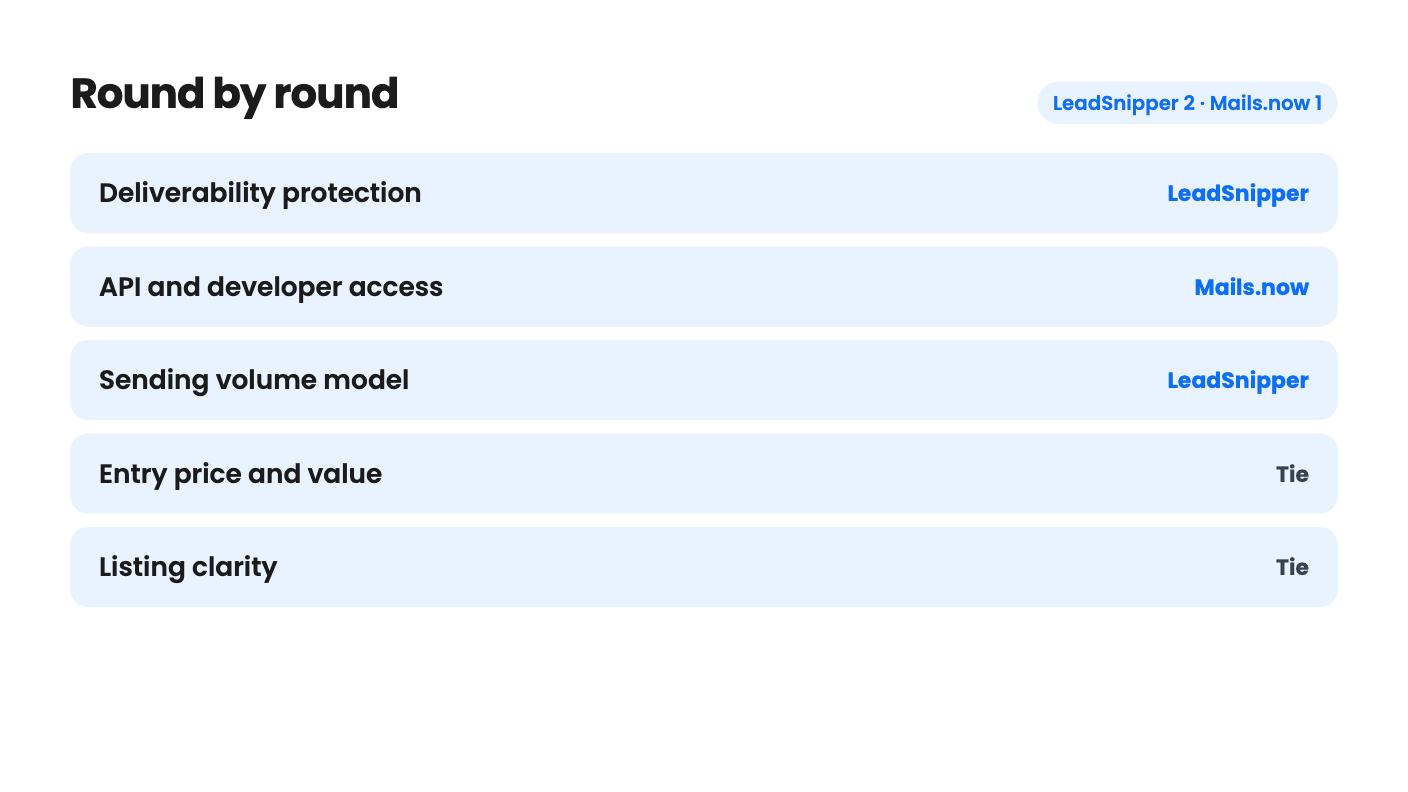
LeadSnipper takes 2 rounds, Mails.now takes 1.
| Round | Winner | Why |
|---|---|---|
| Deliverability protection | LeadSnipper | LeadSnipper builds Reoon verification and auto-pause guardrails into the send flow, while Mails.now's listing says nothing about deliverability, warm-up or spam testing. |
| API and developer access | Mails.now | Mails.now exposes REST endpoints for mailboxes, campaigns and transactional sends plus named webhooks, while LeadSnipper lists API and webhooks as coming soon. |
| Sending volume model | LeadSnipper | LeadSnipper's caps are monthly (10,000 to 150,000), while Mails.now's send credits are one-time and the listing doesn't say what happens when they run out. |
| Entry price and value | Tie | LeadSnipper starts at $39 but its cheapest tier lacks volume split, while Mails.now starts at $49 and needs a separate SMTP relay you pay for elsewhere. |
| Listing clarity | Tie | LeadSnipper contradicts itself on mailbox limits and webhooks, and Mails.now never labels which plan value belongs to which tier. |
| LeadSnipper | Mails.now | |
|---|---|---|
| Starts at | $39 | $49 |
| List price | $69 | $299 |
| Plan | Lifetime Deal | Lifetime Deal |
| Deal ends | Not listed | Not listed |
| Best for | Course creators, Marketing agencies, Solopreneurs | Developers, Marketing agencies, SaaS |
| Alternative to | Lemlist, Mailchimp | ActiveCampaign, Gmail, Mailchimp |
Say you’ve got a few thousand prospects and a plan to email them from several domains, so no single address takes the blame when something goes wrong. Both LeadSnipper and Mails.now are lifetime deals built for that job. They go about it in quite different ways, and the difference decides which one you’ll be happy with.
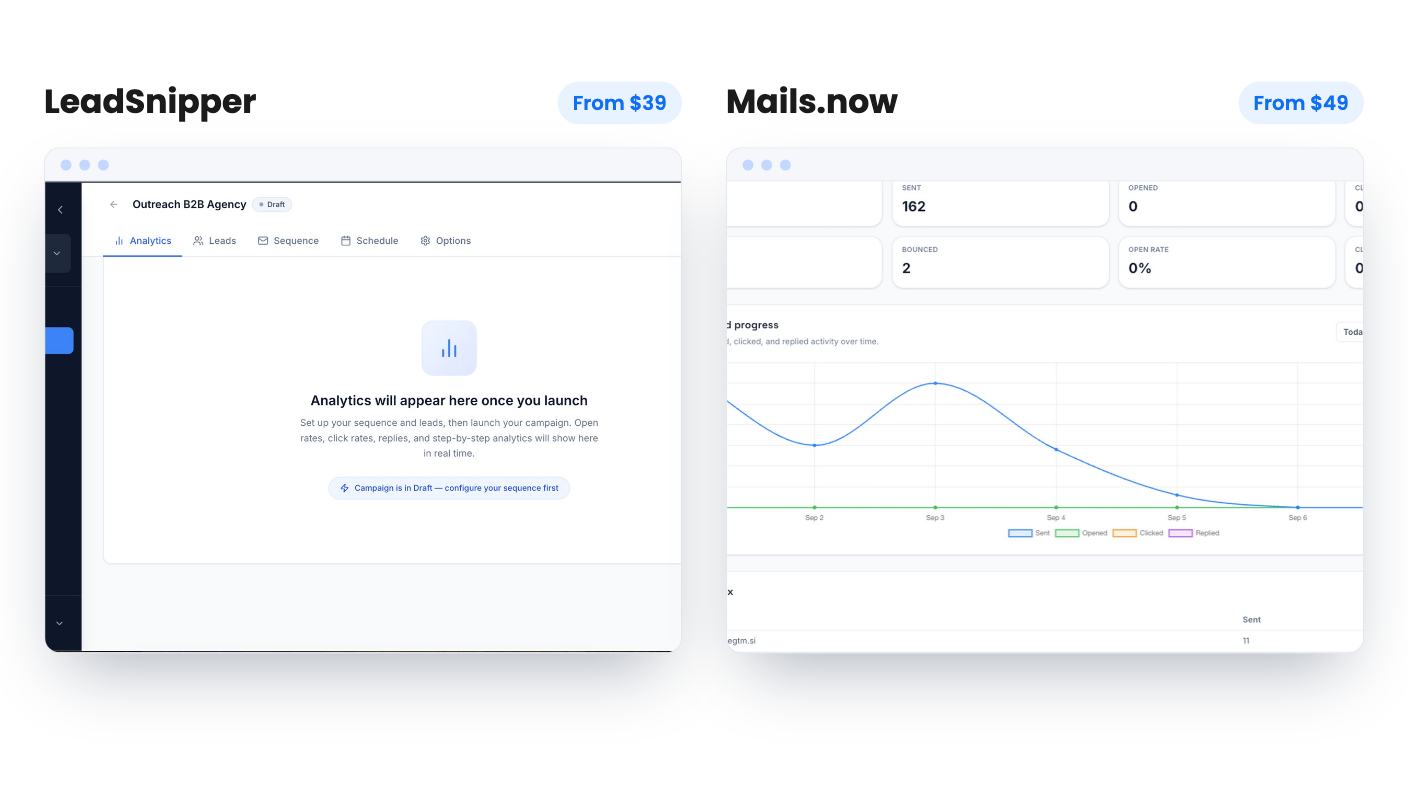
LeadSnipper is a sending platform with a safety focus. You connect your own inboxes, import leads, verify them, run multi-step sequences and let the software spread volume across senders. The pitch is protecting your domain reputation.
Mails.now is closer to a control layer for developers. It provisions domains, verifies DNS, creates single or bulk mailboxes and runs a sequencer on top, all reachable by REST API. The pitch is that everything is programmable.
Neither one finds leads for you. LeadSnipper’s FAQ says so directly. Mails.now only mentions CSV import. So whichever you pick, you’re paying for a lead source somewhere else.
LeadSnipper folds Reoon email verification into the send flow. It’s meant to strip out invalid, catch-all, spamtrap and disposable addresses before anything queues. The listing contrasts this with Instantly and Smartlead, which it says need separate verification subscriptions. If that holds up, it saves you a monthly bill.
There are also auto-pause guardrails that shut down a sender before a bad batch drags the domain down. That’s the feature I’d care about most if one company domain were at stake. We don’t know the thresholds, whether you can change them, or what happens to a half-sent campaign. The listing also doesn’t say whether verification has a credit cap. Treat it as a good claim, not a proven one.
Mails.now says nothing comparable. Its listing doesn’t mention verification, warm-up, spam testing or any pause mechanism. Its analytics break down opens, clicks, replies and bounces by mailbox, step and domain, which helps you spot a weak domain after the fact. That’s reporting, not protection.
If you write code, Mails.now is the more interesting product. It lists REST endpoints for mailboxes, sequencer campaigns and transactional sends. It also names webhook events: email.received, sequencer.email.sent and sequencer.lead.replied. MCP tools are mentioned too, so an AI assistant could drive it.
LeadSnipper lists API and webhooks as coming soon. Its plan table does show custom webhooks on tier 3, so the two don’t agree. For now, I wouldn’t buy LeadSnipper if an API is a hard requirement.
Mails.now also handles transactional email on the same infrastructure, with 3,000 to 9,000 a month depending on tier. That’s convenient, but mixing order confirmations with cold outreach carries risk. A bad campaign could hurt the sender your password resets rely on. The listing doesn’t say whether you can keep the two apart.
Then there’s the catch. Mails.now provides no SMTP of its own. You must connect a relay such as Amazon SES, Mailgun, Postmark, Google Workspace, Gmail or Microsoft 365, and add the SPF, DKIM and DMARC records yourself. You need to be comfortable with DNS, and you’ll be paying for sending somewhere else. It also isn’t clear what mailbox creation does when the relay is yours, so ask before buying.
LeadSnipper has three tiers, and the caps renew monthly:
The $39 tier is thin. Volume split is a headline feature and it’s missing there, which undercuts the point of connecting five inboxes. A 5,000-lead list with a four-step sequence means about 20,000 sends, which is already over that tier’s monthly cap. The $79 tier handles it comfortably.
Mails.now has four tiers from $49 to $196, and you can stack up to 4 codes. The listing gives plan values as a row like 40 / 30 / 20 / 10 without saying which belongs to which tier. Our reading is that the first value is the $196 tier and the last is the $49 one. Confirm that at checkout.
On that reading, $49 gets you 10 sender domains, 20 mailboxes, 5,000 leads, 100,000 one-time send credits and 3,000 transactional emails a month. The $196 tier gives 40 domains, 80 mailboxes, 20,000 leads, 400,000 credits and 9,000 transactional emails.
The word to watch is one-time. Those credits don’t refill. The same 20,000-send campaign takes a fifth of the entry pool, and then it’s gone. The listing doesn’t say what happens at zero or whether you can top up. For a lifetime deal, a finite pool is a real drawback next to LeadSnipper’s monthly allowance.
LeadSnipper’s listing contradicts itself in a few places. The feature section promises unlimited mailboxes, yet the plan table caps senders at 5, 20 or unlimited. It says webhooks are coming soon while the table lists them on tier 3. PDF export appears on tiers 1 and 2 but not tier 3, which looks like a table error. Warm-up gets a mention in an FAQ and nothing more. There’s also a Premium Managed AWS SES service for 100,000 to 500,000 or more emails a month, with no price given.
Mails.now’s problems are gaps rather than contradictions. The unlabelled tier values, the unclear SMTP and mailbox relationship, and the missing company history. A lifetime deal is only as good as the team keeping it running, and neither listing tells you much about that.
If your worry is landing in spam, I’d lean toward LeadSnipper’s $79 tier. You get verification, auto-pause, inbox rotation and a monthly volume that renews. Ask support about warm-up and webhooks first, and skip the $39 tier unless you’re a solo sender testing the water.
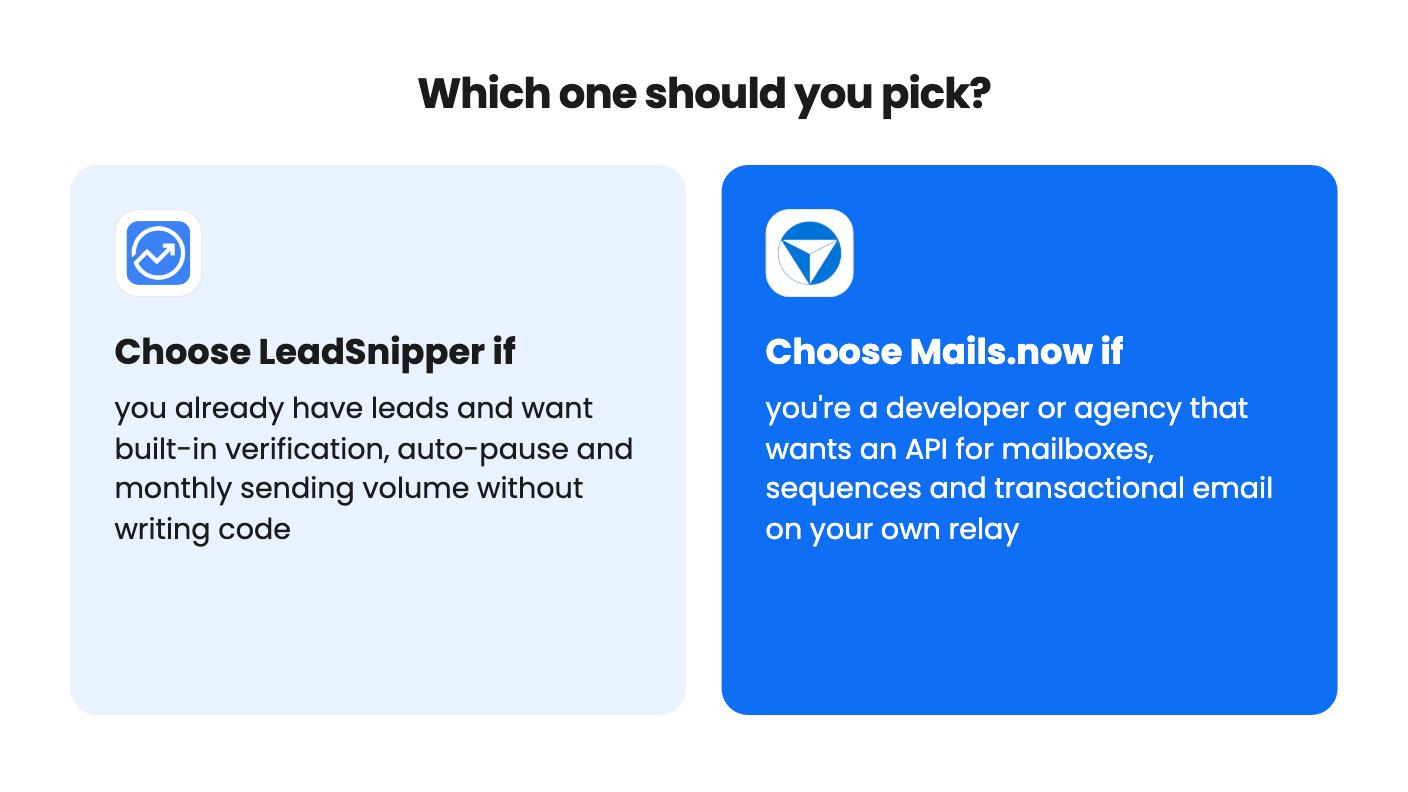
If you’re a developer or a small agency that already pays for SES or Google Workspace, Mails.now fits better. The API, webhooks and per-domain analytics give you control that LeadSnipper doesn’t offer yet. Check the tier mapping, ask what happens when credits run out, and be ready to handle DNS yourself. Both have a 60-day activation window, so use it to test your setup before the clock runs out.
Neither does. LeadSnipper's FAQ says you import contacts from Apollo, LinkedIn, CSV or a CRM sync. Mails.now imports leads by CSV and organises them with lists and tags.
With Mails.now, yes. The listing says it provides no SMTP, so you connect Amazon SES, Mailgun, Postmark, Google Workspace, Gmail or Microsoft 365. LeadSnipper also has you connect your own inboxes.
If you want guardrails and per-sender reporting without code, LeadSnipper's $79 tier looks like the fit. If your team builds with APIs, Mails.now suits you better.
How this comparison was made: researched from both tools' official listings and demo videos, and written with help from AI. We have not tested LeadSnipper or Mails.now hands-on yet. Prices and deal terms change, so check AppSumo before you buy. See our affiliate disclosure.
A look at AppSumo's own email template library, now listed at $0 as a lifetime deal. What you get, what's vague, and who should grab it.
Five AppSumo lifetime deals named as Mailchimp alternatives, grouped by what you send, with the caps and catches in each listing.
Ten email marketing lifetime deals from $29 to $79, grouped by job: sending, list cleaning, and the odd extras. Caps, catches and who should skip each one.