AI Writing & VideoTop deals
AppSumo Deals Ending Before Black Friday 2026: Buy or Wait?
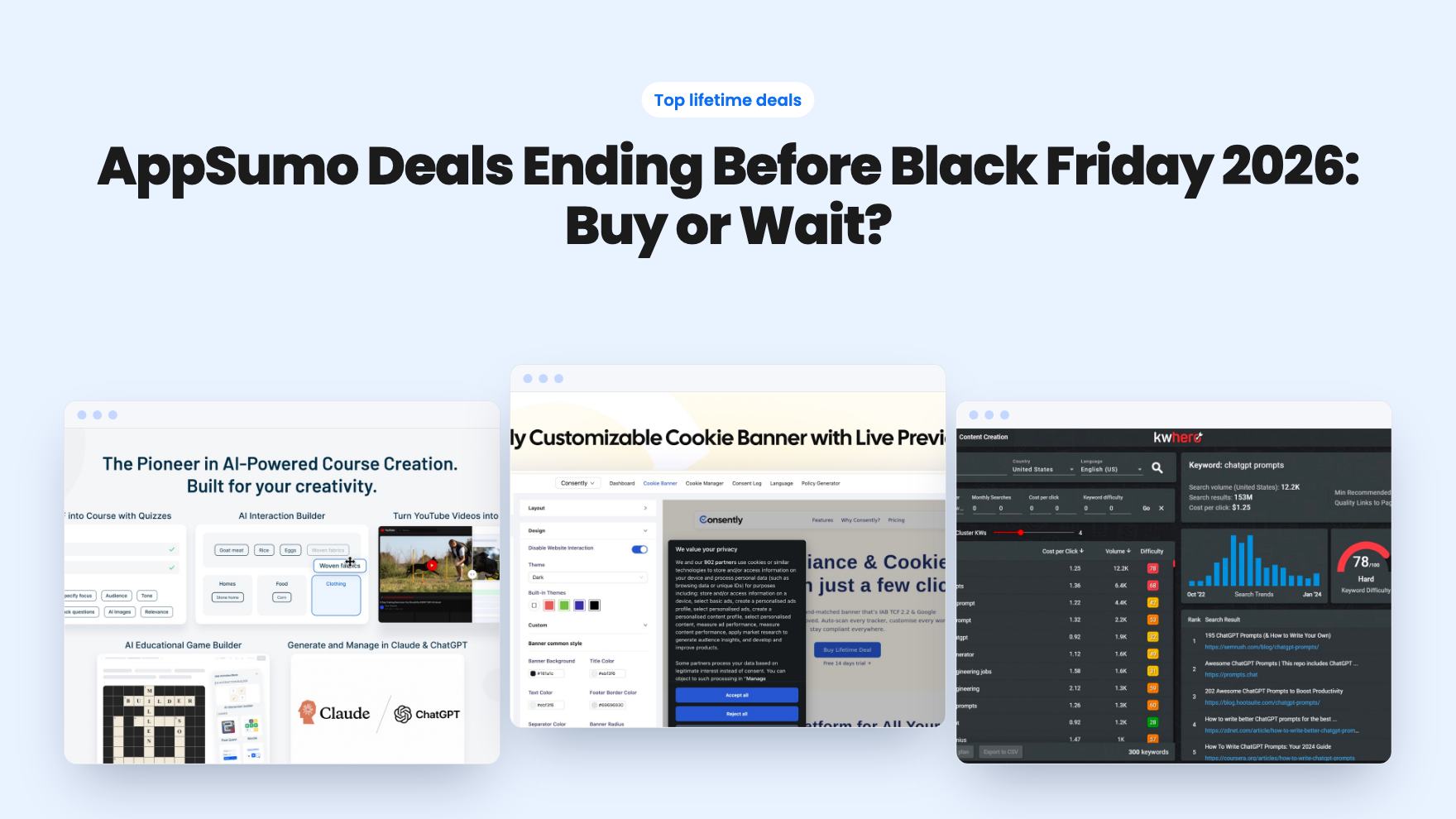
Fourteen AppSumo lifetime deals end before Black Friday on November 27, 2026. Here are the seven worth a look now, and who should skip them.
Both are $49 AI writing lifetime deals. Inkriv learns your voice for newsletters. UseArticle auto-publishes affiliate posts. Here is who should buy which.
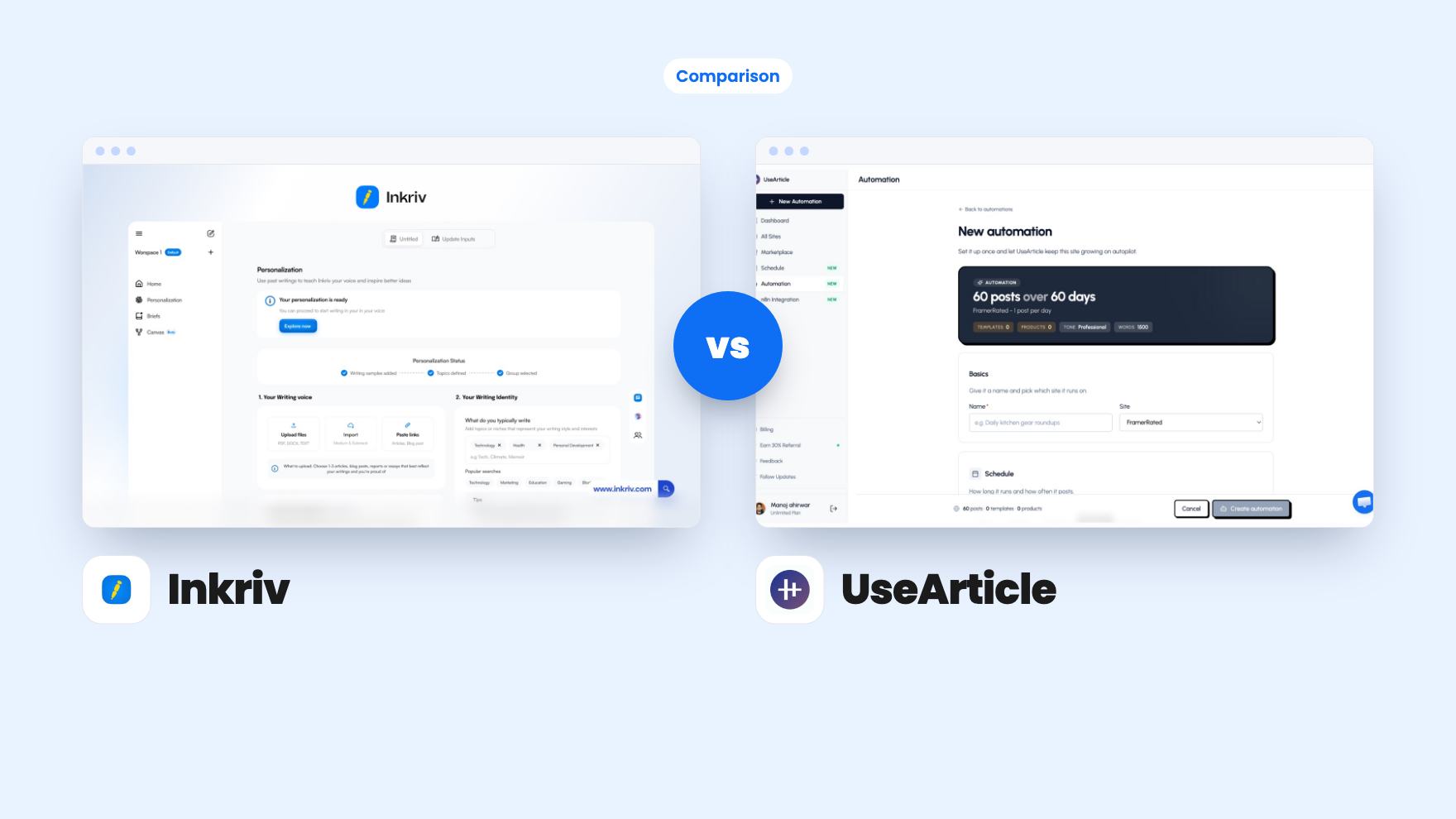
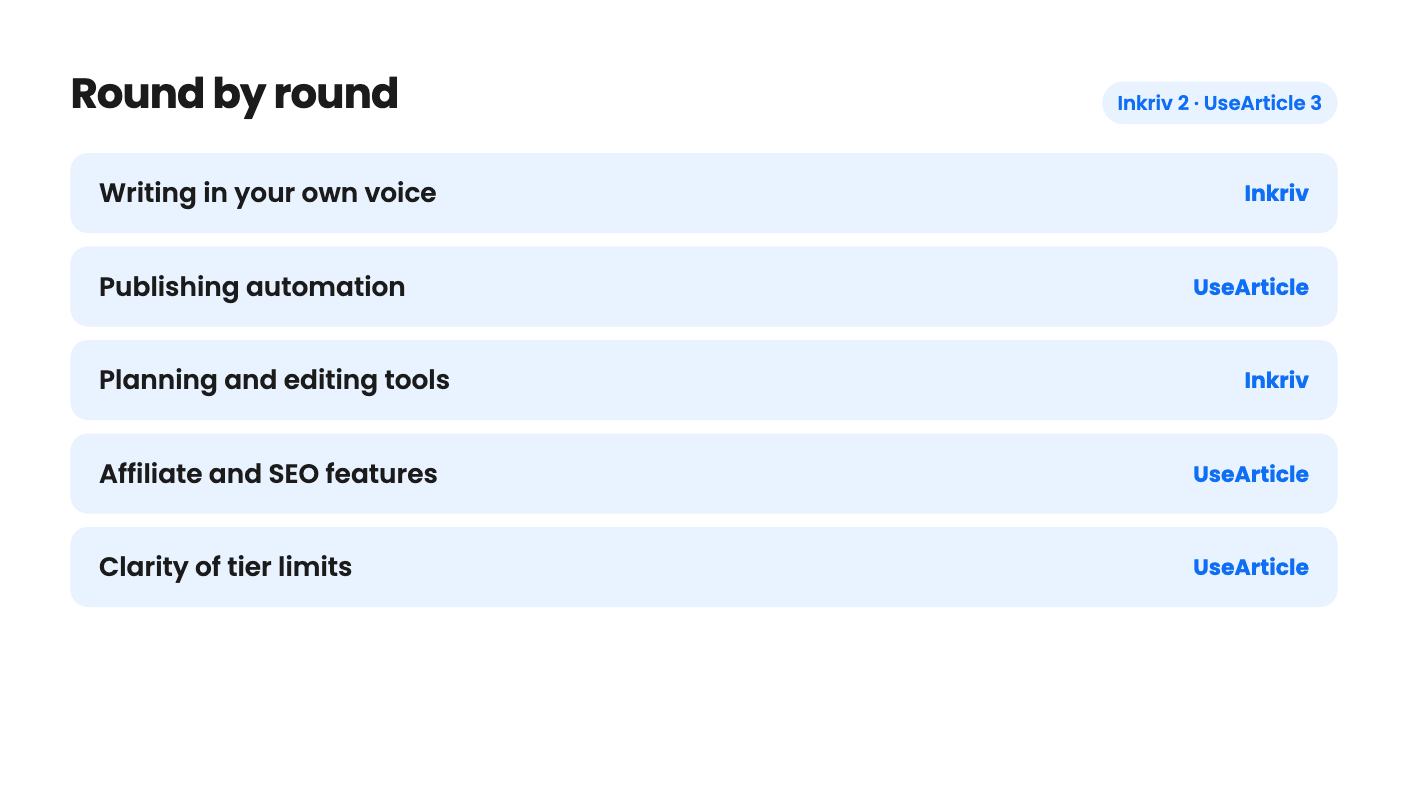
Inkriv takes 2 rounds, UseArticle takes 3.
| Round | Winner | Why |
|---|---|---|
| Writing in your own voice | Inkriv | Inkriv learns tone, vocabulary and rhythm from your imported samples, while UseArticle only offers tone, length and language settings. |
| Publishing automation | UseArticle | UseArticle schedules posts up to 90 days out and publishes daily, with up to 2 automations on tier 1 and 10 on tier 2. |
| Planning and editing tools | Inkriv | Inkriv adds topic suggestions, briefs, an in-editor chat assistant, fact-check prompts and a Brainstorming Canvas that UseArticle has no equivalent for. |
| Affiliate and SEO features | UseArticle | UseArticle includes a 90+ program marketplace, link management and FTC disclosures, and Inkriv lists no SEO or affiliate tooling. |
| Clarity of tier limits | UseArticle | UseArticle's two tiers are easy to read, while Inkriv's plan table has unlabeled columns and an out-of-order words row. |
| Integrations | Tie | Inkriv lists Google Drive and Medium, UseArticle lists Amazon and an API, and both are thin. |
| Inkriv | UseArticle | |
|---|---|---|
| Starts at | $49 | $49 |
| List price | $240 | $360 |
| Plan | Lifetime Deal | Lifetime Deal |
| Deal ends | Not listed | Oct 29, 2026 |
| Best for | Bloggers, Entrepreneur-curious, Agencies | Bloggers, Content creators, Solopreneurs |
| Alternative to | Copy.ai, Jasper | Copy.ai, Jasper |
You’ve got $49 to spend on an AI writing lifetime deal, and two options on AppSumo look almost identical from a distance. Same price, same category, and both name Copy.ai and Jasper as the tools they replace. Look closer and they solve opposite problems.
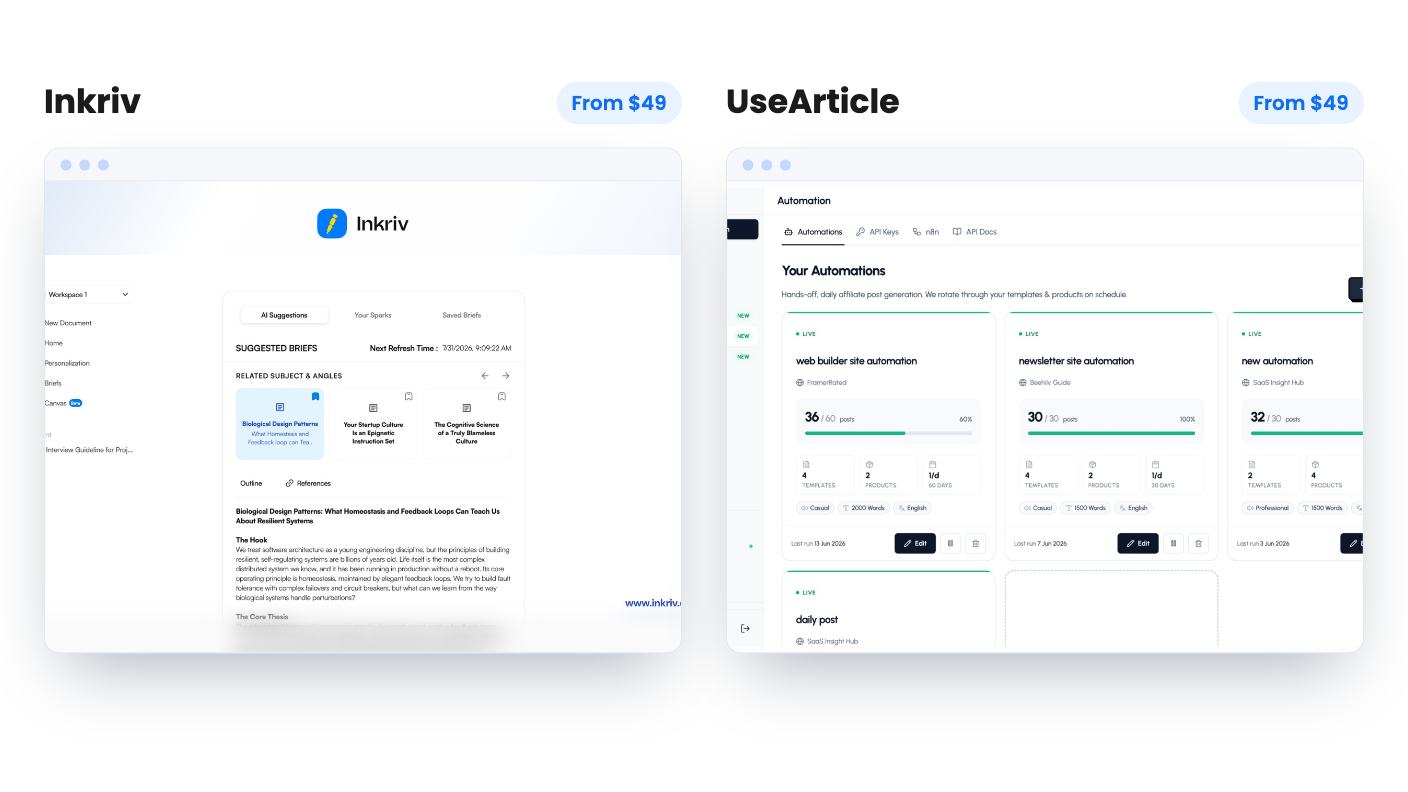
Inkriv is for the person who writes and wants help doing it without losing their sound. UseArticle is for the person who would rather not write at all and wants a site that keeps filling itself. Most of this comparison comes down to which of those people you are.
We haven’t used either one. Everything here comes from the listings, and where they go quiet, we’ll say so.
Inkriv’s whole pitch is that you import writing samples through supported files and links, and it learns your tone, vocabulary, rhythm and structure. It then drafts new pieces or refines existing ones in that style. The listing doesn’t say how many samples it needs or how close the result gets, so treat the voice claim as unproven.
UseArticle takes a different route. You give it product URLs, pick one of 13 formats and set the voice, length and language. The FAQ mentions over 15 languages and adjustable word counts. That’s a style setting, not a learned voice, and the listing shows no example output in any language.
If your name is on the work and readers subscribe because of how you sound, Inkriv is the more sensible bet. If your readers arrive from search and want a clear buying guide, voice matters much less than consistency.
Inkriv gives you more to work with before and after the first draft. It suggests topics and angles from your interests and past writing, builds an outline, and hands you a brief before you open the editor. Inside the editor there are assistants to rewrite, explain, summarize, fact-check and find references, plus autocomplete and a chat assistant for selected passages.
There’s also a Brainstorming Canvas and an Audience Simulator that runs your draft past simulated readers. We’d treat the simulator as a second opinion on clarity. Those readers are a model’s guess, not your list. The fact-check feature has the same problem, since the listing doesn’t say where references come from.
UseArticle puts its effort elsewhere. You set up an automation with a site, schedule, templates, products, style and language, and it publishes daily. A dashboard shows posts completed, scheduled and upcoming, and a colour-coded calendar shows generated, scheduled and skipped posts.
Here’s our biggest question about UseArticle. The listing never says whether you can review a post before it goes live. If it publishes straight to your site, a wrong price or an invented feature lands in front of readers with your affiliate link attached.
This is where UseArticle has no real competition from Inkriv. It includes a marketplace of 90+ affiliate programs you can search by niche, commission rate and payout type. The FAQ also describes link management with tracking, broken link monitoring and FTC disclosures.
For a beginner, that saves a pile of tabs and a spreadsheet. If you already have your programs sorted, it matters less. The only listed integrations are Amazon and an API, so don’t assume every affiliate network is covered.
The listing also doesn’t explain how product details get pulled from a URL. Reading the live page is one thing. Filling gaps from the model’s memory is another, and it decides how accurate your reviews are.
Inkriv lists no SEO scoring and no affiliate tools at all. Its integrations are Google Drive and Medium, which won’t help if you publish through WordPress, Ghost or an email platform.
UseArticle has two tiers. Tier 1 is $49 (list $360) and tier 2 is $119 (list $600). The plan table reads tier 2 first, which matches the prices.
Two automations is tight, and the listing doesn’t say how many posts each produces per day. Missing thumbnails on tier 1 mean adding images by hand. And “unlimited” on tier 2 means you pay your AI provider directly.
Inkriv has three tiers: $49 (list $240), $149 (list $456) and $299 (list $684). The trouble is the plan table. It prints three values per row with no column labels, and most rows descend, such as 100, 30 and 5 simulator reviews. The AI words row reads 15,000, 200,000, 75,000, which breaks that order.
If the last column is tier 1, the $49 plan gets 5 simulator reviews, 10 briefs, 10 active Canvases, 3 workspaces and no priority support. That’s modest for weekly publishing. Ask support which column belongs to which tier before paying.
Both deals require activation within 60 days, and both promise future plan updates. Neither makes usage unlimited. Inkriv’s monthly caps stay forever, and UseArticle warns that access to future AI models may be discounted or may need an add-on.
Both products also look young. UseArticle shows two AppSumo reviews, both five stars, which tells us very little. Inkriv shows no reviews in the listing we have. A lifetime deal only pays off if the company sticks around, and neither listing says anything about funding or track record.
UseArticle carries one more strategic risk. Search engines tend to reward pages with real expertise, and a site made of daily automated reviews may struggle to rank. The listing makes no claims about originality. We’d run it as a draft engine you supervise, not a true autopilot.
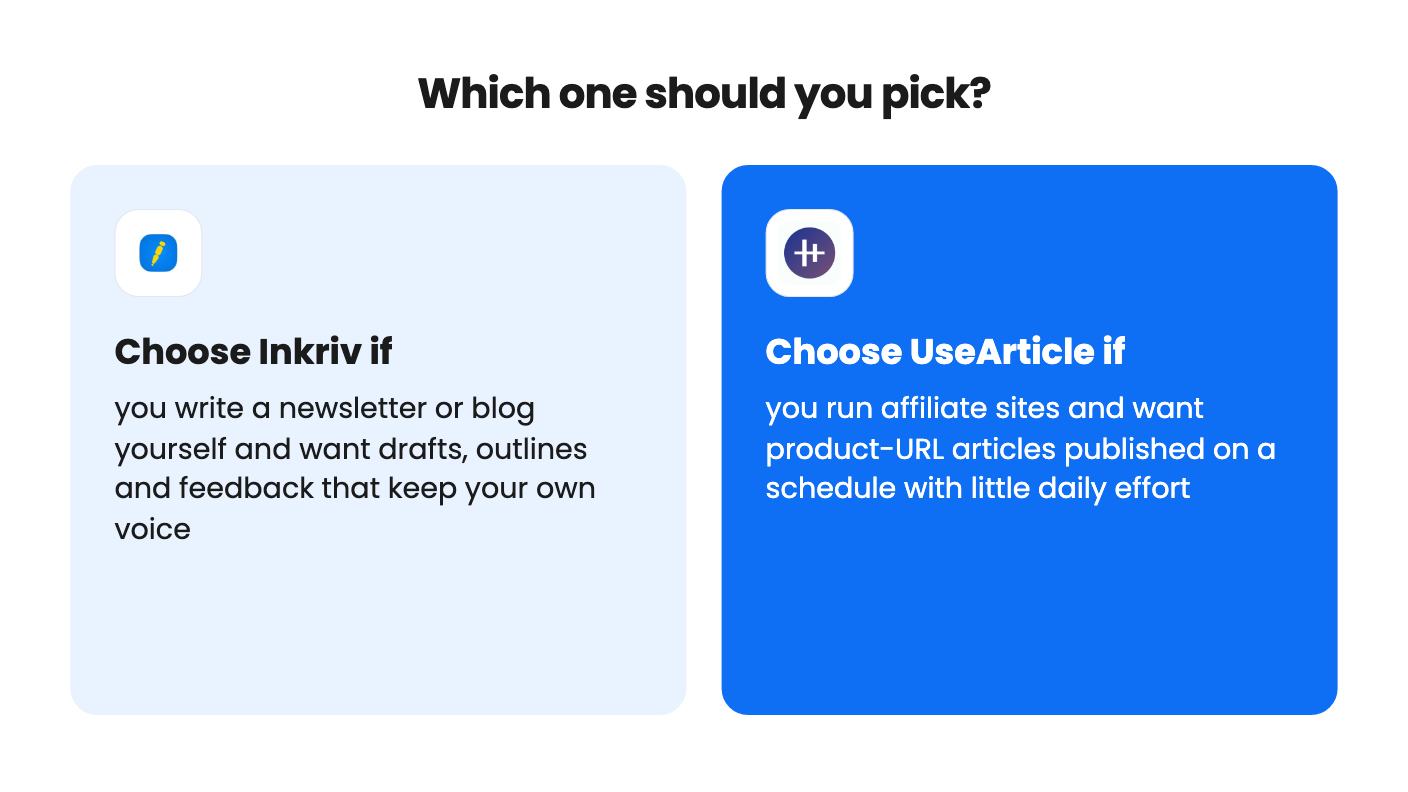
Pick Inkriv if you’re a solo newsletter writer or blogger with a body of work to train it on, and your real bottleneck is finding angles and shaping outlines. Skip it if you need team workflows, SEO tooling or publishing integrations.
Pick UseArticle tier 1 if you run one or two small affiliate sites and keep falling behind on posting. Move to tier 2 only if you need more sites, thumbnails or your own API key, and you’re comfortable with the extra API costs. Skip it if quality matters more to you than volume.
One timing note. UseArticle’s deal ends on 1 November 2026, which is today, so check it’s still live before you decide. If you buy either one, use the 60-day window properly: run a small batch, read every output closely, and keep it only if you’d put your name on the result.
UseArticle is built for that, with product URL input, 13 article formats and an affiliate marketplace. Inkriv is aimed at newsletters and personal writing, and its listing mentions no affiliate features.
Both start at $49. Inkriv's list price is $240 and UseArticle's is $360, but list prices say little. What matters is the monthly caps on Inkriv and the 2-automation limit on UseArticle tier 1.
No. Inkriv has monthly caps on words, briefs, simulator reviews and more. UseArticle tier 2 needs your own API key for unlimited blogs, and future AI models may cost extra or need an add-on.
How this comparison was made: researched from both tools' official listings and demo videos, and written with help from AI. We have not tested Inkriv or UseArticle hands-on yet. Prices and deal terms change, so check AppSumo before you buy. See our affiliate disclosure.
Fourteen AppSumo lifetime deals end before Black Friday on November 27, 2026. Here are the seven worth a look now, and who should skip them.
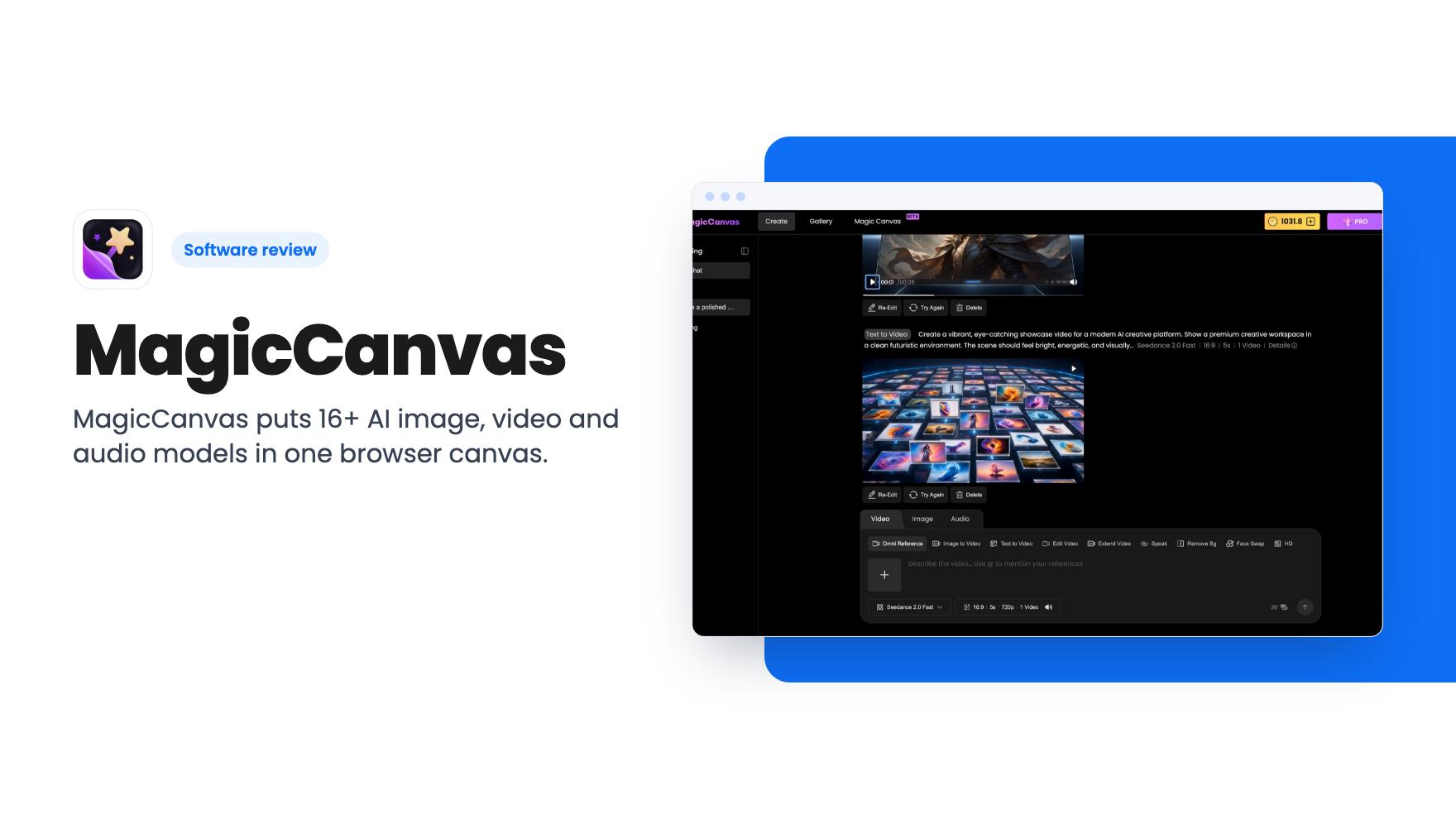
MagicCanvas puts 16+ AI image, video and audio models in one browser canvas. The $59 lifetime deal looks cheap, but the monthly credit caps matter most.
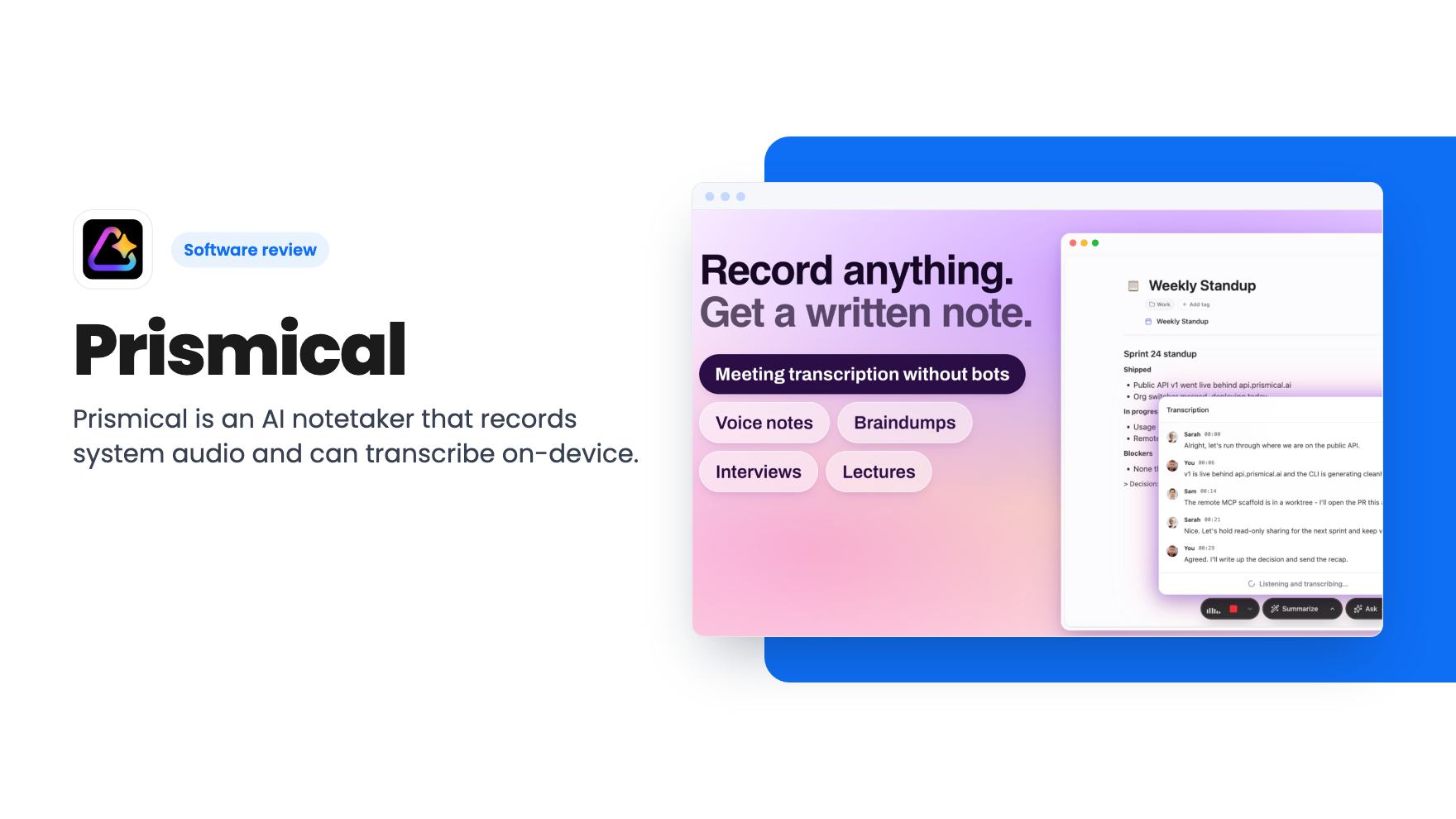
Prismical is an AI notetaker that records system audio and can transcribe on-device. The AppSumo lifetime deal runs $59 to $749, and the tier limits matter.