
Project ManagementAlternatives
Monday.com lifetime deal alternatives on AppSumo, compared
Five AppSumo lifetime deals named as Monday.com alternatives, from $49 to $109, with the limits and gaps that matter and who each one suits.
FuseBase is a branded client portal and docs hub. Indy chains proposals, contracts and invoices. Here's which lifetime deal fits a freelancer.
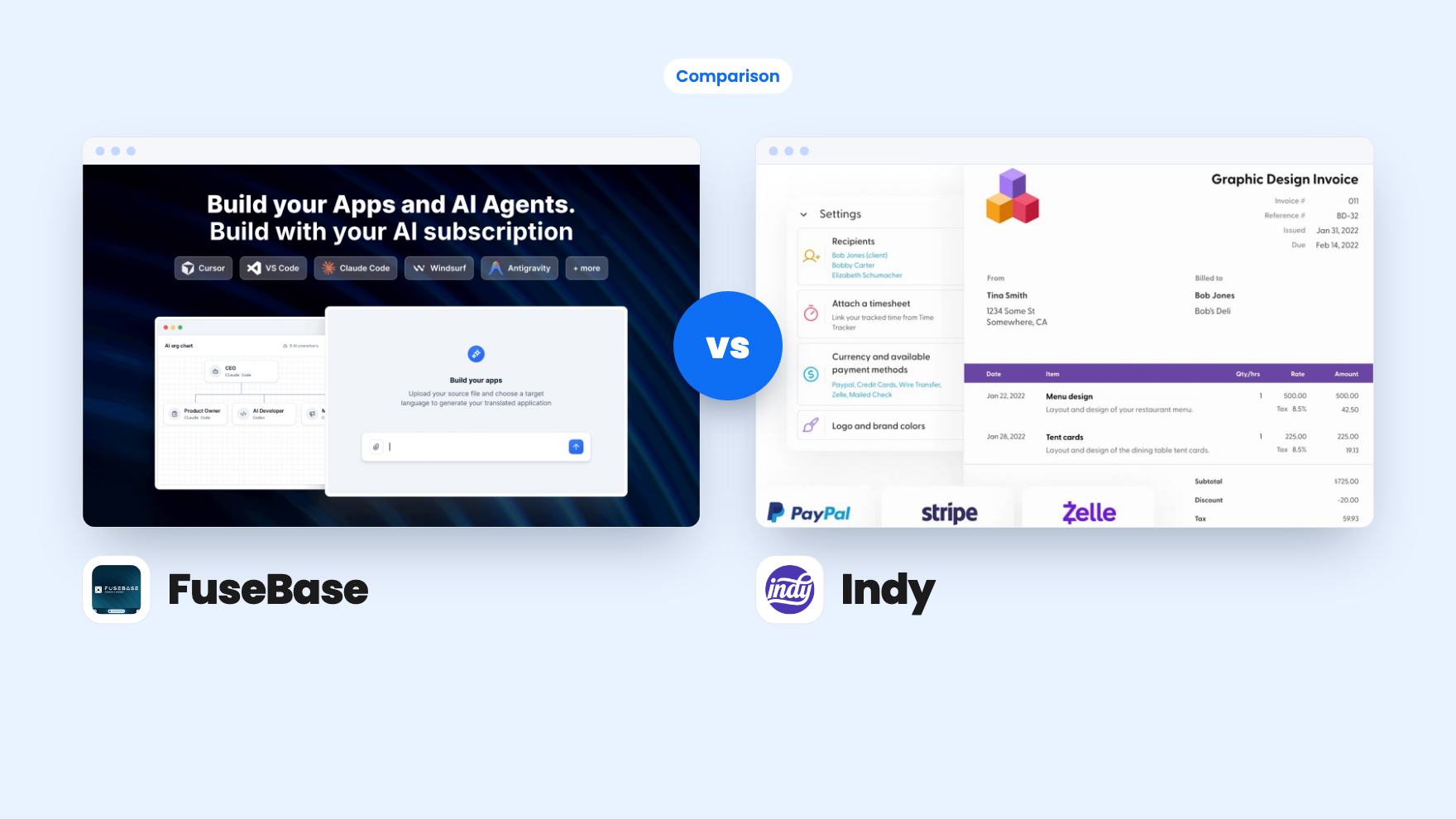
FuseBase takes 3 rounds, Indy takes 1.
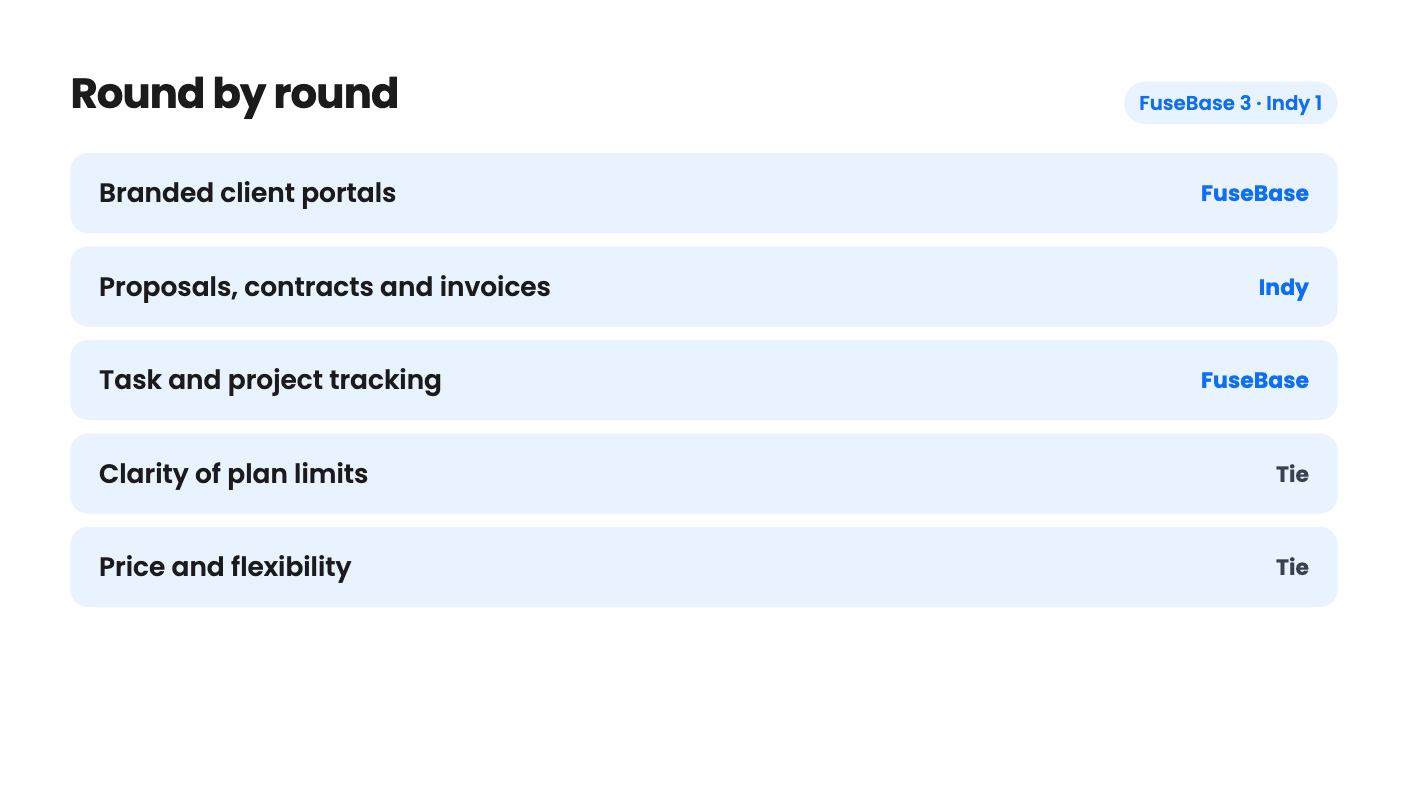
| Round | Winner | Why |
|---|---|---|
| Branded client portals | FuseBase | FuseBase describes white-labeled portals with magic-link access, while Indy only says its Pro plan has portals and never says the $39 tier is Pro. |
| Proposals, contracts and invoices | Indy | Indy moves an accepted proposal into a contract and an invoice, with recurring invoices and PayPal, Stripe or direct deposit; FuseBase's listing describes no invoicing. |
| Task and project tracking | FuseBase | FuseBase mentions a unified task view with time tracking, a calendar view and an Organization Dashboard, against Indy's task lists and kanban boards. |
| Clarity of plan limits | Tie | FuseBase's plan table lists ten values per feature in no clear order, and Indy's listing gives no caps at all. |
| Price and flexibility | Tie | Indy is $39 but not stackable, while FuseBase starts at $79 and stacks without limit, so each trades cost against room to grow. |
| Track record | FuseBase | FuseBase has 606 AppSumo reviews averaging 4.68 out of 5, while Indy has a single 5.00 review. |
| FuseBase | Indy | |
|---|---|---|
| Starts at | $79 | $39 |
| List price | $468 | $300 |
| Plan | Lifetime Deal | Lifetime Deal |
| Deal ends | Not listed | Not listed |
| Best for | Project managers, Sales managers, Small businesses, Solopreneurs | Freelancers, Small businesses, Solopreneurs |
| Alternative to | Basecamp, Monday.com, Notion | Freshbooks, Honeybook, Wave Accounting |
You’ve just won a client. Now you need a proposal, a contract they can sign, somewhere to share files, and eventually an invoice. FuseBase and Indy both sell lifetime deals to freelancers who want that handled in fewer tabs, but they start from opposite ends of the job. We haven’t used either one, so everything here comes from the listings.
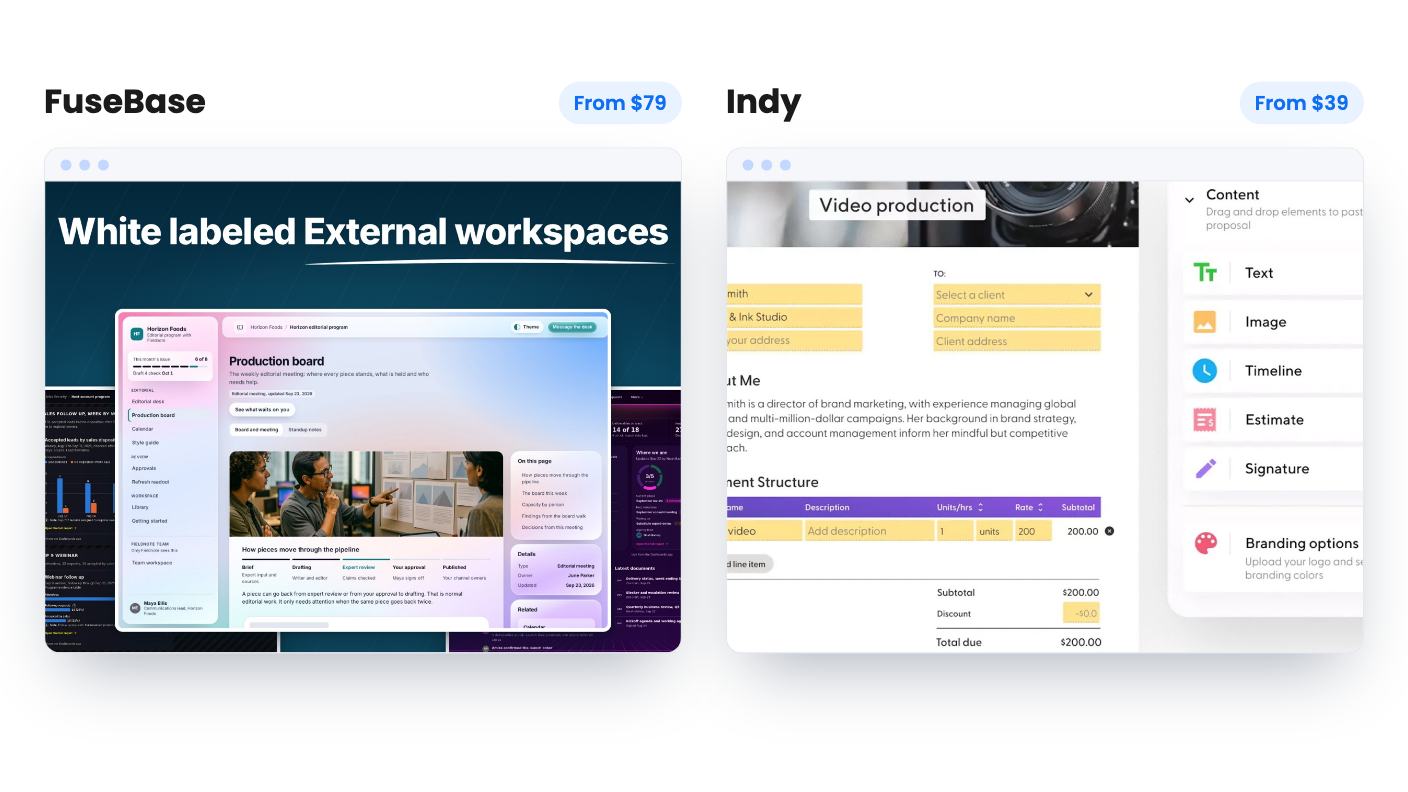
FuseBase starts with the handover. It’s a workspace for internal notes and projects, plus branded portals where clients see only what you’ve shared with them. It used to be called Nimbus Note, and it has since grown to include AI agents, app building and hosted tools.
Indy starts with the sale. It chains proposals, contracts and invoices together, then adds a shared client workspace with files, chat and tasks. The listing says an accepted proposal can move automatically into a contract and an invoice, and that’s the best idea on either page.
So the real question is whether your pain is delivering work or getting it agreed and paid for. Plenty of freelancers have both problems. You’ll need to decide which one costs you more time.
FuseBase is the stronger choice here. You can build white-labeled portals, deal rooms and even SEO-friendly sites, and pull pages from your internal workspace into them with permissions attached. One portal can hold several clients, with access limited to specific files and folders.
The demo video adds the detail we like most. Clients get in through magic links and security codes, so nobody registers or resets a password. You can also lock blocks so clients and colleagues can comment without deleting anything by accident. The video looks like an older product tour, though, so the newer AI and MCP material rests on the listing’s word alone.
Indy’s workspace is simpler. You get shared files, chat, tasks, access settings that control what each client sees, and task lists or kanban boards. Here’s the catch. The FAQ says Indy’s Pro plan includes client portals, but the deal page never says whether the $39 tier is Pro. That’s the first question to put to support.
This is where Indy pulls ahead, and it isn’t close. Proposals come from templates or a drag-and-drop builder, and you can see when one has been viewed and approved. Contracts can be signed without the client creating an account, and you get a notice when they’re viewed or signed. Invoices are branded, can recur for retainer clients, and take PayPal, Stripe or direct deposit.
Two gaps are worth knowing about. The integrations list names only Google Calendar and PayPal, while the feature text mentions Stripe, so confirm the setup and any fees. The listing also says nothing about late fees, reminders, currencies, taxes or expenses. This is not a bookkeeping tool, and the listing’s own Wave and FreshBooks comparison only holds for the invoicing slice.
FuseBase’s side is thin by comparison. AppSumo’s summary mentions e-signatures, but the listing doesn’t explain how they work. It describes no invoicing at all. Pick FuseBase and you’ll be paying for invoicing somewhere else.
Indy is $39 against a $300 list price, in a single tier. The deal isn’t stackable, you must redeem within 60 days, and the listing gives no caps on clients, projects, invoices or storage. It also gives no refund terms, so check the checkout page.
FuseBase starts at $79 and runs to $790 for ten codes. Codes stack without limit. Codes 1 to 2 map to the Solo plan, 3 to 9 to Essentials, and 10 and up to Advanced. Past code 10, each extra code adds 3 members, 3 guests, 100 GB of storage, 1,500 OCR records and 2 client portals. AppSumo’s summary mentions a 60-day money-back guarantee, which gives you room to try a real client.
The trouble is the plan table. It lists ten values per feature in no obvious order, and the user row reads 50, 22, 18, 16, 12, 10, 3, 1, 14, 19. White labeling, SOC 2, HIPAA and MCP access show as available in some columns and not others. Don’t assume the $79 tier has any of them. The crossed-out list prices on FuseBase are inflated, so ignore those too.
Neither deal tells you its limits clearly. FuseBase buries them, and Indy leaves them out. We’d call that a draw, and both deserve a question to support before you pay.
FuseBase has 606 AppSumo reviews averaging 4.68 out of 5. Even AppSumo’s own marketing summary admits occasional lag and a learning curve for new features. That fits a product that keeps adding things. Breadth is the risk here, because a tool covering docs, portals, tasks, transcription and AI is rarely the best at any one, and the task side sounds lighter than a dedicated project manager.
Indy has one review, a 5.00. One review tells you almost nothing. The listing gives no founding date, user count or roadmap either, so you’re taking more on trust. At $39 the exposure is small, but it’s still a bet on a product we can’t read much about.
Pick FuseBase if the thing you keep fumbling is handing over work: deliverables, updates, a branded place clients return to. Start with a single $79 code, run a real client through it, and check the plan values for your code count before you stack more.
Pick Indy if you lose time retyping client details across a proposal, a contract and an invoice. Send support one message first, asking for the exact limits and whether client portals are in the $39 tier.
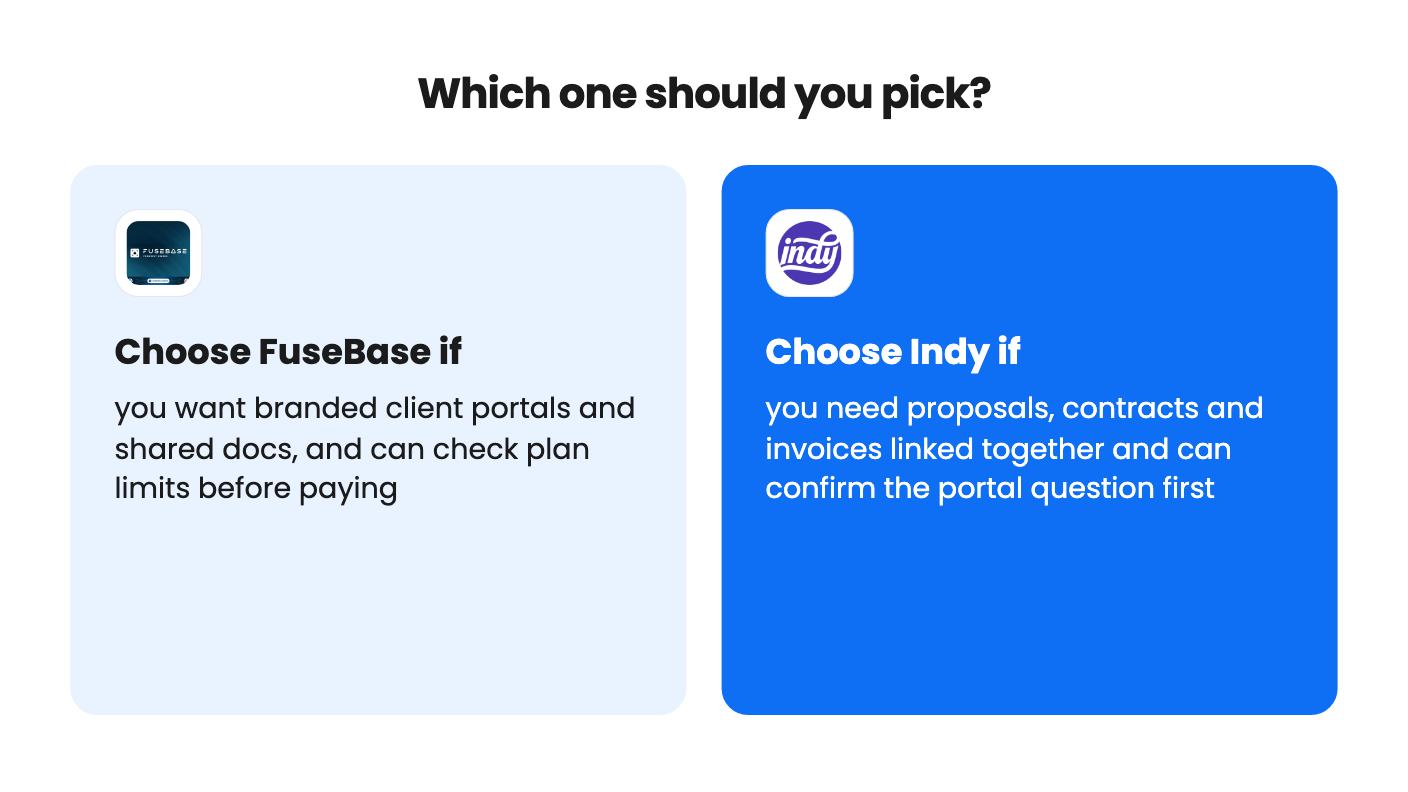
If you need real bookkeeping or a deep project engine, neither one is the answer. And if you truly want both halves, Indy at $39 is the cheaper experiment for the paperwork chain, as long as support confirms the limits first.
The listing doesn't say. Its FAQ states that the Pro plan includes client portals, but the deal page never says which plan the $39 tier is. Ask support before buying if portals matter to you.
On FuseBase, yes. Codes stack without limit, and past code 10 each one adds 3 members, 3 guests, 100 GB of storage, 1,500 OCR records and 2 client portals. Indy's deal is not stackable.
Indy. It offers branded and recurring invoices with status tracking and payments through PayPal, Stripe or direct deposit. FuseBase's listing doesn't describe invoicing, so you'd need a separate tool.
How this comparison was made: researched from both tools' official listings and demo videos, and written with help from AI. We have not tested FuseBase or Indy hands-on yet. Prices and deal terms change, so check AppSumo before you buy. See our affiliate disclosure.
Five AppSumo lifetime deals named as Monday.com alternatives, from $49 to $109, with the limits and gaps that matter and who each one suits.
Five AppSumo lifetime deals named as ClickUp alternatives, grouped by need, with the seat caps, credit limits and gaps the listings show.
Five AppSumo lifetime-deal alternatives to Asana, grouped by need, with seat caps, credit limits and gaps spelled out so you can see who each one suits.