Email MarketingReview
Million Dollar Email Templates 2.0 Review: Free Swipe File Deal
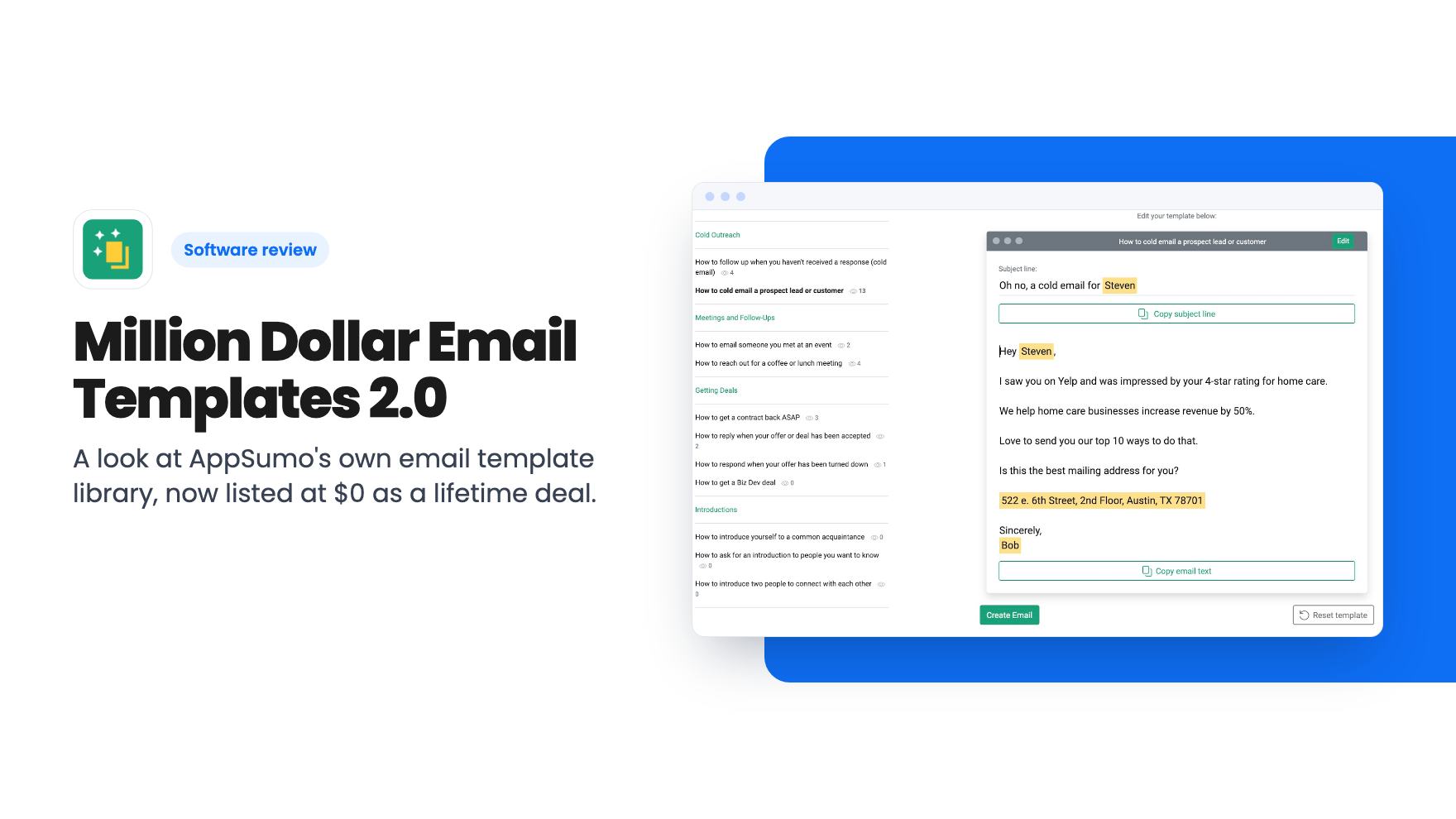
A look at AppSumo's own email template library, now listed at $0 as a lifetime deal. What you get, what's vague, and who should grab it.
Two email verifier lifetime deals. BillionVerify is cheaper and API-first but hides its credits. CleanMyList states 20,000 checks a month.
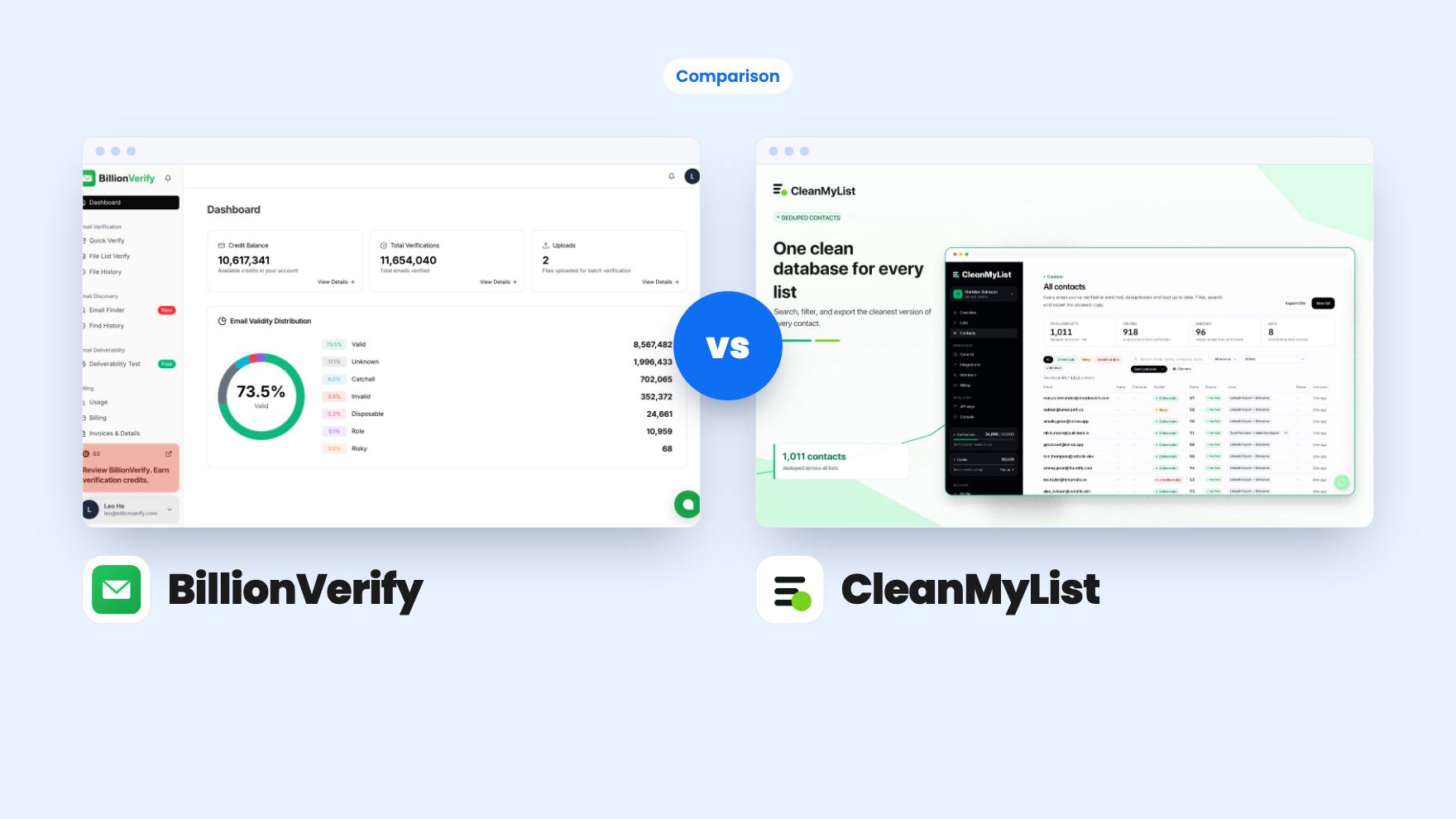
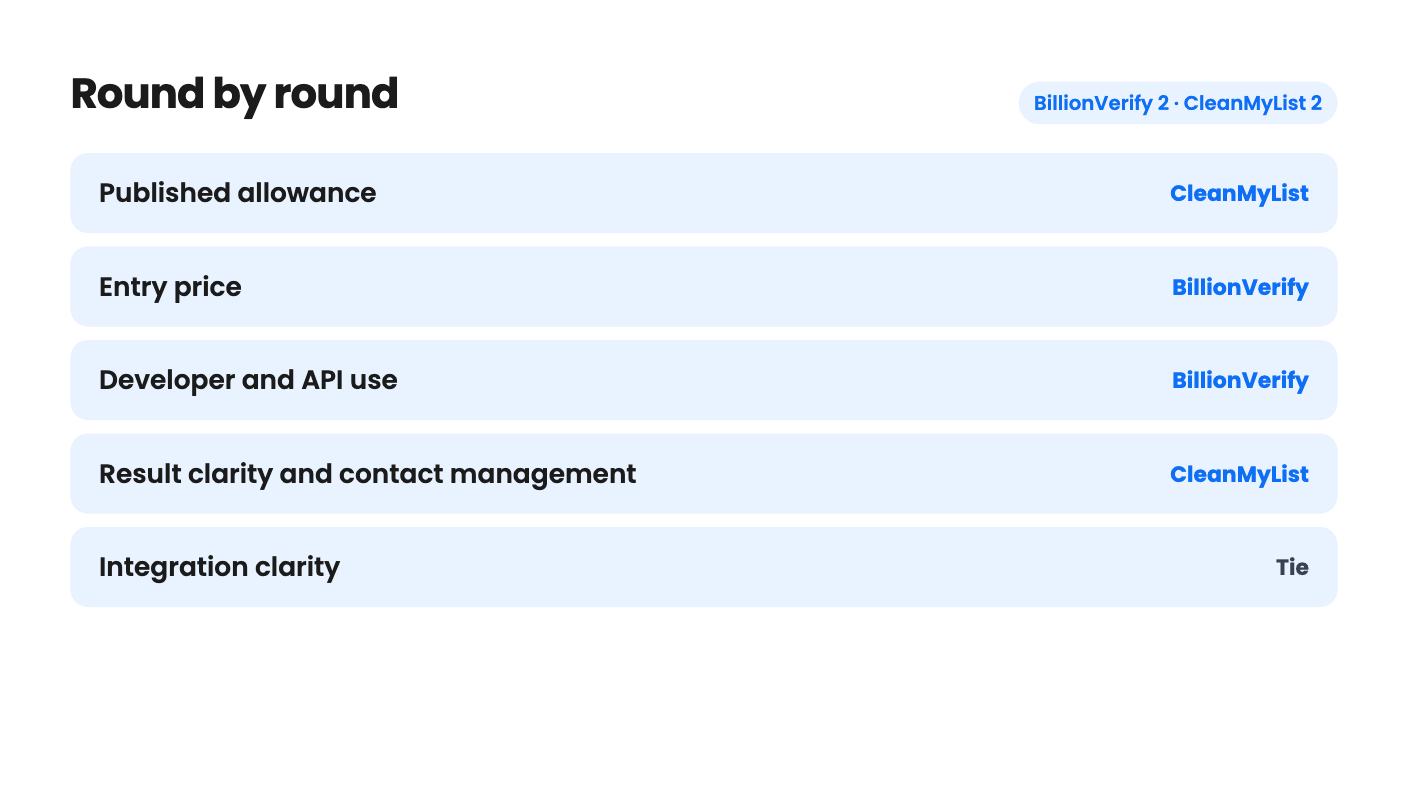
BillionVerify takes 2 rounds, CleanMyList takes 2.
| Round | Winner | Why |
|---|---|---|
| Published allowance | CleanMyList | CleanMyList states 20,000, 60,000 or 120,000 checks a month, while the BillionVerify listing gives no credit figure for either tier. |
| Entry price | BillionVerify | BillionVerify starts at $49 against $79, though we can't say what the $49 actually buys. |
| Developer and API use | BillionVerify | BillionVerify lists SDKs for Python, Node.js, Go and PHP plus an MCP server, with 1 to 3 second SMTP checks. |
| Result clarity and contact management | CleanMyList | CleanMyList gives a reason for each deliverable, risky or undeliverable verdict and keeps a deduplicated master contact database. |
| Integration clarity | Tie | Both listings name different integration lists in different places, so check your tool before buying either. |
| Evidence of quality | Tie | BillionVerify claims 99.9% accuracy with no method, and CleanMyList publishes no accuracy figure and has only 3 reviews. |
| BillionVerify | CleanMyList | |
|---|---|---|
| Starts at | $49 | $79 |
| List price | Not listed | $516 |
| Plan | Lifetime Deal | Lifetime Deal |
| Deal ends | Not listed | Not listed |
| Best for | Marketers, Marketing agencies, Agencies | Marketers, Marketing agencies, Small businesses |
| Alternative to | Hunter.io, ZeroBounce | ZeroBounce |
You exported a list from last spring’s webinar, loaded it into your email tool and sent a campaign. Two days later the bounce count is ugly and your sender reputation is taking the hit. Both of these tools exist to stop that, and both are sold as lifetime deals on AppSumo.
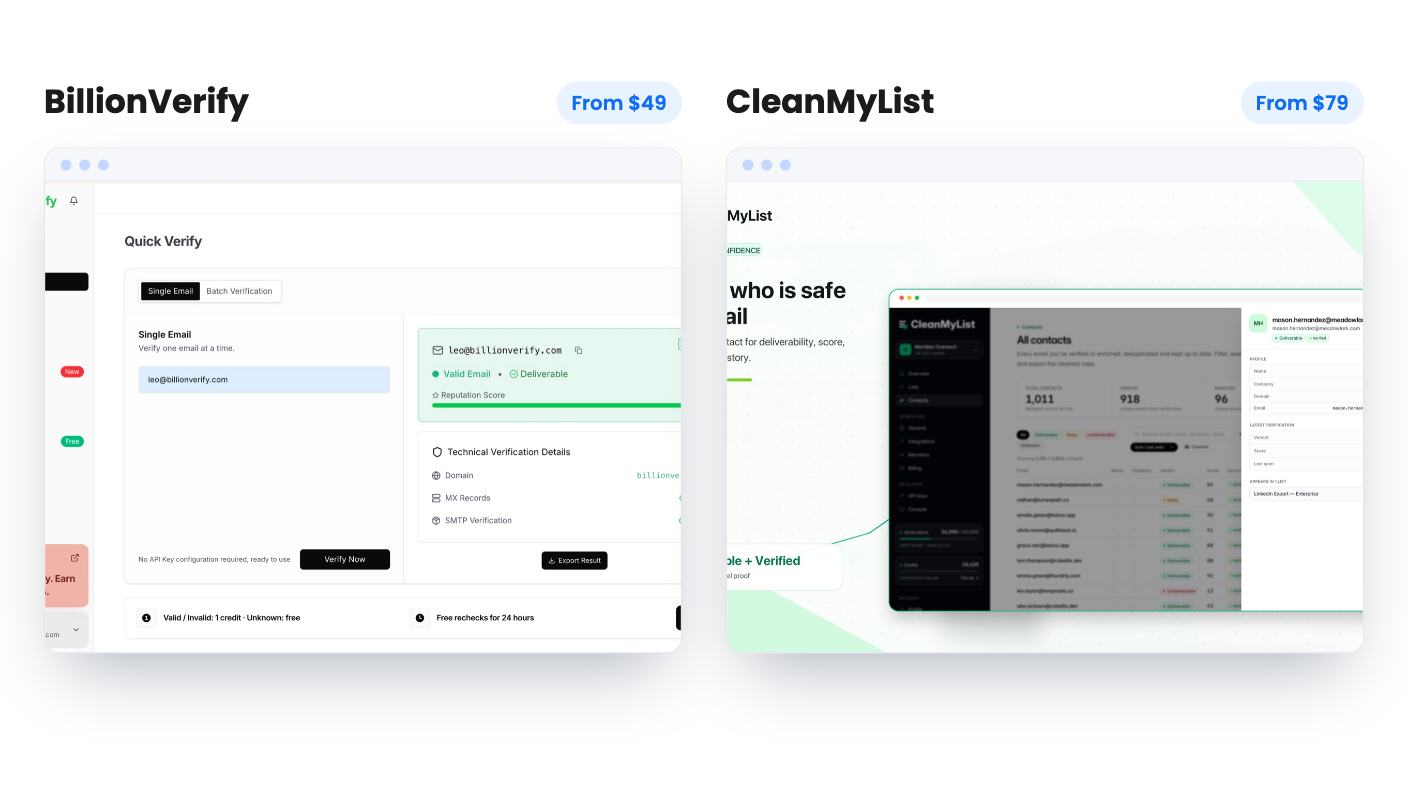
We haven’t used either one, so everything below comes from the listings. Neither has a demo video, which means much of it is the vendors describing themselves.
The biggest difference isn’t a feature. It’s that CleanMyList tells you what you’re buying and BillionVerify doesn’t.
CleanMyList’s $79 tier includes 20,000 verifications every month. The $199 tier gives 60,000 and the $399 tier gives 120,000. You can see the number, do the maths against your own lists, and decide.
BillionVerify has two tiers, $49 and $98, and the listing gives no monthly credits, no total verifications and no API cap for either. For a product priced per email, that’s the one number you need. We’d treat it as a blocker until the seller answers in writing.
There is a hint. Both BillionVerify tiers let you stack up to 5 codes, which suggests each code adds capacity. That’s an inference, not something the listing says.
BillionVerify lists the standard stack on every request: syntax validation, DNS and MX lookup, SMTP mailbox confirmation, disposable email detection, role account flags like info@ and support@, catch-all detection and spam trap screening. The SMTP step matters most, since it asks the receiving server whether the mailbox exists. Catch-all domains get a score rather than a plain good or bad label, though the listing doesn’t show how that score appears.
CleanMyList sorts every address into deliverable, risky or undeliverable, and each verdict comes with a reason you can inspect. Catch-all domains land in the risky bucket. We like this approach for a small business. If a risky address belongs to a real customer, you can see why it was flagged and keep it.
CleanMyList doesn’t list its individual checks the way BillionVerify does. It says deliverable means passing the available checks, which is vague. So BillionVerify is clearer about what runs under the hood, and CleanMyList is clearer about what you see afterward.
This is where BillionVerify has the stronger story, at least on paper. The API returns structured JSON in under 200ms for cached results and 1 to 3 seconds for a full SMTP check, with SDKs for Python, Node.js, Go and PHP. There’s also an MCP server for Claude and Cursor, and the listing gives no detail on how it behaves.
A 1 to 3 second check is fine in the background but awkward if someone is waiting on a signup form. You’d probably verify after submission instead of blocking the button.
CleanMyList leans toward people who don’t write code. You can import contacts from a connected tool, verify them and push selected results back, which skips the usual CSV round trip. It also keeps a searchable, deduplicated master contact database with references to source lists. The listing doesn’t say how many contacts it holds or whether stored contacts count against your allowance. It offers an API too, but gives no speed figures or SDKs.
Both listings are messy on integrations:
In both cases the longest list is probably the most complete, but confirm your tool before paying. CleanMyList also warns that some providers need a paid plan for API access, and MailPoet needs a companion WordPress plugin.
BillionVerify costs $49 or $98, with a 60-day redemption window and stacking up to 5 codes. The listed prices of $0.00 are a data quirk, so ignore them.
CleanMyList costs $79, $199 or $399, with a 60-day activation window. You can switch between the three tiers later, and there’s no stacking. Only the two higher tiers get the priority verification queue, and the listing doesn’t say how slow the standard queue is.
The catch with CleanMyList is that the allowance resets monthly and doesn’t roll over. Clean one big list per quarter and you’ll use a fraction of what you paid for. Rescue, which looks for replacement addresses, and enrichment both run on separately bought credits, as does any verification beyond your allowance. The listing doesn’t give that credit price, so heavy use has an unknown cost.
BillionVerify’s own FAQ puts pay-as-you-go at $10 for 10,000 emails, against $50 at NeverBounce, $60 at Emailable and $129 at ZeroBounce. That’s useful context. If you only clean a list once or twice a year, neither lifetime deal is likely to beat paying per use.
BillionVerify’s listing contradicts itself in a few places. Accuracy is stated as 99.9% with no method behind it. Bulk speed is given as 50,000 emails per hour in one answer and about 100,000 in another. The batch API takes 1,000 emails per request while dashboard uploads are called unlimited. None of that proves the product is weak, but it reads like a listing written in a hurry. It also gives no company history, customer count or uptime record.
CleanMyList is more restrained. It publishes no accuracy figure, which is honest but unhelpful, and it says plainly that verification can’t guarantee inbox placement. AppSumo shows 3 reviews, all five stars. That’s too thin a sample to lean on.
BillionVerify offers 100 free credits with no card, which is the sensible way to test it. Run a small, messy sample from your own list and see how it labels the risky addresses. The CleanMyList listing mentions no free trial.
If you clean lists every month and your email tool is on the integration list, CleanMyList is the easier call. You know the allowance, the results explain themselves, and you can start at $79 and move up only if you hit the cap. Just don’t buy it for a once-a-year scrub.
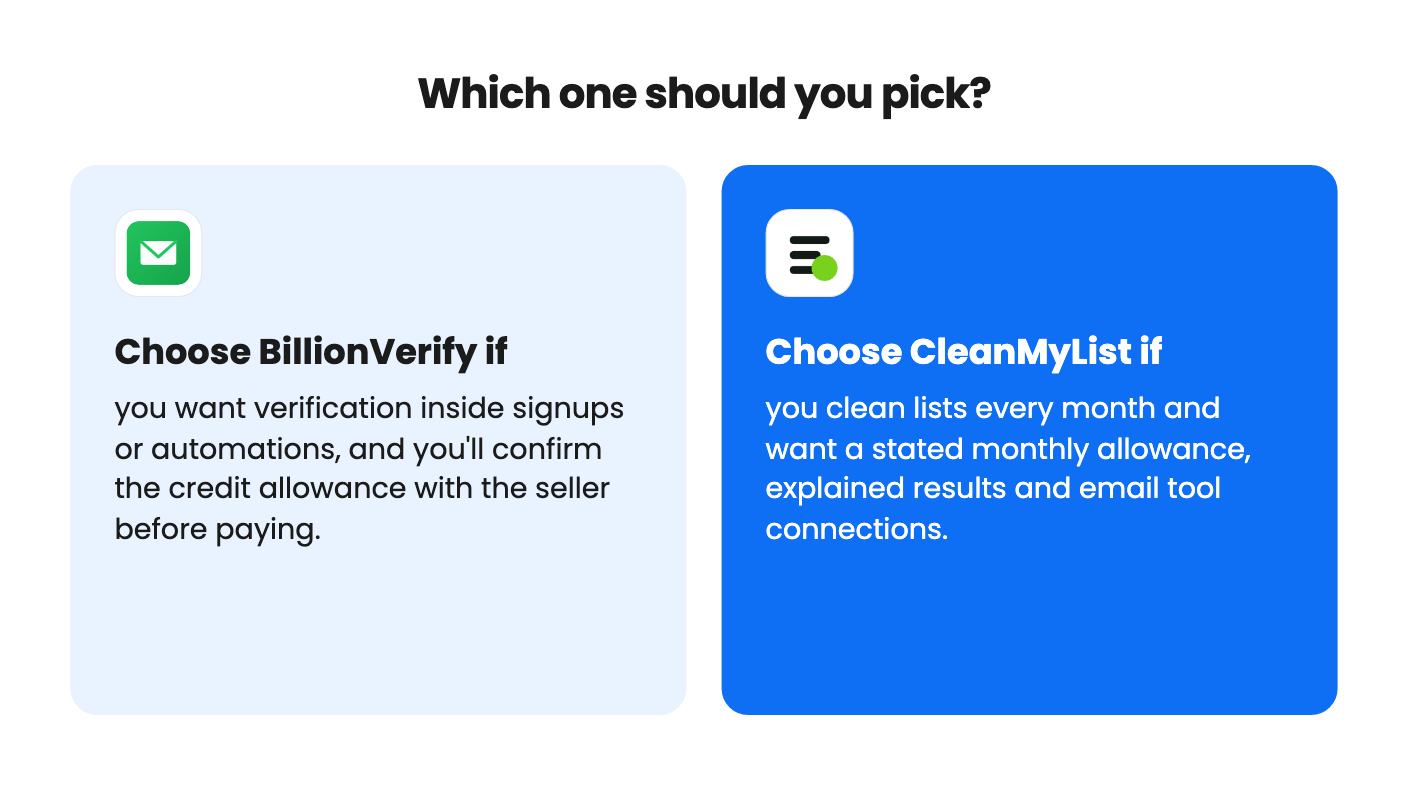
BillionVerify suits developers and agencies who want verification wired into signups or enrichment flows. Use the free credits first, get the tier allowance in writing, and buy a single $49 code before stacking anything. Until that number is confirmed, it’s the riskier of the two.
CleanMyList looks like the safer pick, because the listing states 20,000 verifications a month for $79. BillionVerify may be fine too, but its listing doesn't say what either tier includes.
On CleanMyList they don't. The monthly allowance resets and unused checks vanish. BillionVerify's listing doesn't describe its credit rules at all, so ask the seller.
Not always. BillionVerify's own FAQ quotes $10 per 10,000 emails, so someone cleaning 10,000 addresses twice a year would spend about $20 annually. Steady monthly volume is where a lifetime deal pays off.
How this comparison was made: researched from both tools' official listings and demo videos, and written with help from AI. We have not tested BillionVerify or CleanMyList hands-on yet. Prices and deal terms change, so check AppSumo before you buy. See our affiliate disclosure.
A look at AppSumo's own email template library, now listed at $0 as a lifetime deal. What you get, what's vague, and who should grab it.
Five AppSumo lifetime deals named as Mailchimp alternatives, grouped by what you send, with the caps and catches in each listing.
Ten email marketing lifetime deals from $29 to $79, grouped by job: sending, list cleaning, and the odd extras. Caps, catches and who should skip each one.