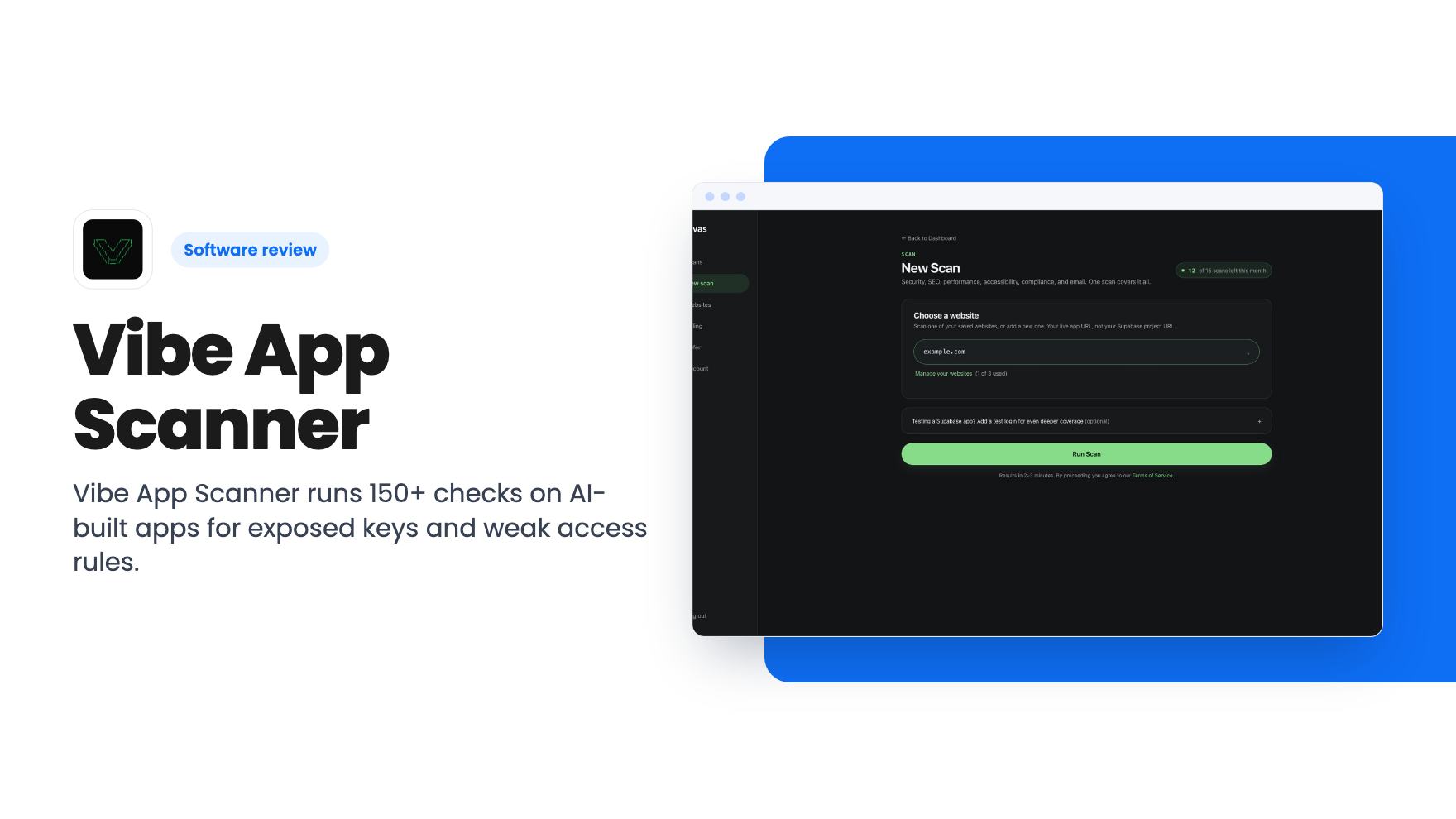
You built an app with an AI coding tool, it works, and real people are signing up. Somewhere in the back of your head sits a nagging thought: is the database open to anyone who knows where to look? That worry is exactly what Vibe App Scanner is built for. It’s a web-based scanner for AI-built apps, sold on AppSumo as a lifetime deal that starts at $49.
We haven’t used it ourselves. Everything below comes from the AppSumo listing, which is marketing copy, so we’ll flag where it’s vague or where the limits bite.
Why AI-built apps need their own kind of check
AI coding tools are fast, and they’re not careful. They’ll happily put a secret key in client-side code or skip the access rules that stop one user reading another user’s data. The listing names the problems it hunts for: exposed keys, broken auth, and missing row-level security (RLS) on the database.
That focus is the real pitch. General scanners like Detectify and Snyk, which AppSumo lists as alternatives, are broad tools. Vibe App Scanner narrows down to the mistakes that vibe-coded apps tend to make. Whether that narrower aim catches more of what matters for you depends on your stack.
What happens when you run a scan
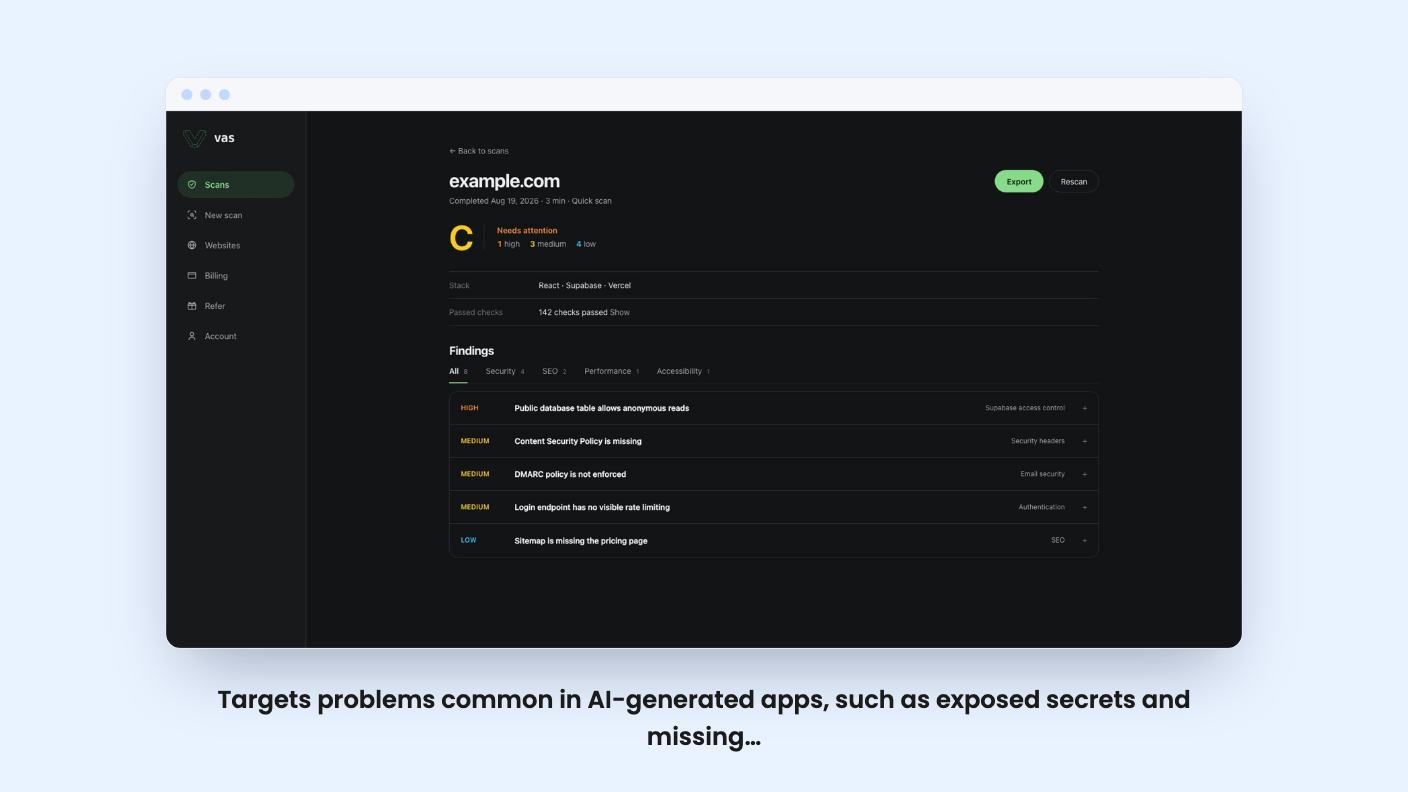
You enter a URL. The scanner detects your stack, and the listing says it recognises React, Supabase, Vercel and more than 20 platforms. It then runs 150+ targeted checks. The listing’s FAQ also mentions platform guides for Firebase, Bubble, Webflow, Retool, Appwrite, Xano, FlutterFlow and Glide, so it isn’t only for code-first projects.
The checks go beyond security. According to the listing, the suite also covers SEO and AI-search readiness, performance, accessibility, compliance and email checks. We’d treat those as extras. If you want a deep accessibility audit, a dedicated tool is the safer bet.
It also looks for secrets in served bundles and common misconfigurations, and it offers breach monitoring that references Have I Been Pwned.
Reading the results without panicking
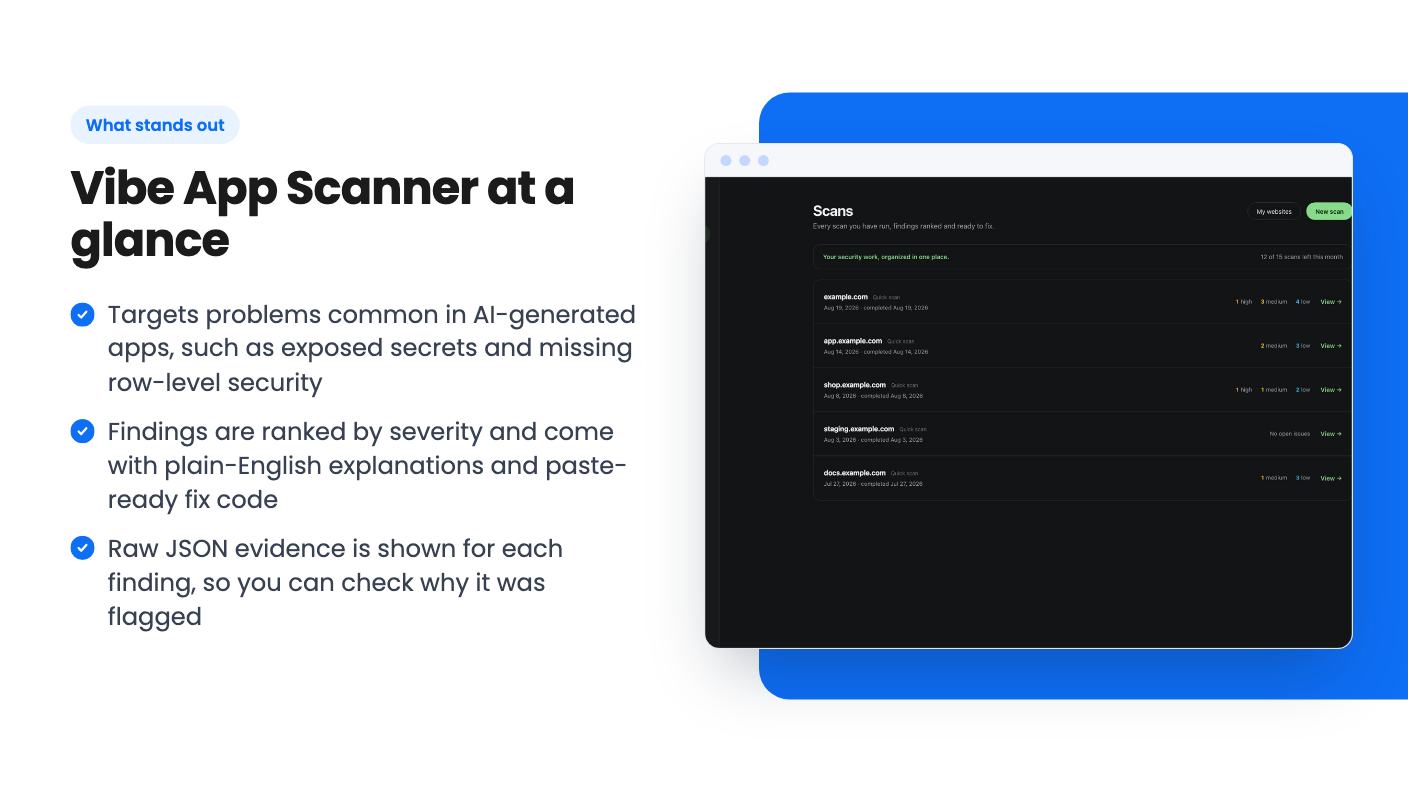
Security reports can bury you. This one says it ranks every finding by severity and labels what it caught, such as exposed secrets, RLS misconfigurations and missing headers. Each issue gets a plain-English explanation of why it’s dangerous and what an attacker could do with it.
The part we like most is the fix side. The listing promises ready-to-use remediation code you can paste into your AI tool or editor. For a solo founder who isn’t a security person, that’s the difference between a finding you understand and one you ignore.
You can also open the raw JSON evidence behind each finding. That matters because scanners produce false alarms. Being able to see what was tested and why it was flagged lets you judge for yourself. AppSumo’s own review summary admits that some findings may not be fully complete, so don’t treat a clean report as a clean bill of health.
Login testing is a sample, not an audit
Broken access control usually only shows up once you’re signed in. Vibe App Scanner lets you add a dedicated test account with email and password login, and it checks protected pages and API responses.
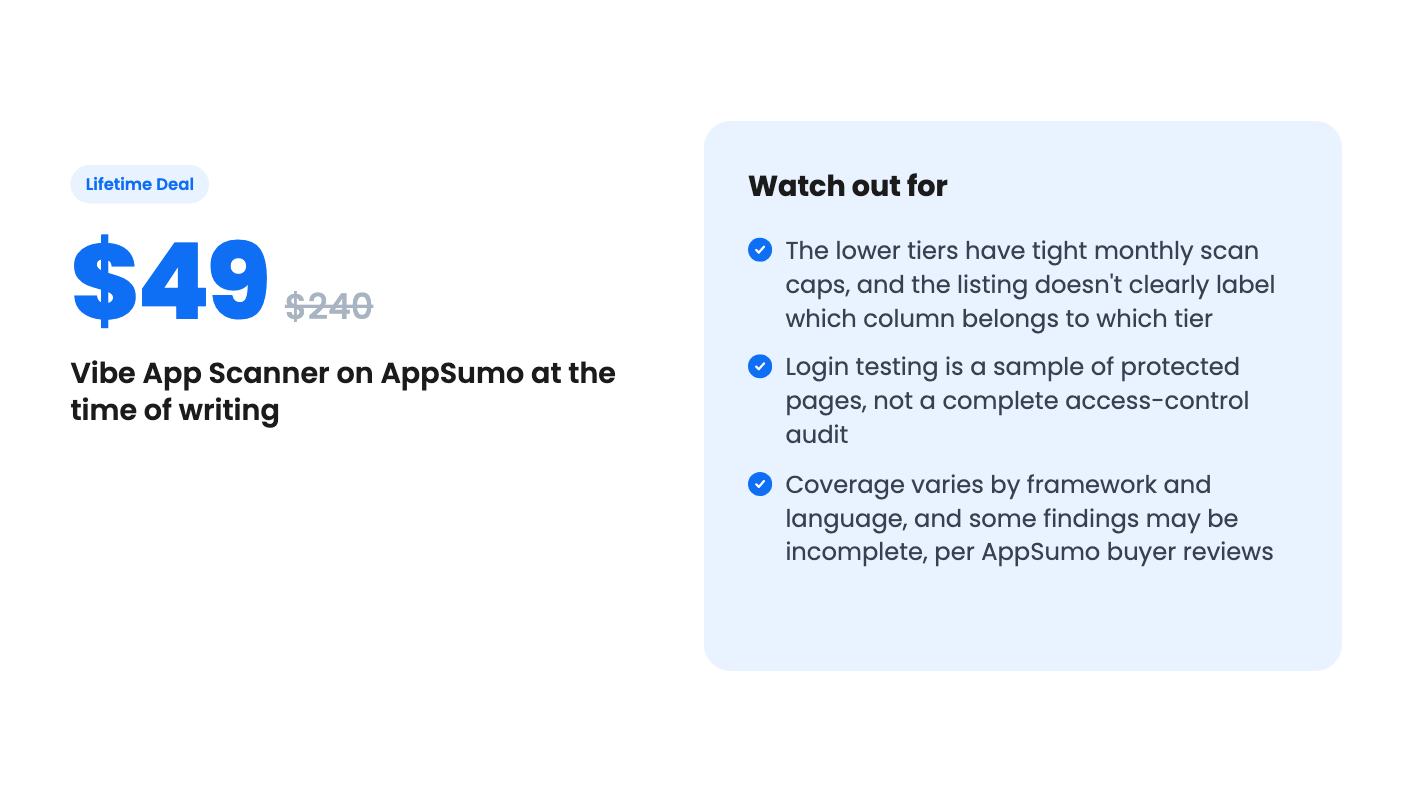
The listing’s own FAQ is refreshingly blunt about the limits. It checks a sample of protected pages. It isn’t an automated deep crawl or a complete access-control audit. Each authenticated scan also uses one scan from your monthly allowance, and scheduled, API and MCP scans don’t use the saved credentials.
In practice, this is a useful smoke test. If your app handles payments or private customer data, you’ll still want a human to test who can see what.
Tiers, caps and the fine print
There are three lifetime tiers: $49 (listed at $240), $119 (listed at $350) and $249 (listed at $480). Treat the list prices with a pinch of salt, as they are for every AppSumo deal.
The plan table shows scans per month as 150, 50 and 15, websites as unlimited, 10 and 3, and several features that switch on or off: code repository scanning, email breach monitoring, weekly scan automation, MCP access and API access. The listing doesn’t label the columns by tier. Because the top tier is the most expensive, the likely reading is that $49 gets 15 scans a month, 3 websites, and no repo scanning, breach monitoring, weekly automation or MCP. Check this on the AppSumo page before paying.
If that reading is right, 15 scans a month is fine for one or two apps you scan after each release. It gets tight fast if you scan often, or if you spend scans on authenticated checks.
A few other terms to know:
- You must activate your license within 60 days.
- You can upgrade while the deal is live, but you can only downgrade within 60 days of purchase.
- Plan updates for Go (Tier 1) and Pro (Tiers 2 and 3) are included.
- Access to future AI models may be discounted or may need an add-on.
- The deal ends November 18, 2026.
That last AI-model line is the one to watch. It means the lifetime price may not cover every future improvement.
Who should buy, and who should skip
The $49 tier suits a solo founder or small agency shipping a handful of AI-built apps on Supabase, Firebase or similar. You get a plain-English check for the mistakes that are most likely to hurt you, for less than the cost of one month of many security subscriptions. Agencies handling many client sites should look at the higher tiers, since the $49 website cap is probably small.
It’s a poor fit if you need compliance-grade assurance, a full penetration test, or a deep audit of how users can reach each other’s data. It’s also a young product, and AppSumo’s review summary notes that coverage varies by language and framework. The seven reviews, averaging 4.71, are encouraging but a small sample.
The 60-day money-back guarantee mentioned in AppSumo’s summary lowers the risk. The sensible move is to run it on your most exposed app first. If it finds something real, it has paid for itself. If it finds nothing and your stack looks unsupported, you can ask for a refund.
How this review was made: researched from Vibe App Scanner's official listing, and written with help from AI. We have not tested Vibe App Scanner hands-on yet. Prices and deal terms change, so check AppSumo before you buy. See our affiliate disclosure.