HR & PayrollReview
ResumeUp.AI Review: A $49 Lifetime Deal Built for Job Seekers
ResumeUp.AI is an AI resume builder, ATS checker and job tracker sold on AppSumo from $49. Here's what the listing says, what it leaves out, and who should buy.
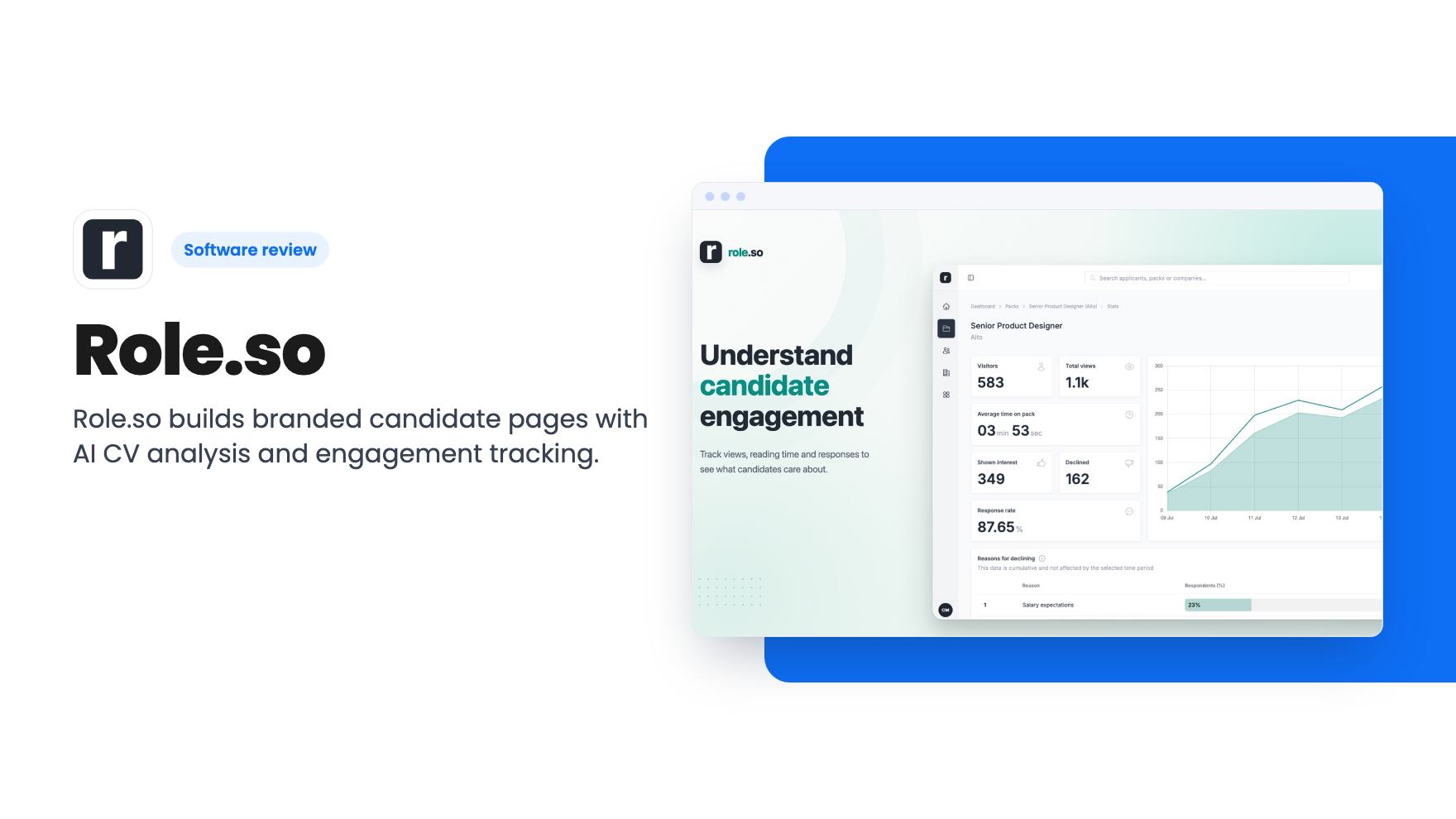
Role.so builds branded candidate pages with AI CV analysis and engagement tracking. Here's what the $79 to $399 AppSumo lifetime tiers include and where they stop.
Lifetime deal price
$79$27071% off
Lifetime Deal
Our take: Buy if you recruit regularly, already have an ATS or a simple process, and want to stop sending bland PDFs. Pick the $199 tier for most small teams. Skip it if you hire once or twice a year, need a full ATS, or want proof the product holds up, because we found no demo video or customer results.
Picture the last time you hired. You wrote a job description, pasted it into a job board, and then watched decent candidates ghost you after one look at a wall of bullet points. Meanwhile your company has a story, a team and some real perks that never made it into the posting.
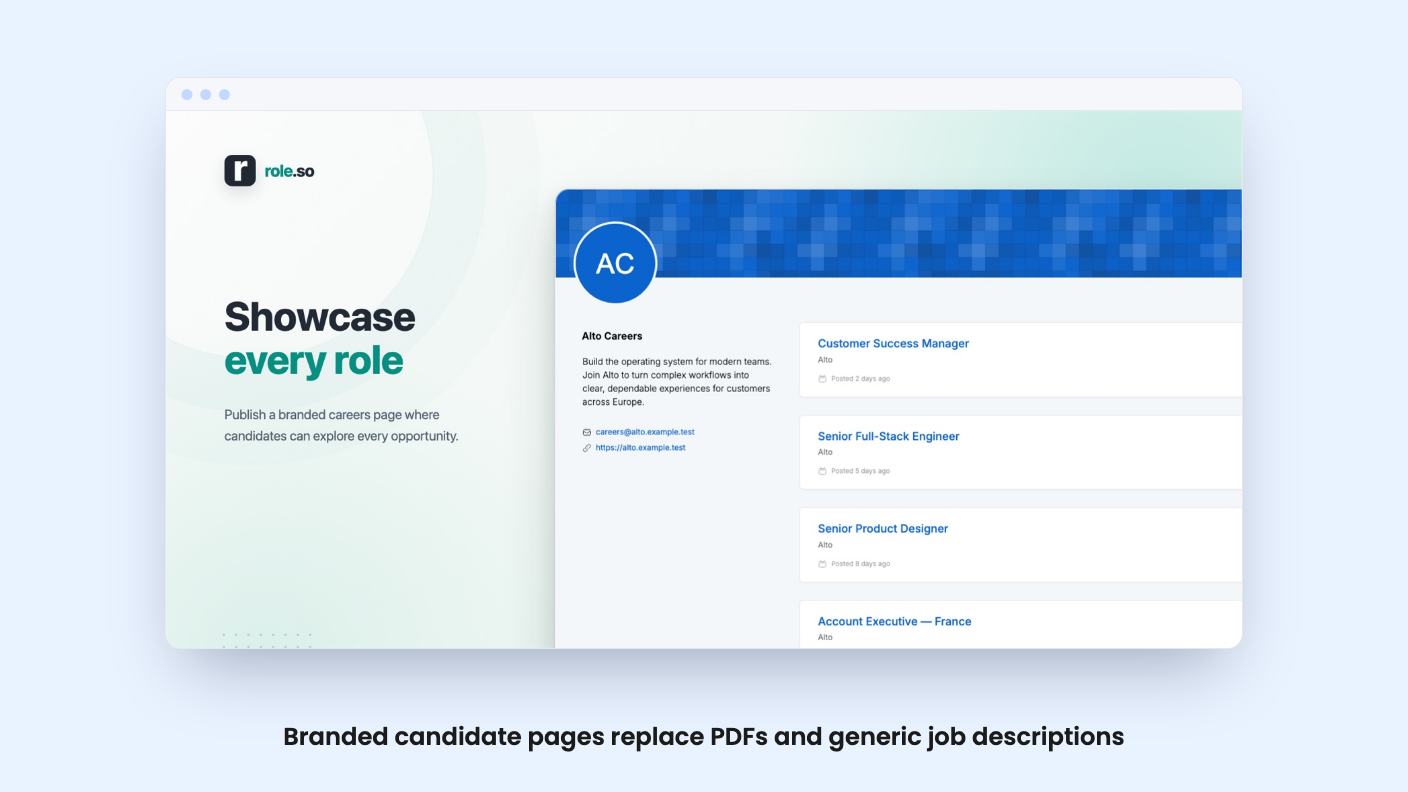
Role.so is built for that gap. It’s a candidate experience tool that turns each opening into a branded, interactive page instead of a PDF or a generic listing. It’s currently sold as a lifetime deal on AppSumo, from $79 to $399.
We haven’t used it hands-on, and there’s no product video attached to the listing. Everything below comes from the listing’s own descriptions, which is marketing copy, so read it with that in mind.
The core idea is one page per opportunity. You showcase the company, the culture, the team and the benefits, and you answer common candidate questions before anyone books a first interview. The listing says the AI can generate a candidate page from a job description, which would save you the blank-page problem.
Then there’s CV analysis. The listing says the AI reviews CVs and flags strengths, weaknesses and potential concerns. Treat that as a first-pass helper at most. The listing doesn’t say how the analysis works or how accurate it is, and you shouldn’t let any tool make hiring calls for you.
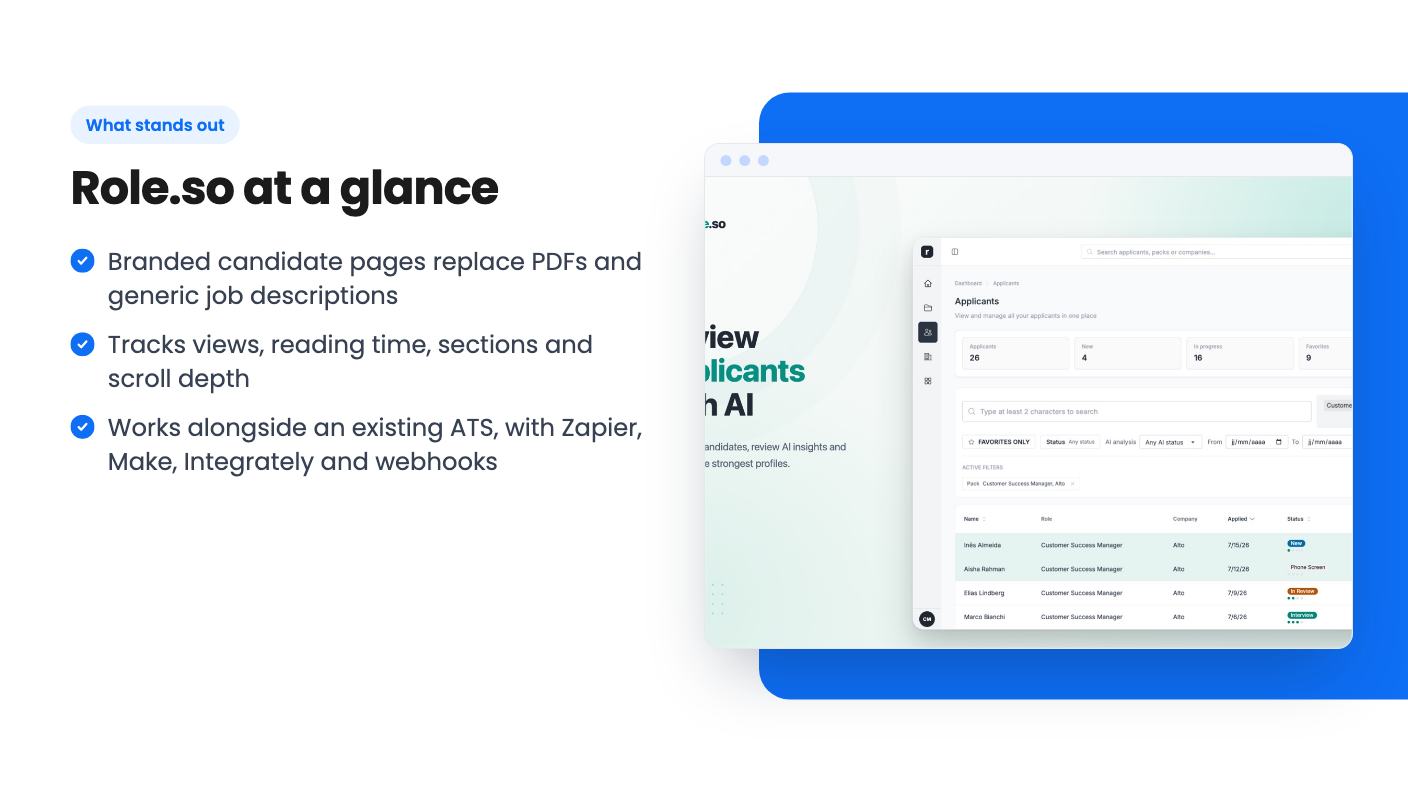
Candidates can apply right on the page by uploading a CV and completing your form. If you’d rather keep applications in your current system, you can redirect them to any external application page or ATS.
The listing is upfront here. Role.so is not an applicant tracking system, and it says it complements Workable, Ashby, Recruitee and similar tools. That’s honest, but it changes the buying math.
If you have no hiring system at all, this won’t give you a pipeline, stages or offer management. You’d be adding a presentation layer on top of nothing. If you already run an ATS, you’re adding a second place to look at candidates.
The integrations are Zapier, Make, Integrately and webhooks. There’s no native ATS connector in the list, so connecting to your hiring tool means building the automation yourself. That’s fine if you already use those platforms, and a chore if you don’t.
Most careers pages tell you nothing about who read them. Here, the listing says you can see who viewed a page, reading time, which sections candidates interacted with, and scroll depth at 25, 50, 75 and 100 percent.
In practice, that could tell you whether people drop off before they reach the salary range or the benefits. That’s useful information for tuning a job post. It won’t tell you why someone dropped off, though, and with small hiring volumes a handful of views won’t give you much of a pattern.
There’s also a feedback feature. You can collect structured responses from candidates and try to understand why they decline. The listing doesn’t say how that feedback is gathered or whether you can customize the questions on the lower tiers. Custom questions appear only on the top tier.
The pricing is where the details live. Here’s how the listing splits it up:
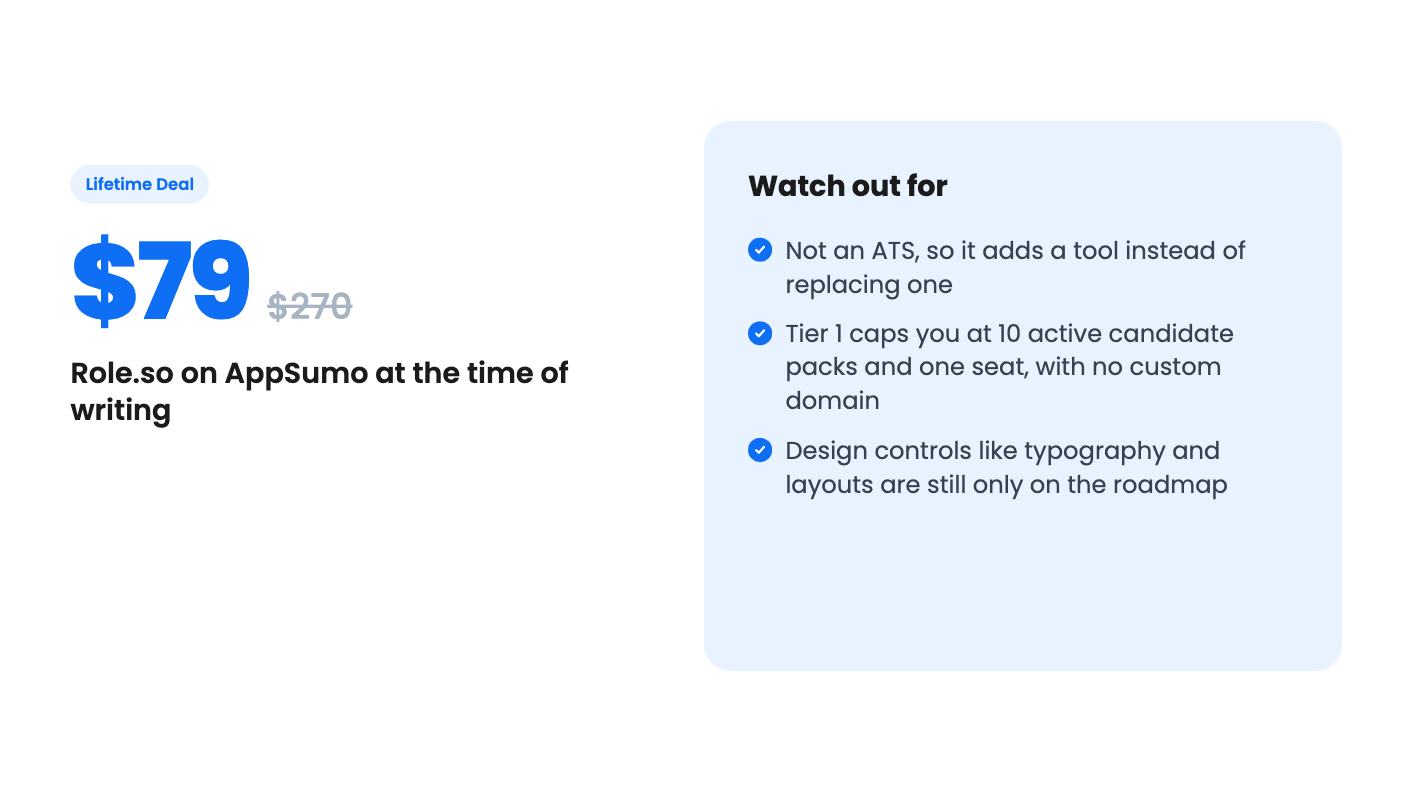
The cheapest tier is thin. Without a custom domain or brand colors, your pages carry less of your identity, and that was the whole selling point. Without webhooks you also lose the automation route into your ATS. For $79 we’d treat it as a trial, not a working setup.
The $199 tier is where the product makes sense for a small business. You get branding, a careers page and automation for a fraction of what the list price suggests. Keep in mind those “was” prices are the listing’s own reference figures, not something we’ve checked.
The $399 tier is mostly about volume. Unless you’re an agency running many roles across clients, 250 active candidate packs and a second workspace is probably more than you need. The listing never defines exactly what an “active candidate pack” counts as, so ask before you assume it means one open role.
The deal includes lifetime access and all future plan updates. You must activate your license within 60 days of purchase, and you can move between the three tiers. There’s no code stacking, so you pick one plan and that’s it.
The bigger risk is the product’s age. The listing says advanced customization, including typography, layouts and extra design controls, is on the roadmap. That means today’s pages are customizable through images, brand colors, custom domain, white-label pages and flexible content sections, but not much beyond that. Roadmap items are promises, not features.
We also can’t see reviews, a customer list or any hiring outcomes in the material we have. Candidate experience tools are easy to love in a demo and hard to prove. A better-looking page might lift response rates, or it might change nothing for roles where candidates just want a salary and a start date.
Skip it if you hire once or twice a year. A well-written Notion page or a decent careers section does the job, and you won’t use 50 packs.
Skip it if you need to manage applicants end to end. This isn’t that tool, and the listing says so.
Also skip if your hiring is mostly high-volume or hourly roles, where candidates rarely read a page about culture before applying.
It fits best for a recruiter, a small agency or a founder who hires steadily for skilled roles, already has some way of tracking candidates, and wants every opening to look like it came from a company that cares. If that’s you, start by looking at the $199 tier and check the refund terms on the AppSumo page before you commit.
No. The listing says plainly that it isn't an ATS and is meant to sit beside tools like Workable, Ashby or Recruitee. Candidates can apply through Role.so by uploading a CV and filling in a form, or you can send them to an external application page.
For most small teams the $199 tier is the realistic choice. It has 50 active candidate packs, 3 seats, a custom domain, a careers page and webhooks. The $79 tier drops all of those, and the $399 tier mainly adds capacity, a second workspace and custom questions.
According to the listing, you can upgrade or downgrade between the three license tiers. You must activate your license within 60 days of purchase. The listing doesn't spell out the refund terms in the text we have, so check the AppSumo page before buying.
How this review was made: researched from Role.so's official listing, and written with help from AI. We have not tested Role.so hands-on yet. Prices and deal terms change, so check AppSumo before you buy. See our affiliate disclosure.
ResumeUp.AI is an AI resume builder, ATS checker and job tracker sold on AppSumo from $49. Here's what the listing says, what it leaves out, and who should buy.
Six HR and hiring lifetime deals from $49 to $99, grouped by need. The listings don't mention payroll, and most are young products with caps to check.
PhoneScreen AI phones candidates for $99 with 20 screens included. Qualivio ranks CVs from $69 with monthly caps. Here's which first round fits you.