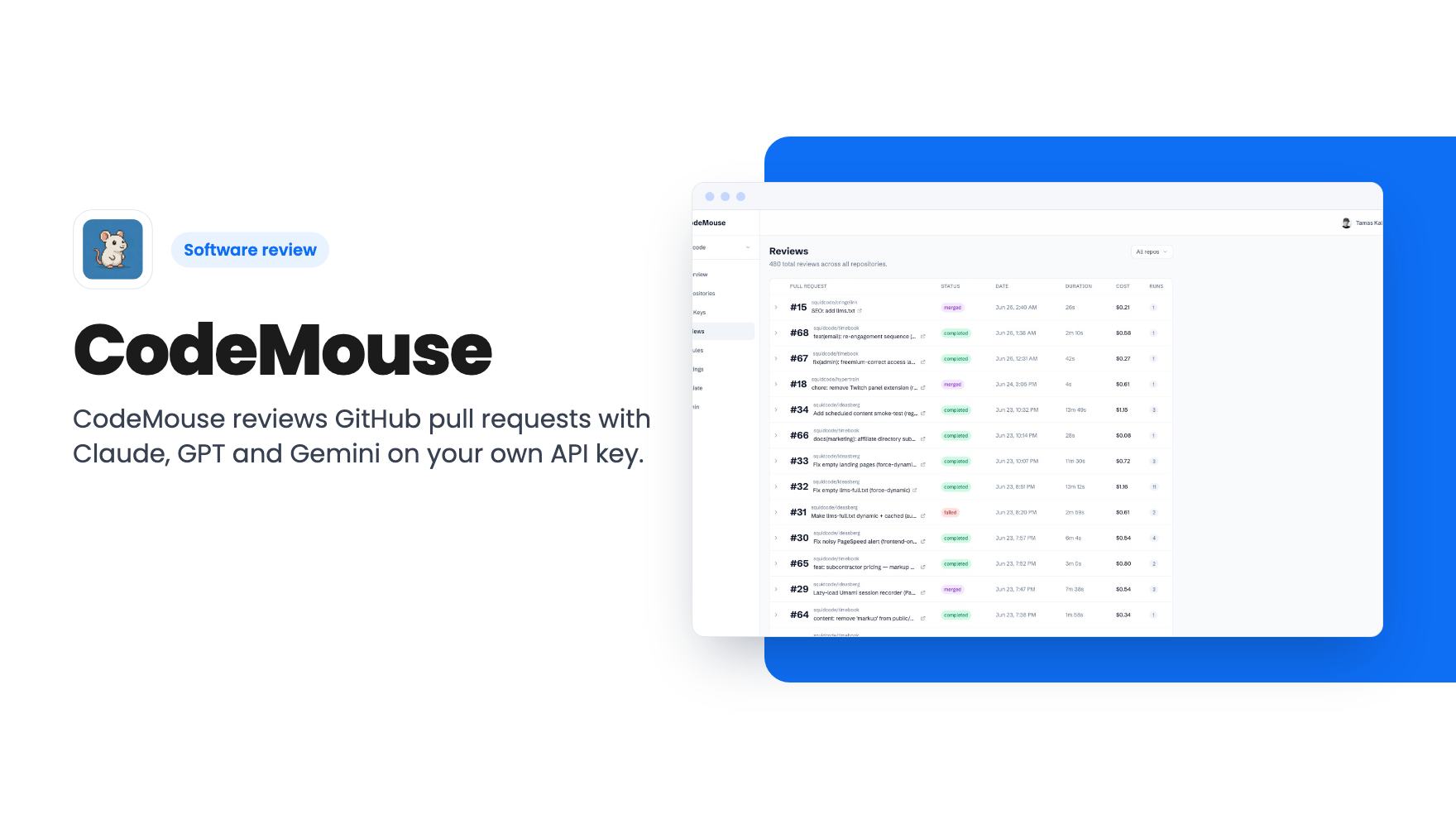
Pull requests pile up on small teams. The one person who really knows the codebase is busy, so a change sits for a day and then gets a quick approval because everyone wants to move on. AI code reviewers promise to fill that gap, and most of them bill per seat every month. CodeMouse, currently $39 on AppSumo against a $360 list price, takes a different route: you pay once for the tool and bring your own AI key.
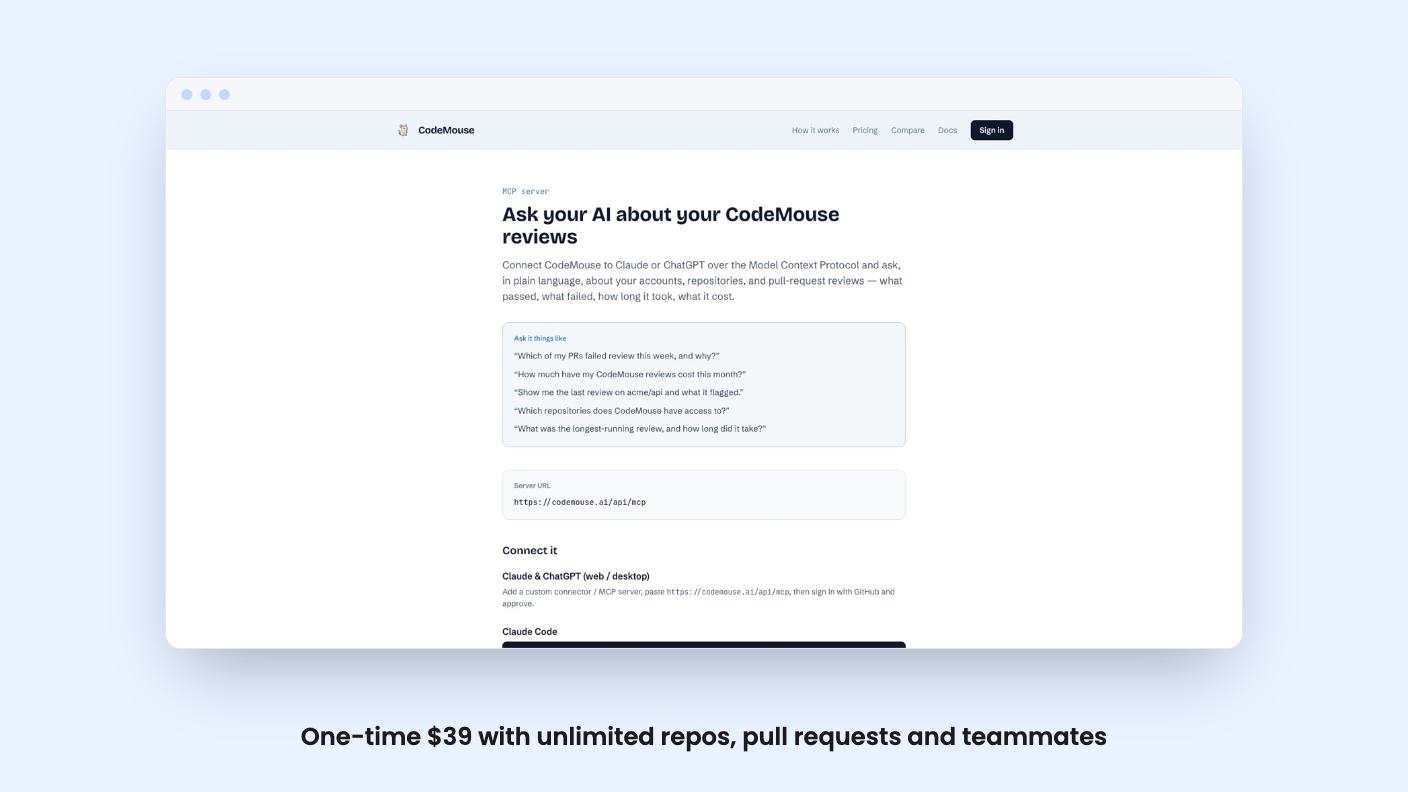
We haven’t used it. What follows is based on the AppSumo listing, which is marketing copy, and there’s no demo video to check it against.
What it actually does
CodeMouse installs as a GitHub App. You pick your repositories, add an API key in its dashboard, and open a pull request. According to the listing, a review shows up automatically within minutes. It says it works with any language and with any GitHub repo, public or private, and that there’s no CI pipeline or YAML to configure.
That last point matters if nobody on your team enjoys maintaining workflow files. It also means the product is tied to GitHub. The listing doesn’t mention GitLab or Bitbucket anywhere, so if your code lives there, stop reading and move on.
Three models instead of one
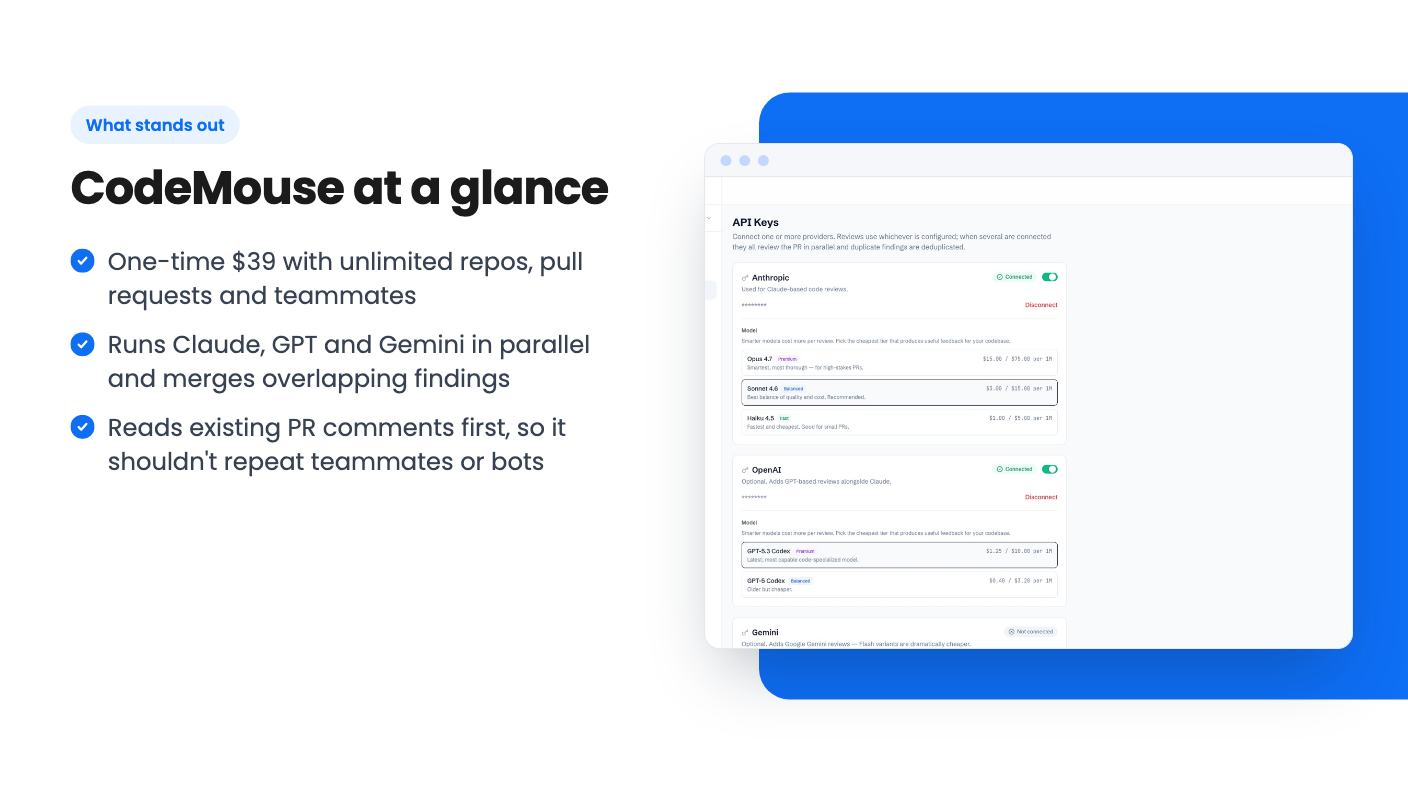
The headline feature is that Claude, GPT and Gemini can review the same pull request in parallel. You choose one, two or all three. CodeMouse then combines the findings and merges overlapping ones, so you see each issue once instead of three near-identical comments.
The idea is sound. Different models miss different things, and a second opinion is cheap. But the listing’s claim of “far fewer missed bugs than a single reviewer” comes with no benchmark, no numbers and no example. Treat it as a reasonable hypothesis, not a result.
There’s also a cost question the listing leaves open. The $0.05 to $0.15 per review figure doesn’t say how many models it assumes. Running all three will presumably cost more than running one, but the page never spells that out.
It reads the thread before it speaks
This is the part I find most interesting. Before commenting, CodeMouse reads every existing comment on the pull request, including teammates, other bots and its own earlier runs. It’s supposed to skip anything already raised and to follow up on its own threads when fixes land.
Anyone who has watched a bot repeat the same lint complaint on every push will see the appeal. A reviewer that goes quiet when there’s nothing new to say is worth more than a chatty one.
The plan features also list auto-approve and thread follow-up. The listing doesn’t explain when auto-approve triggers, what conditions apply, or whether you can switch it off. An AI approving pull requests is a setting you’d want to control, so find that out before you rely on it.
The real cost of a lifetime deal with your own key
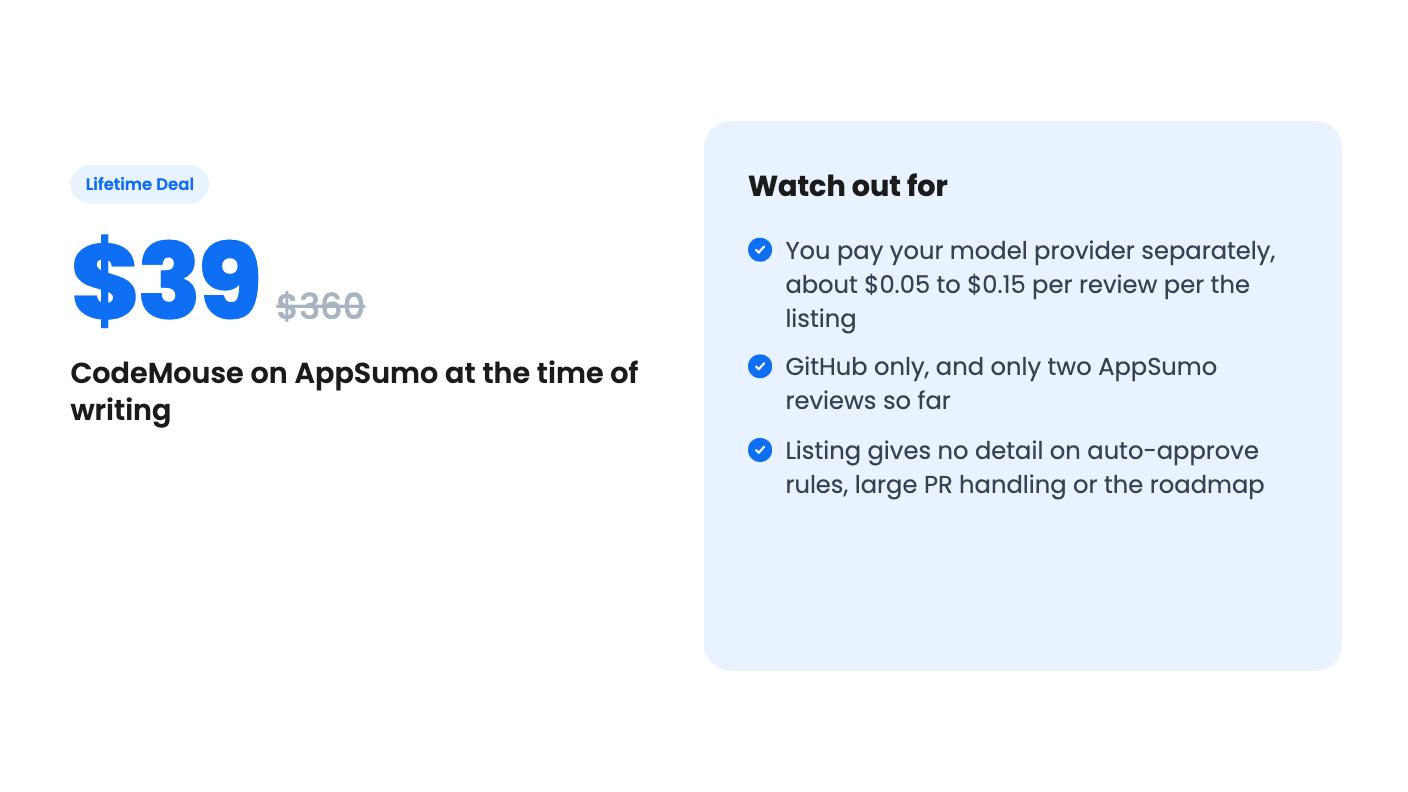
There’s one tier at $39, and it comes with all future plan updates. The listing mentions switching between license tiers, but with only one tier on offer that line doesn’t mean much. You must activate your license within 60 days of purchase, so don’t buy it and forget it.
What you get is unlimited repositories, pull requests and teammates, plus dashboard visibility into cost and tokens. What you don’t get is a free ride on inference. At the listed $0.05 to $0.15 per review, 100 reviews a month would run roughly $5 to $15 paid to your model provider. For a small team that’s easy to live with.
The listing doesn’t say whether very large pull requests stay inside that range. If your team ships big diffs, watch the first few bills.
On privacy, the listing says your repository is cloned only for the review and deleted right afterward, and that API keys are encrypted at rest with AES-256-GCM. Reasonable claims, though we can’t verify them. Remember too that the code still goes to whichever model providers you connect, because that’s where the review happens. Read their data terms.
Where it looks thin
The product looks young. AppSumo shows two reviews, both five stars. That’s a nice average over a tiny sample, and it tells you very little about how the tool behaves on a messy monorepo or how fast the developer fixes bugs.
The listing also says nothing about who builds it, how big the team is, or what’s planned next. That matters more with a lifetime deal, because you’re paying once and counting on the product to keep working as GitHub and the model APIs change. The cheap price limits your downside, but it doesn’t remove it.
I’d also want to see real review samples. The listing has feature bullets and no screenshots of actual comments in the text we have, so we can’t judge how useful the output is.
Who should buy it, and who should skip it
It suits a small team of two to ten developers on GitHub that already holds an API key with one of the three providers. If your reviews are bottlenecked on one busy person, a tool that gives every pull request a first pass for pennies is a fair bet at $39. Solo developers who want a second opinion before merging their own work fit too.
Skip it if you’re on GitLab or Bitbucket, if your security policy forbids sending code to third-party model providers, or if you want a fixed monthly bill with no usage costs. Skip it as well if you need a vendor with a long public track record.
If you do buy, install it on one active repository and let it review a couple of weeks of real pull requests. Compare what it flags with what your people catch, and check the refund terms on the deal page before you commit.
How this review was made: researched from CodeMouse's official listing, and written with help from AI. We have not tested CodeMouse hands-on yet. Prices and deal terms change, so check AppSumo before you buy. See our affiliate disclosure.