Your agent needs to read the internet, and two lifetime deals both claim to handle it. They look similar on a listing page. They aren’t built around the same job.
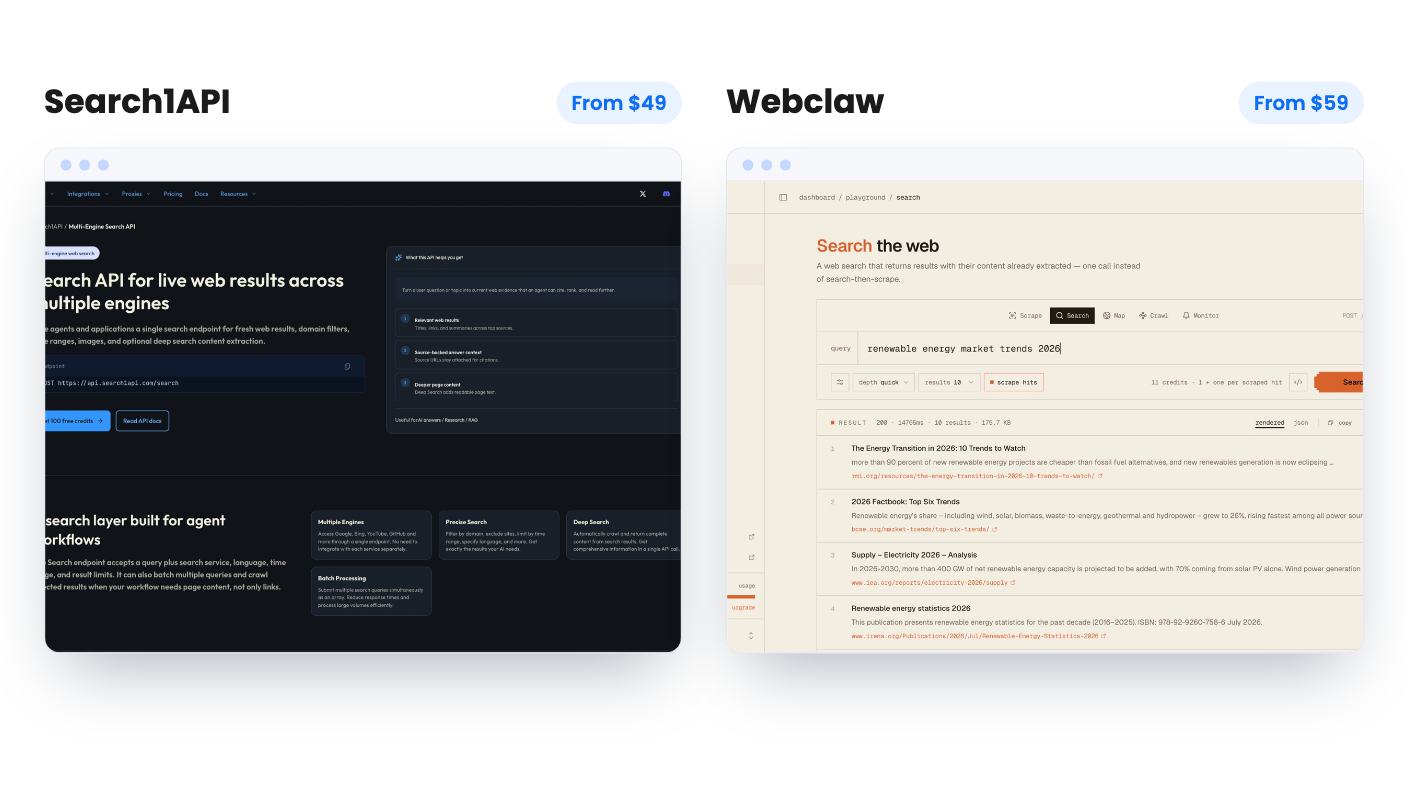
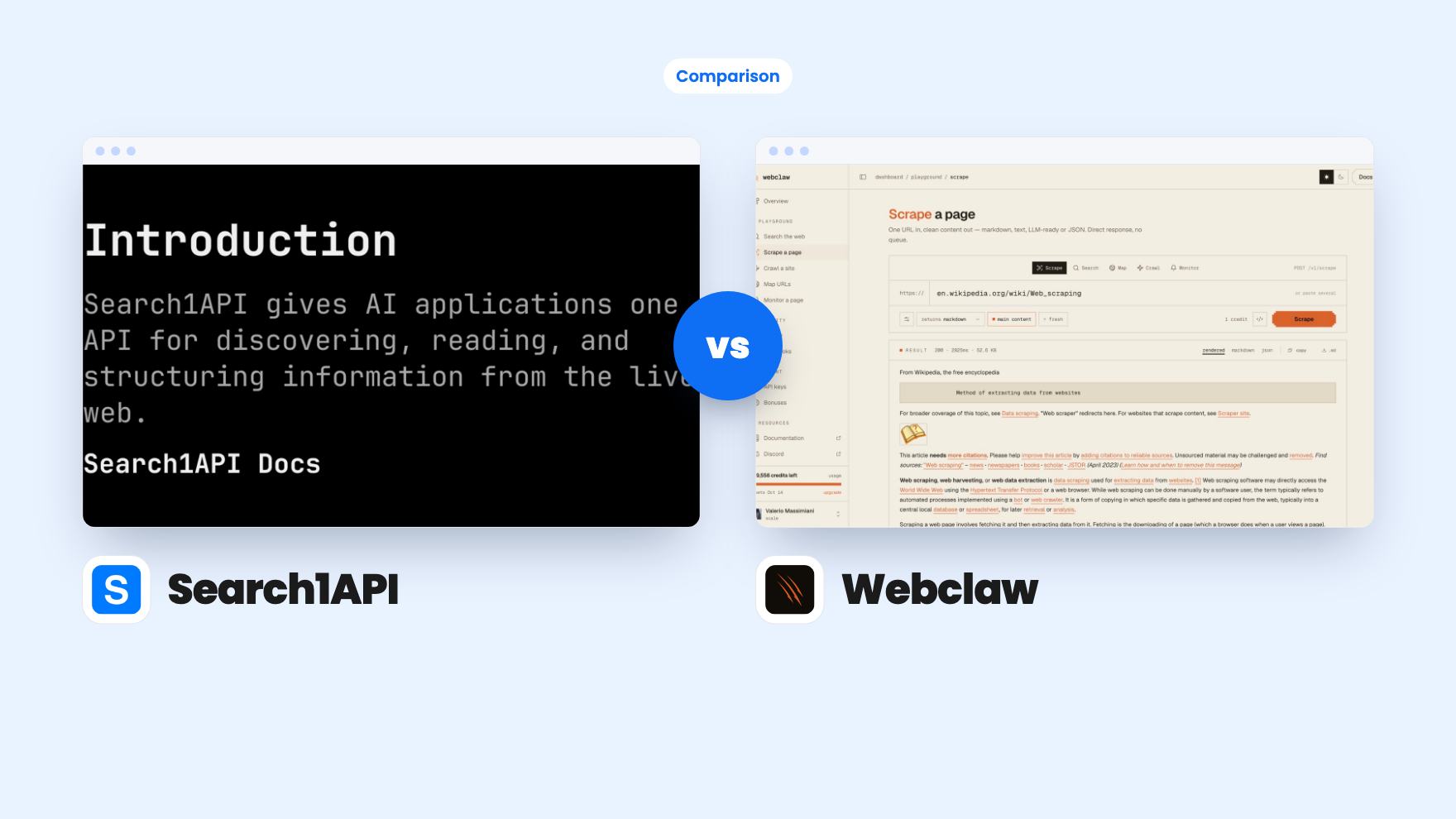
Search1API is a search-first tool. Its headline is one endpoint in front of 17 search engines, with crawling, extraction and sitemap workflows around it. Webclaw is an extraction-first tool. Its headline is turning any page into clean markdown or JSON, with search as one of several tools in the kit.
So the real question isn’t which is better. It’s whether your agent spends more time finding pages or reading them.
Search: where Search1API pulls ahead
The 17 engines are the reason to look at Search1API. You choose one with a search_service parameter. The list covers Google, Bing, DuckDuckGo and Yahoo for general web, GitHub, arXiv, Reddit and X for developer and community sources, YouTube, Wikipedia and IMDb for media, and WeChat, Bilibili, Baidu, 360 and Quark for the Chinese-language web.
If you’re building a research agent, having GitHub, arXiv and Reddit as direct sources is genuinely useful. If any of your audience sits on the Chinese web, five dedicated engines are rare at this price. If none of that applies, you’re paying for breadth you’ll never call.
Webclaw handles search differently. The listing says results arrive with their content already extracted, and you can control how many results get scraped so a broad query doesn’t become a surprise bill. That saves a round trip. It doesn’t say which engines sit underneath, and it doesn’t claim anything close to 17.
Reading a page is where Webclaw has more to show. You get six output formats: markdown, JSON, HTML, plain text, raw HTML and an LLM-optimized mode that the listing says cuts token count by around 90% compared with raw HTML. If you pay per token downstream, that detail matters.
The map tool is the other standout. It discovers URLs from sitemaps and links without extracting anything, so you can filter with glob patterns and then crawl only the pages you want. The listing’s own example is scraping 200 pages instead of 5,000. Search1API mentions sitemap workflows too, but gives no comparable detail.
Then there’s the honesty gap. Search1API’s FAQ says plainly that not every site can be crawled every time. It names YouTube, Reddit, GitHub, Medium and WeChat Official Accounts as adapted, and offers customised crawling to corporate users. That’s a fair admission. It also means arbitrary sites are a gamble.
Webclaw has its own caveat. It uses HTTP with TLS fingerprint impersonation instead of a headless browser, and the review notes this may struggle with pages that rely heavily on client-side JavaScript. Oddly, the feature list also says JavaScript rendering is included in the one-credit-per-page price. Those two statements don’t sit comfortably together, so test your target sites before trusting either.
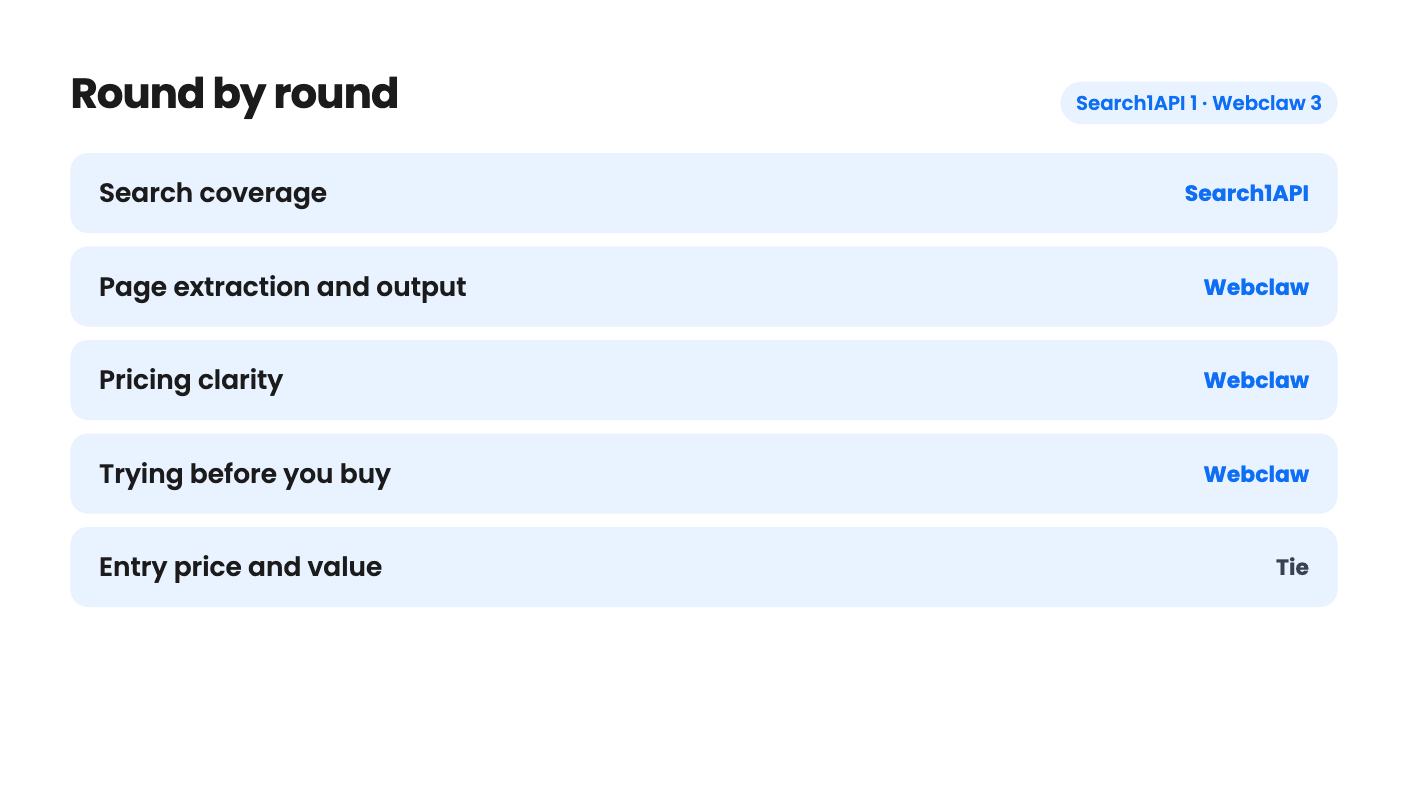
Price and tier limits
Search1API runs four tiers at $49, $98, $147 and $196, against list prices of $80 to $320. You can stack up to four codes and must redeem within 60 days. The credits are one-time, not monthly, and the listing shows 240,000 / 80,000 / 320,000 / 160,000 in a scrambled order with no tier labels. Four even steps of 80,000 would be a natural reading, but the page doesn’t confirm it.
The bigger gap is what happens after the credits run out. The listing doesn’t say whether you can top up or what a credit costs at regular prices. At $49 that’s a small risk. At $196 it matters.
Webclaw’s tiers are $59, $149, $259 and $399, against list prices of $299 to $1,199. Every tier mixes monthly credits (5,000 to 125,000) with a one-time pool (25,000 to 600,000), plus caps on research runs, sources and concurrency. The columns appear to rise with price, though the research-run figures of 60 / 8 / 15 / 30 don’t follow that pattern, so confirm your tier’s limits first. You can also switch between tiers, and there’s no code stacking.
Two more warnings on Webclaw. The review text quotes slightly different prices for tiers 2 to 4 than the plan list, so check the checkout page. And the listing says the deal ends on 2026-10-28, which has already passed as we write this. It may still be live, or it may not be.
On billing, Webclaw is clearer. It says one credit per page, with rendering, anti-bot solving and AI extraction included and no surcharges. Search1API only spells out DeepSearch: 1 credit for the query plus 1 per successfully crawled page. Failed requests shouldn’t deduct credits, which is a good policy.
Risk, trials and track record
Webclaw is easier to test. The open-source core is AGPL-3.0, free to self-host with no limits and no card. You can run it against your own target sites, measure your volume, and only then decide on a tier. For a buyer who’s unsure, that’s the strongest point in either listing.
Search1API offers no free tier in what we can see. Its refund wording is also muddled. The FAQ says purchases are non-refundable, talks about cancelling a subscription, then says you can email for a refund if the service doesn’t match its description. Check AppSumo’s own terms before relying on any of it.
Track record is thin on both sides. Search1API shows one review at 5.00. Webclaw shows five at 4.80. Neither sample tells you much about reliability over a year, and we haven’t tested either tool hands-on.
Which one to buy
Pick Search1API if your agents search first and read second. The 17 engines, the developer and community sources and the Chinese platforms are the real draw, and $49 is a modest bet if you treat the credits as a prepaid balance. Run a real workload inside the 60-day window and confirm your tier’s credit count with support before you spend more than the entry price.
Pick Webclaw if you mostly need clean page content, site mapping or token-efficient input for an LLM. The monthly credits suit steady use better than a single fixed balance, and the free self-hosted version lets you check JavaScript-heavy targets before paying. The catch is the price, since the top tier costs twice as much as Search1API’s, and the deal date needs checking.
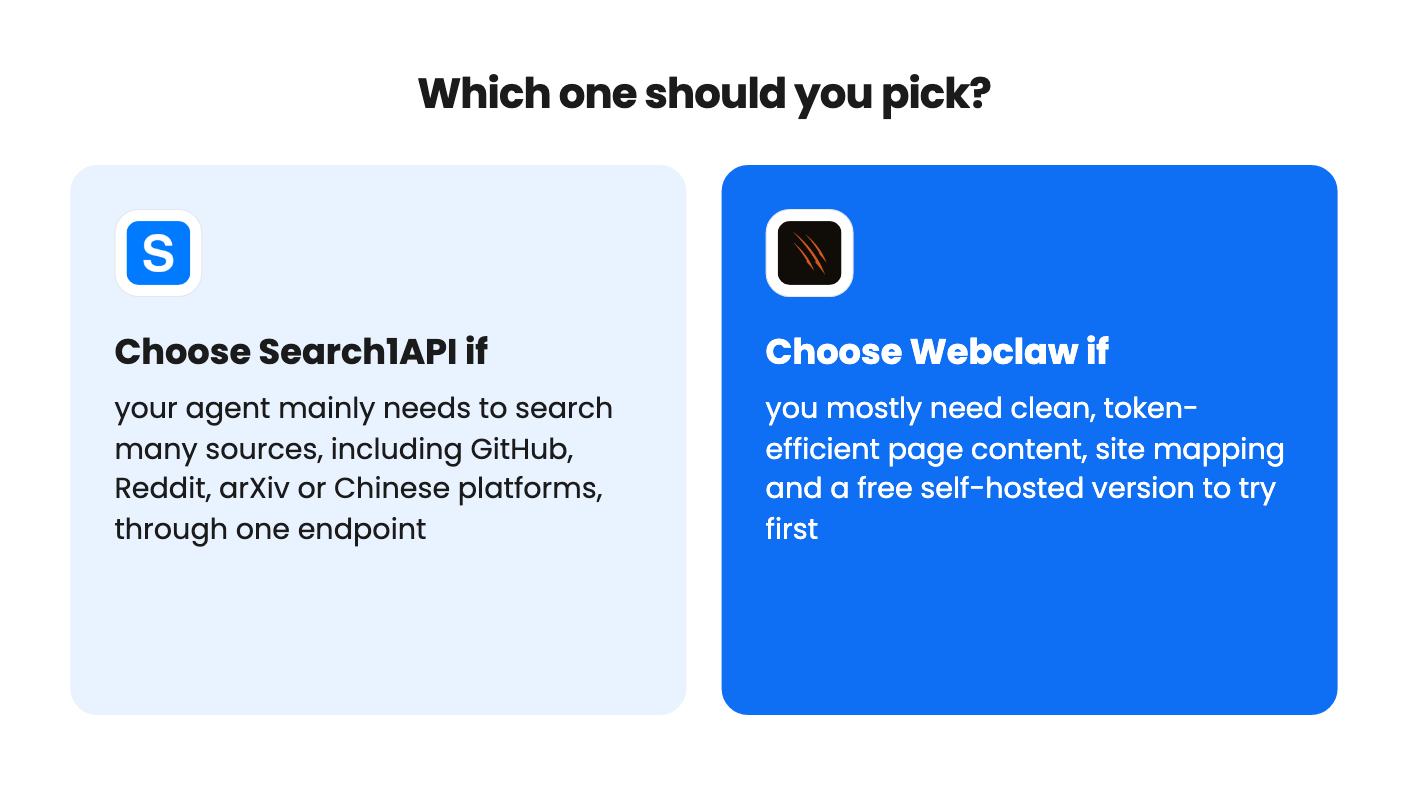
If you honestly need both, start with Webclaw’s free core to see whether its search results cover you. Add Search1API’s $49 tier only if you find yourself wanting GitHub, arXiv, Reddit or the Chinese engines.
How this comparison was made: researched from both tools' official listings and demo videos, and written with help from AI. We have not tested Search1API or Webclaw hands-on yet. Prices and deal terms change, so check AppSumo before you buy. See our affiliate disclosure.