Say you need web data every week. Maybe it’s supplier prices behind a login, or competitor pages you want an AI assistant to read and summarise. Both Notte and Webclaw sit in AppSumo’s web scraping category, and both name Browse AI as an alternative. But they solve different versions of that problem, and picking the wrong one will cost you a weekend.
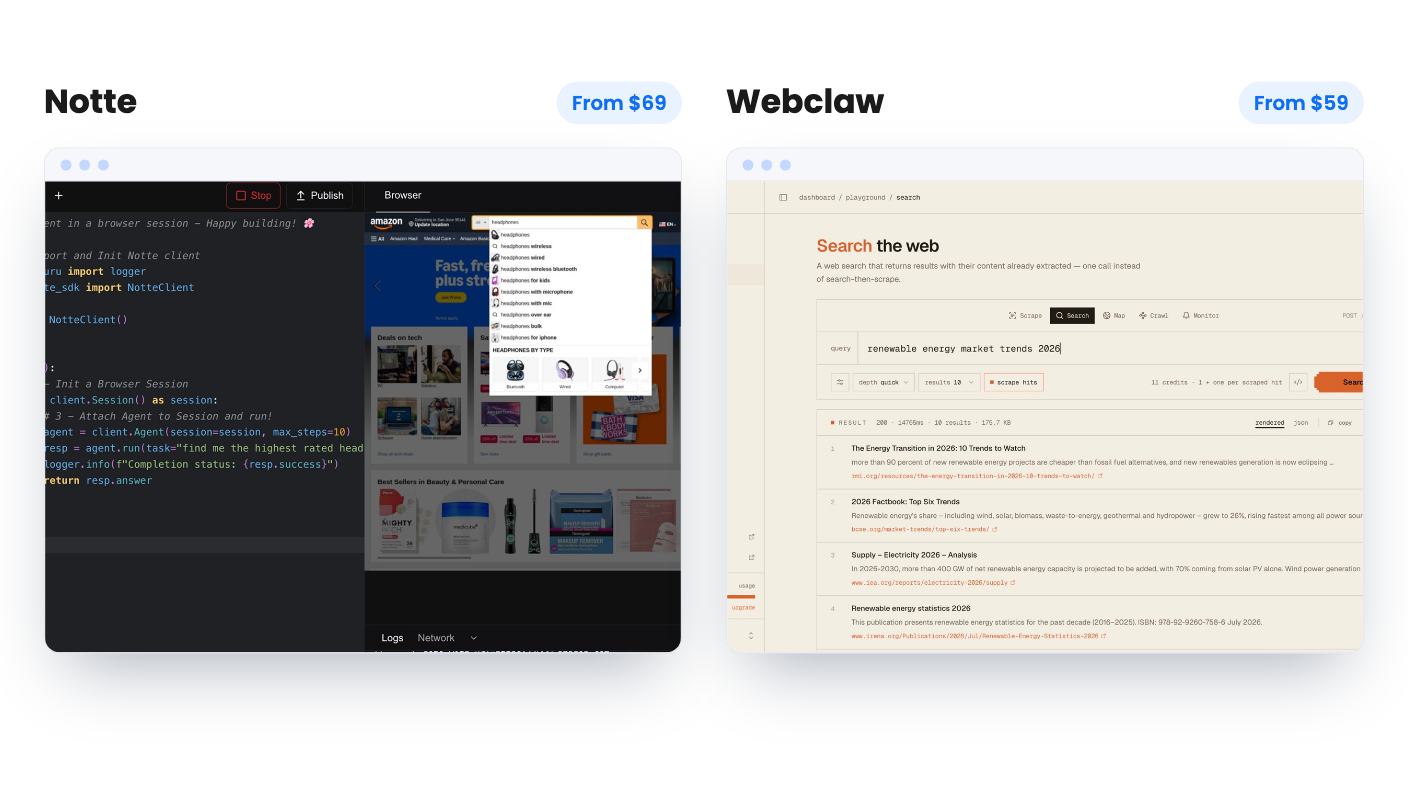
The short version is that Notte automates what a person does in a browser, and Webclaw turns pages into clean text for software. Here’s how that plays out.
Two different jobs
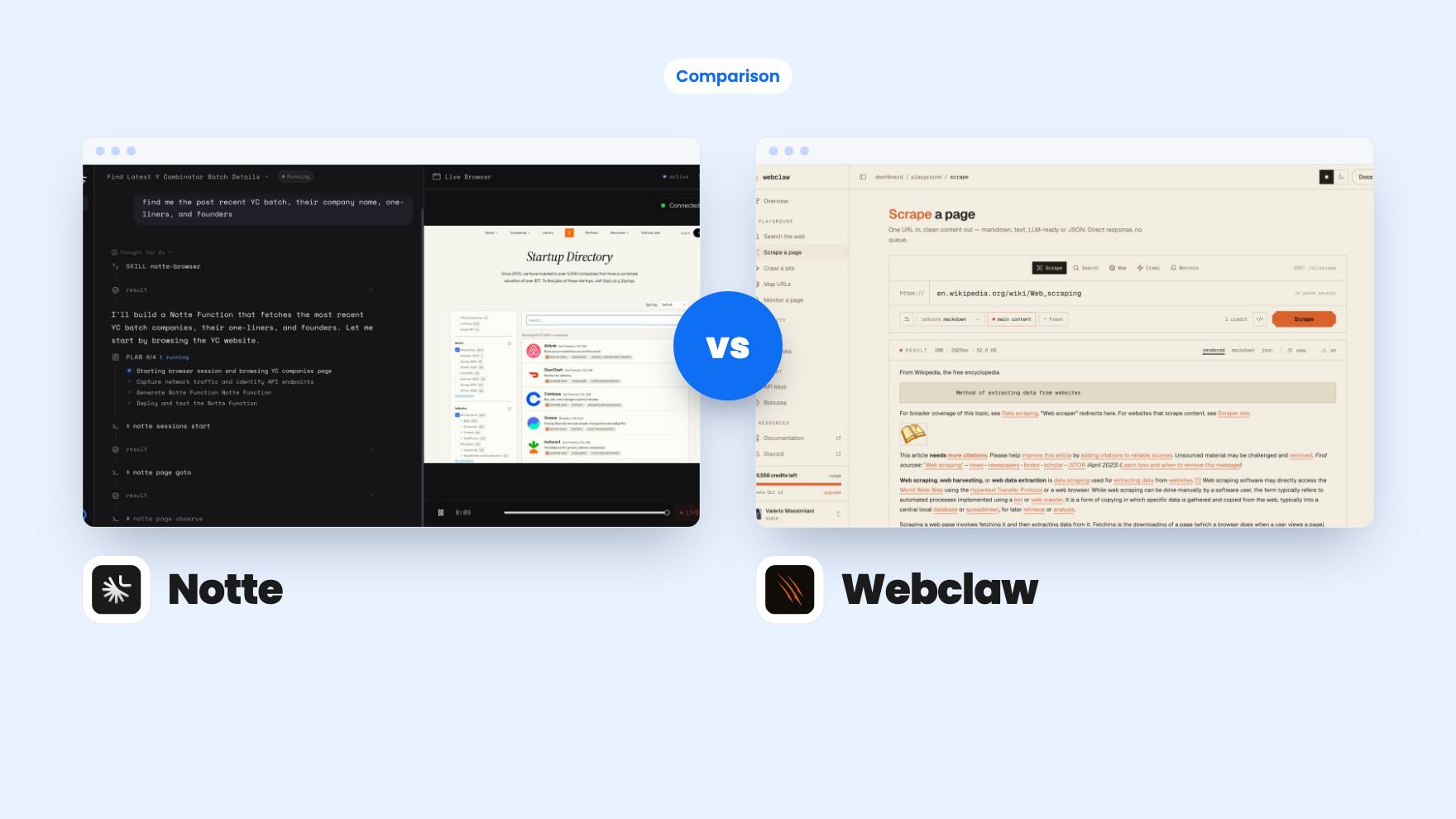
Notte’s pitch is that you describe a browser task in plain language and its Anything API builds the workflow and deploys it as a function. You can run that function serverless, put it on a cron schedule, or call it through the API from anywhere. The listing also says later runs can skip the browser entirely, though it doesn’t explain how or which tasks qualify.
Webclaw works the other way around. You give it a URL through the cloud API, the CLI or an MCP client. It fetches the page over HTTP, strips out navigation and cookie banners, and hands back the content in the format you pick. There’s no clicking through screens involved.
So ask yourself which sentence sounds like your week. “I need something to log in and do a sequence of steps” points to Notte. “I need the text of a lot of pages, fast” points to Webclaw.
What Notte is good at
The interesting part of Notte is how much of it deals with things going wrong. Hybrid workflows mix fixed scripting with AI reasoning, and there’s adaptive fallback logic for when a page changes. Session Profiles keep logins alive between runs. Credentials go into encrypted vaults, and personas come with real emails and phone numbers meant for automated two-factor codes.
The console is the feature I’d weigh most. It shows sessions, steps and logs, and it can replay Chrome DevTools Protocol events so you can see why a run failed. Any automation tool looks fine on a good day. Being able to find out why Tuesday’s run broke is what you’re really paying for.
There’s also a record-once option. You record a workflow and Notte converts it into a script you can export and deploy as an endpoint. That’s the gentlest way in, but the listing’s only concrete usage example is Python code, so expect to be writing some.
The gaps matter too. The listing doesn’t say how many 2FA personas you get or which services they work with. Stealth and anti-bot handling are claimed without detail. CAPTCHA solving is described as working with the Firefox browser type, yet the code sample beside it uses Chromium with CAPTCHA solving on. It’s a small thing, but it suggests the documentation is still being tidied.
What Webclaw is good at
Webclaw is built around speed and token savings. It offers six output formats: markdown, JSON, HTML, plain text, raw HTML and an LLM-optimised mode. The listing says that last one cuts token count by around 90% compared with raw HTML, and that most pages come back in well under 200ms because it uses HTTP with TLS fingerprint impersonation instead of a headless browser.
The MCP server exposes 14 tools, including scrape, search, crawl, map, batch, extract, summarize, diff, brand and research. Claude, Cursor and Codex are named as compatible clients. The listing also describes a /v2 compatibility layer for people switching from Firecrawl without rewriting code.
The map-then-crawl pattern is sensible. Map discovers URLs from sitemaps without extracting anything, so you can filter with glob patterns and scrape the 200 pages you want instead of the 5,000 you don’t.
One point in the listing contradicts itself. The feature copy says one credit per page includes JavaScript rendering and anti-bot solving. Yet the FAQ stresses that no headless browser is used, which usually means trouble with pages that build their content client-side. Test your own target sites on the free self-hosted version before you trust either claim.
Price and tier limits
Both deals are lifetime, both ask you to activate within 60 days, and neither allows code stacking. After that they diverge.
|
Notte |
Webclaw |
| Entry price |
$69 |
$59 |
| Mid tiers |
$159 |
$149, $259 |
| Top tier |
$379 |
$399 |
| Number of tiers |
3 |
4 |
| Monthly allowance |
100 browser hours on every tier |
5,000 to 125,000 credits |
| Concurrency |
25 / 50 / 100 |
10 / 25 / 50 / 100 |
Notte’s monthly allowance is 100 browser hours at every tier. The 8,000 and 24,000 hour figures at tiers 2 and 3 are one-time bonuses, and AppSumo’s own summary blurs that. Tiers 2 and 3 also include $100 and $300 in Anything API LLM credits, while tier 1 includes none. All tiers let you bring your own LLM key and proxy, so your real running cost will be higher than the sticker price.
Webclaw’s limits are in credits. Its plan list shows monthly credits of 5,000 / 9,000 / 40,000 / 125,000 and one-time credits of 25,000 / 150,000 / 300,000 / 600,000. The columns aren’t labelled by tier, so they appear to run from tier 1 upward, and you should confirm that on the page. The research runs figures (60 / 8 / 15 / 30) don’t follow any pattern, which is another reason to check. The listing doesn’t say what each action costs in credits beyond one credit per page, so heavy crawling is hard to budget.
Track record and deal timing
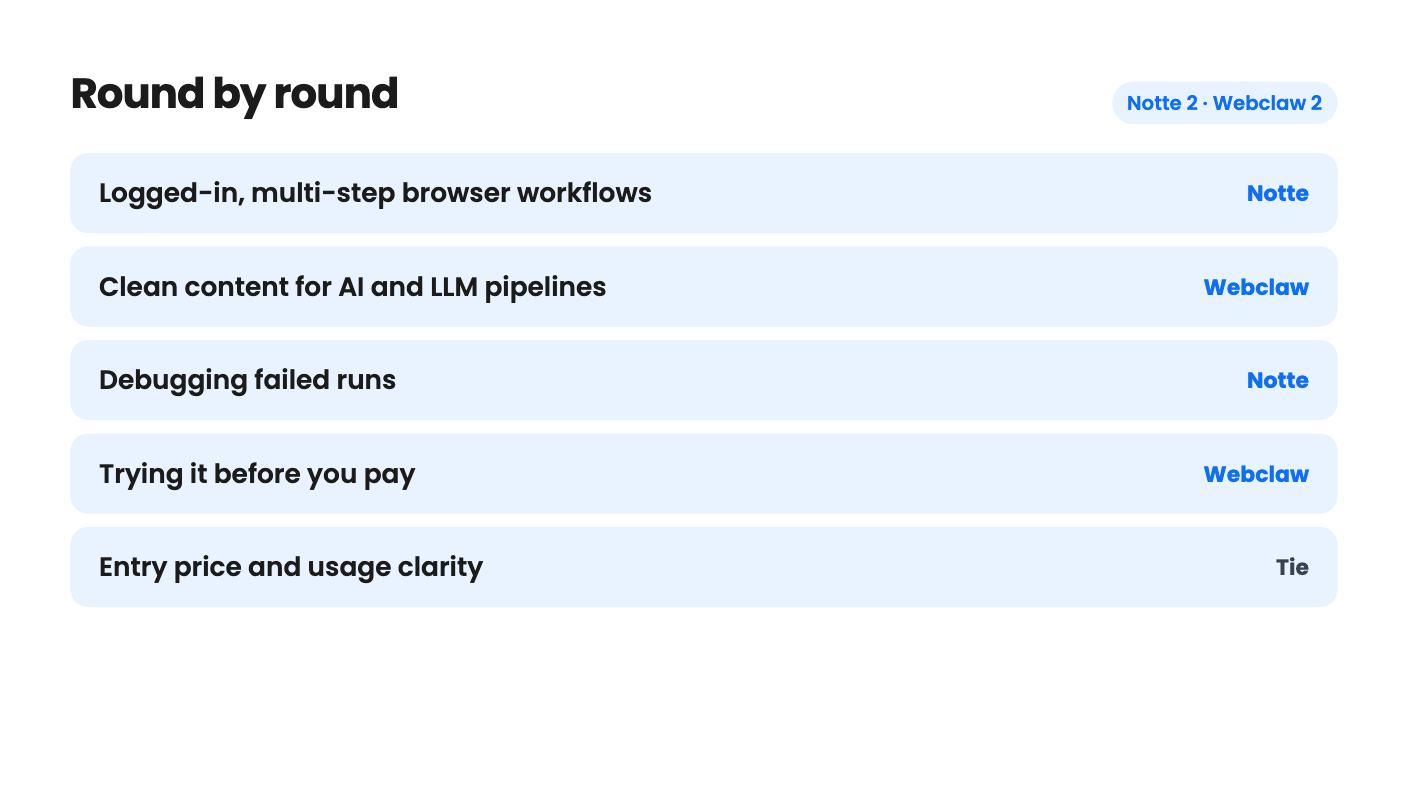
Notte has 26 AppSumo reviews averaging 3.85 out of 5, and the platform’s own summary admits some buyers hit a steep learning curve. Webclaw has 4.80 from only five reviews. Five is too few to read much into, so I wouldn’t treat the higher number as proof of anything.
Neither listing gives company history, uptime figures or a roadmap. With a lifetime deal on a developer tool, you’re betting the company stays around. That’s true of both.
Timing is a practical issue. Notte’s deal ends on November 5, 2026. Our notes put Webclaw’s end date at October 28, which has already passed, and the collected listing data shows no end date at all. Check whether Webclaw’s deal is still open before you plan around it.
Which one to buy
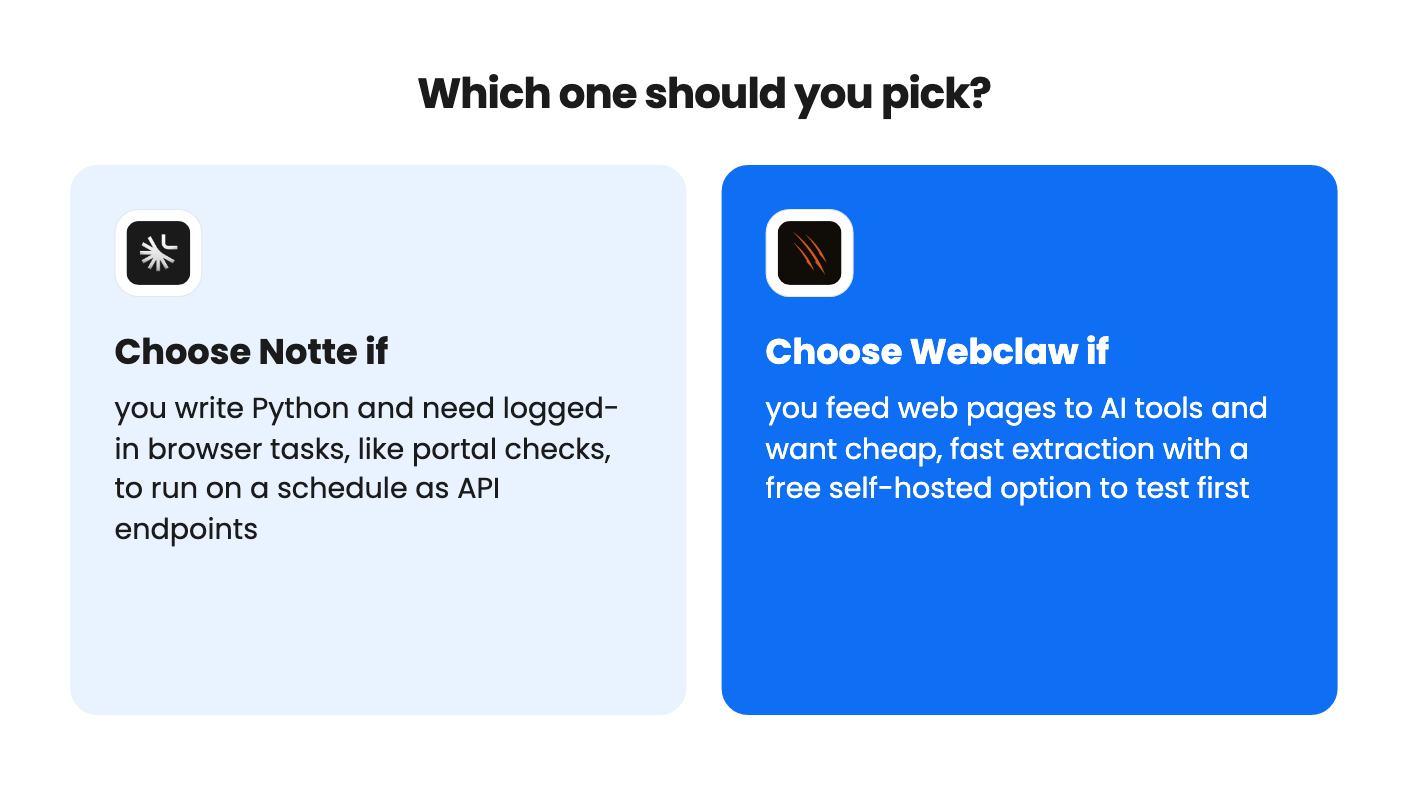
Pick Notte if your work involves logging in, clicking through portals and running the same steps on a schedule, and you or someone you hire writes Python. Tier 1 at $69 is a fair way to find out, as long as you budget for your own LLM key. Skip the higher tiers unless you already know you need lots of parallel sessions.
Pick Webclaw if the end goal is clean page content for an AI assistant or pipeline, and you like the idea of testing the free open-source version first. Start at the lowest tier, and only move up once your own volume tells you the credits are too tight.
If you can’t write code and don’t have anyone who can, neither of these is the right buy, and a no-code scraper will serve you better.
How this comparison was made: researched from both tools' official listings and demo videos, and written with help from AI. We have not tested Notte or Webclaw hands-on yet. Prices and deal terms change, so check AppSumo before you buy. See our affiliate disclosure.