SEO ToolsAlternatives
Linktree Alternatives on Lifetime Deal: 5 Tools Compared
Five AppSumo lifetime deals named as Linktree alternatives, from $19 to $59 entry prices. See who each suits and what the listings leave out.
Fluxion Analytics makes GA4 easier to read. SourceXray ties form enquiries to the ad or keyword behind them. Here's which lifetime deal fits.
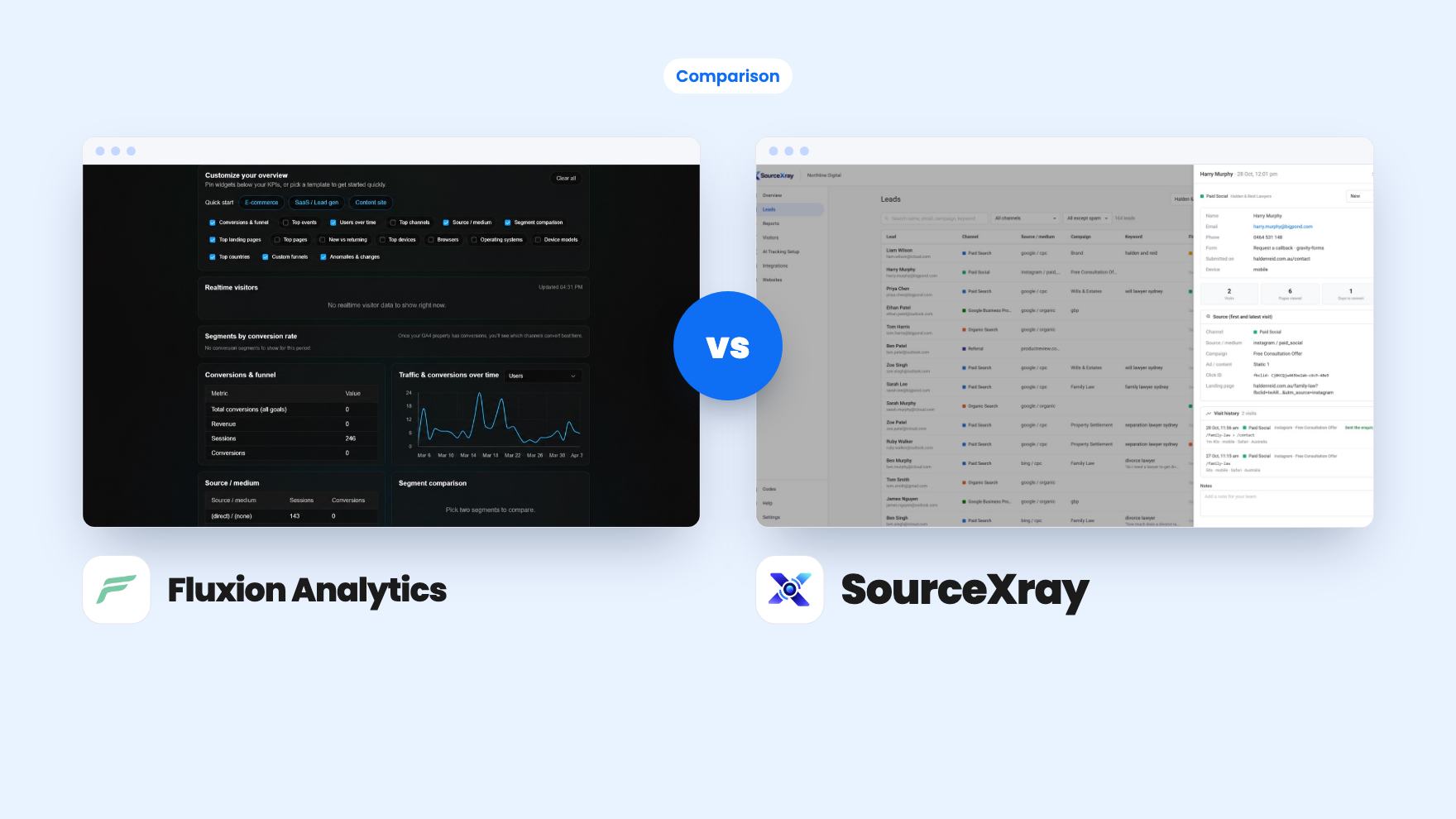
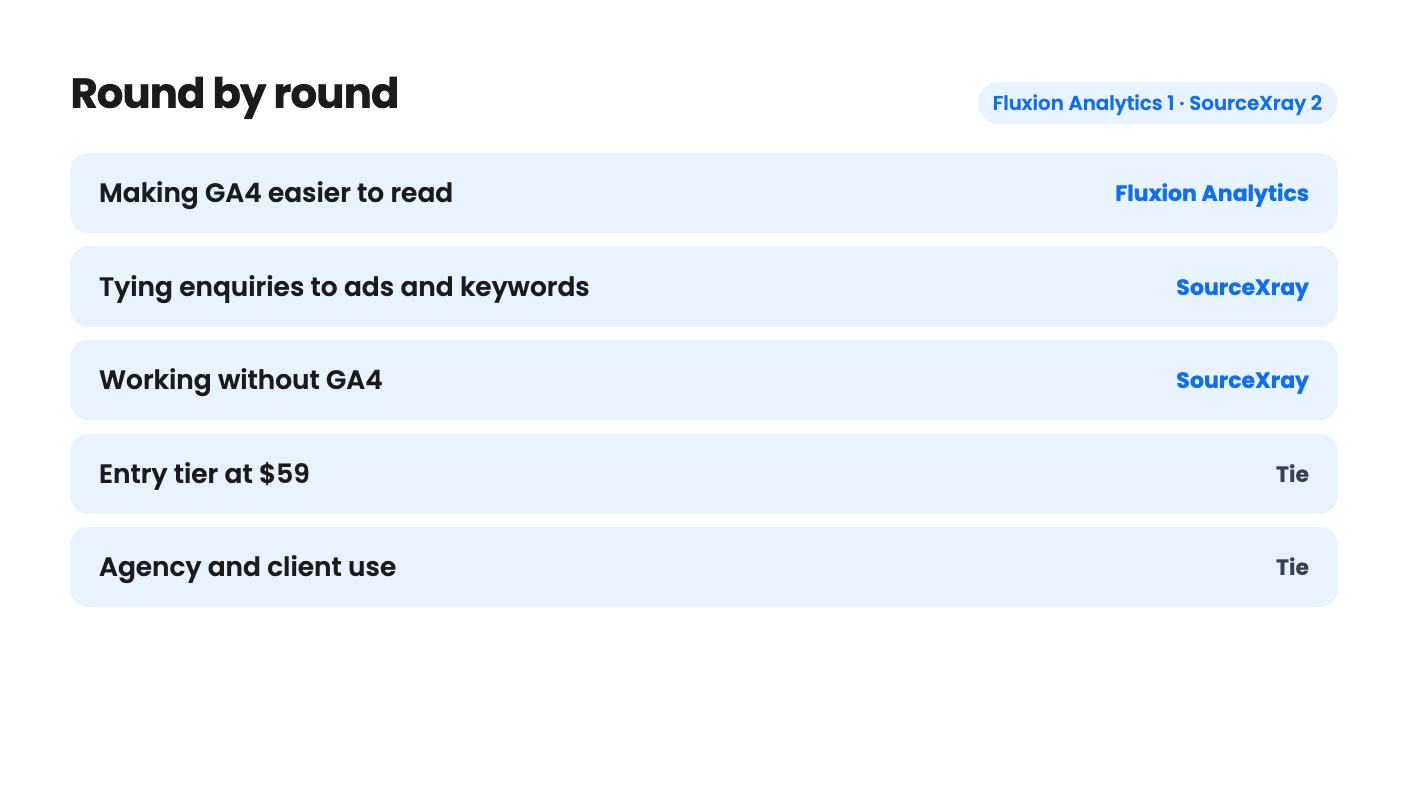
Fluxion Analytics takes 1 round, SourceXray takes 2.
| Round | Winner | Why |
|---|---|---|
| Making GA4 easier to read | Fluxion Analytics | Fluxion sits on top of GA4 with click-to-filter dashboards and multi-property switching, while SourceXray doesn't try to improve GA4's interface. |
| Tying enquiries to ads and keywords | SourceXray | SourceXray tags each form enquiry with its source and shows the exact Google Ads and Microsoft Ads keyword, and Fluxion's listing has no lead tracking. |
| Working without GA4 | SourceXray | SourceXray's FAQ says you don't need Google Analytics, whereas Fluxion only reads GA4 data and does nothing without it. |
| Entry tier at $59 | Tie | Fluxion's cheapest tier appears to mean one seat and no AI, and SourceXray's means 1,000 leads, 10,000 page views and 5 AI messages a month. |
| Agency and client use | Tie | Fluxion has seats and per-property permissions but no listed scheduled or branded reports, and SourceXray has unlimited sites on a shared lead and page view pool. |
| Clarity of the listing | Tie | Fluxion's AI window has no stated plan after it ends and SourceXray's tier table is ordered confusingly, so both need checking at checkout. |
| Fluxion Analytics | SourceXray | |
|---|---|---|
| Starts at | $59 | $59 |
| List price | $360 | $348 |
| Plan | Lifetime Deal | Lifetime Deal |
| Deal ends | Not listed | Not listed |
| Best for | Marketers, Small businesses, Web designers | Marketers, Marketing agencies, Small businesses |
| Alternative to | Google Analytics | Google Analytics, WhatConverts |
You pay for Google Ads, a handful of people fill in your contact form, and then someone asks which campaign brought them in. Or you’re a freelancer who dreads opening GA4 just to see which page converts. Both of you might browse the same analytics category on AppSumo and spot a $59 lifetime deal. You’d be buying very different things.
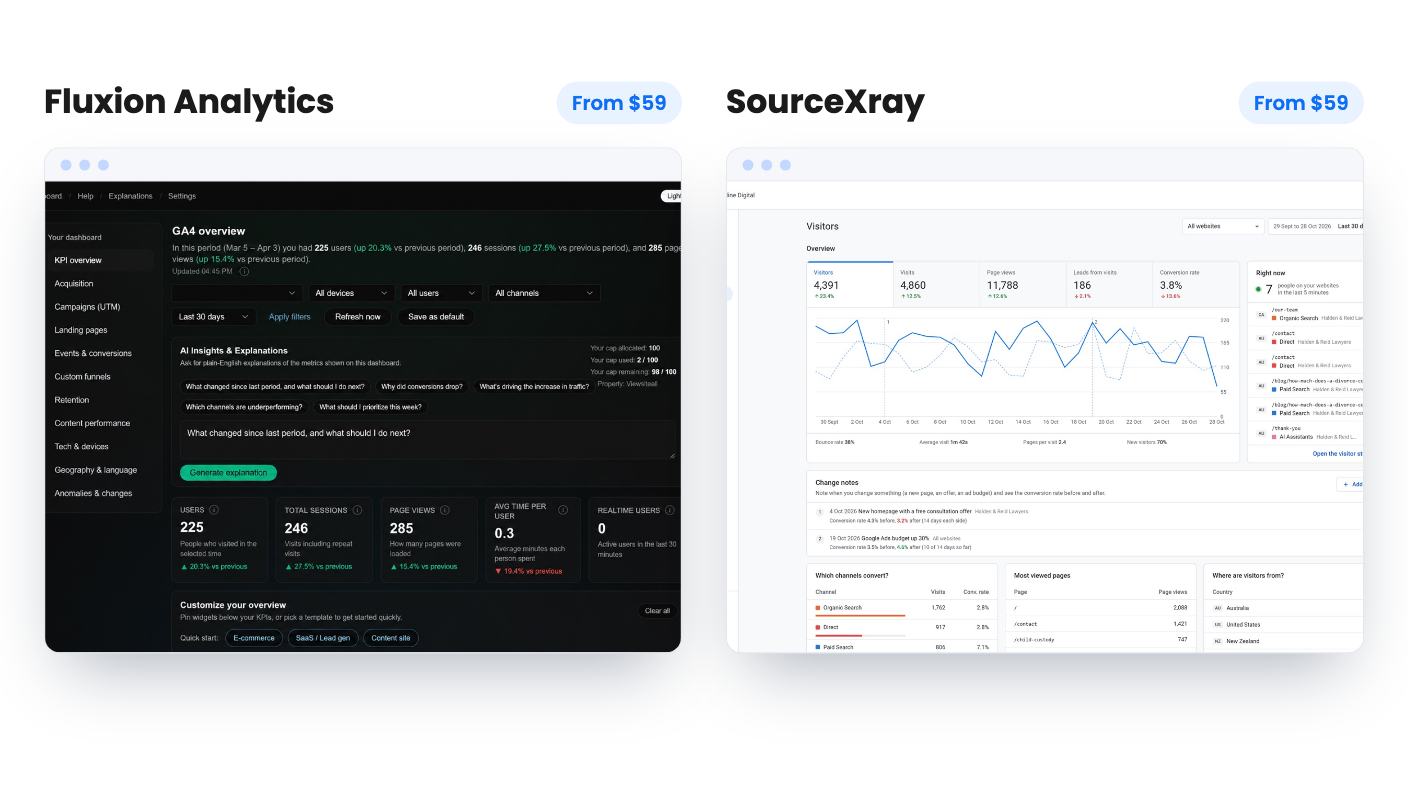
That’s the first thing to settle. Fluxion Analytics and SourceXray both list Google Analytics as the product they’re an alternative to, but they answer different questions. We haven’t used either one, so everything here comes from the listings.
Fluxion connects to your existing GA4 properties through Google OAuth. You change no tags, you don’t need BigQuery, and your data stays in Google. It reads the numbers and shows them in dashboards you can click through by campaign, channel, page and segment. Add AI summaries that explain spikes and drops, and that’s the pitch.
SourceXray starts somewhere else. You add one line of code, and every form enquiry gets tagged with the ad, keyword, campaign or website that brought it in. The listing says it also records how the person first found you, even weeks earlier, plus the visits in between.
So Fluxion improves how you look at traffic you already measure. SourceXray measures something GA4 usually doesn’t connect for you: the enquiry itself, and where it came from.
That difference should decide most of this.
Fluxion’s most unusual feature is bot and AI crawler detection. You paste a Cloudflare API token into Settings, and it syncs daily, listing crawlers such as GPTBot, ClaudeBot and Googlebot by name, company and category. It only works if your site runs through Cloudflare. There’s also an AI chat that answers questions from your dashboard data. The listing has no demo video or example answers, so we can’t judge how good those answers are.
On reporting, Fluxion promises export-ready views you can screenshot. It says nothing about scheduled emails, PDFs or white-labelling. If you need a branded monthly report to arrive on its own, the listing doesn’t promise it.
SourceXray’s strongest feature, in our view, is marking leads as qualified or won. A campaign that brings 50 enquiries from people who never buy is worse than one that brings 8 who do, and without outcome marking you only see volume. It also shows the exact Google Ads and Microsoft Ads keyword behind paid leads, gives ChatGPT and other AI tools their own channel, and adds a live visitor stream, funnels, and call, email and WhatsApp click tracking.
The form compatibility list is long: Gravity Forms, Elementor, Contact Form 7, WPForms, Webflow, Shopify contact forms, HubSpot forms, Typeform and more. Leads can go to email, Slack, Teams, Google Chat or Discord, and back to Google Ads and Meta as conversions.
There’s also an AI setup assistant that builds Tag Manager tags and GA4 key events from a plain-English request. Nothing goes live until you approve it, and any change can be undone in one click. That’s a careful design. The catch is a small monthly message cap.
Fluxion has three tiers: $59 (listed at $360), $129 (listed at $960) and $249 (listed at $2,760). The plan table shows “10 seats / 3 seats / 1 seat” and AI Insights at “100/mo × 2 yrs / 100/mo × 1 yr / —”, with no column labels. Our reading is that $59 gets one seat and no AI, $129 gets three seats and a year of AI, and $249 gets ten seats and two years. That’s an inference, so check the page before paying.
If we’ve read it right, the $59 tier is a friendlier GA4 view and little more. The AI also comes with a time window, and the listing doesn’t say what happens when it closes. For something sold as a lifetime deal, that’s a gap.
SourceXray has five tiers, from $59 to $295, and you can stack up to 5 codes. Every tier has unlimited websites, but leads and page views are shared across them. On our reading, $59 gets 1,000 leads and 10,000 page views a month with 5 AI messages. At $118 you get 5,000 leads, 25,000 page views and 15 AI messages. At $295 it’s 100,000 leads, 200,000 page views and 80 AI messages. The table is ordered oddly, so confirm the mapping at checkout.
There’s a catch near the bottom. Zapier, Make, webhooks, HubSpot and GoHighLevel need two or more stacked codes. If you want leads flowing into a CRM, your real starting price is $118, not $59. Page views at the entry tier also run out fast. When they do, visitor stats pause until next month, though leads and alerts keep working.
Both deals ask you to activate or redeem within 60 days, and both promise all future plan updates.
Neither listing says how old the company is, how big the team is, or what the roadmap looks like. That’s common with lifetime deals, but it means you’re betting on the company surviving. Starting at a low tier is the sensible hedge for both.
Fluxion carries an extra dependency. It only works with GA4, so a change in Google’s API access would hit it directly. Your data stays safe in Google, which softens the blow, but you shouldn’t build client workflows around Fluxion alone.
SourceXray’s risks are different. The listing talks about enquiries, forms and leads, and never mentions purchase or revenue tracking, so ecommerce stores shouldn’t assume it fits. Lead history lasts 12 months on the entry tier and 24 on the rest. Single visits in the live stream are kept for 90 days, then only daily totals remain. The privacy claims look reasonable on paper: no IP addresses stored, no fingerprinting, and a Data Processing Addendum available.
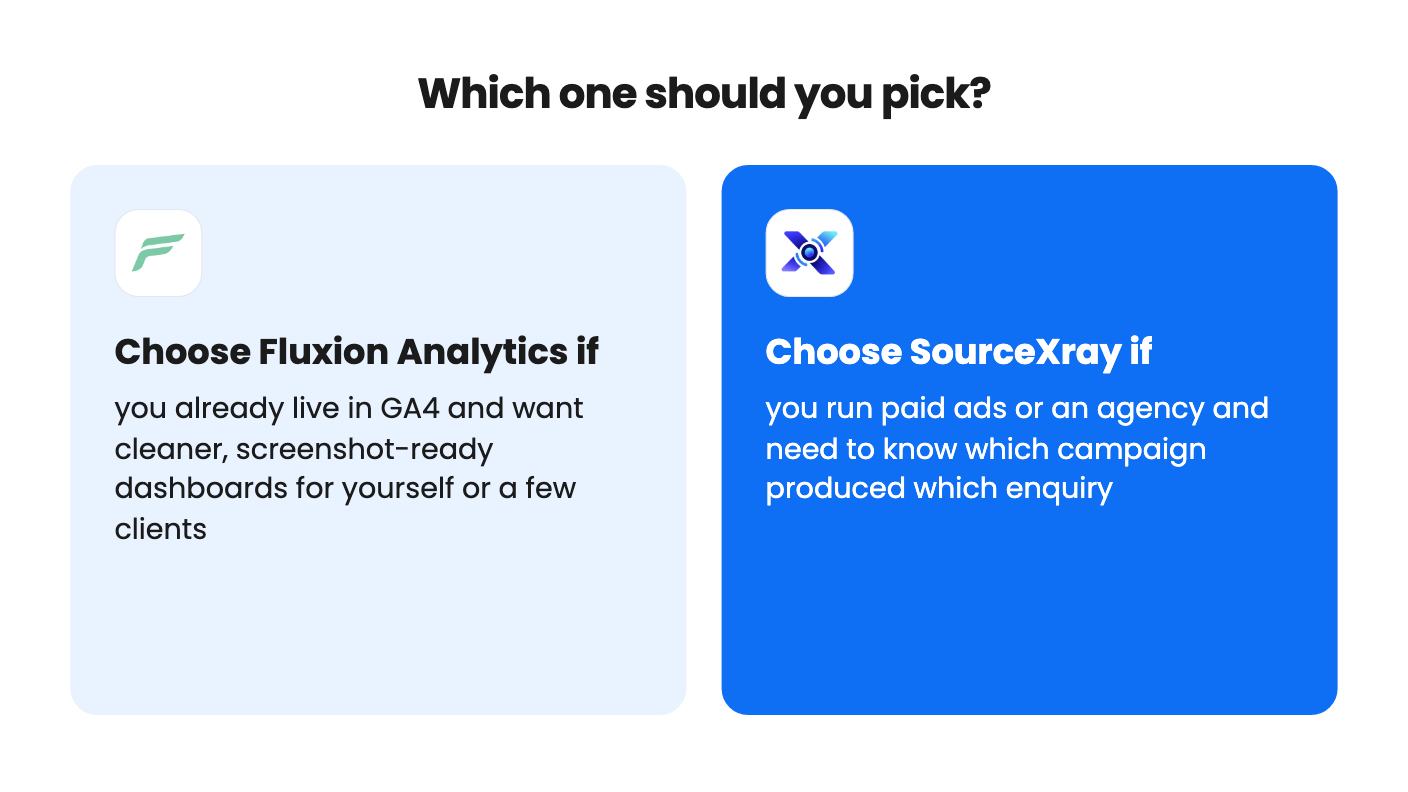
Pick Fluxion if you already use GA4, you find its interface a slog, and you want clean views to screenshot into client updates. The $129 tier looks like the practical choice for a freelancer with a few clients. Skip the $59 tier if the AI is the reason you’re buying.
Pick SourceXray if you spend on ads and can’t say which campaign produced which enquiry. It suits agencies and lead-generation businesses best, and $118 is the realistic starting point if you want a CRM connection.
If you don’t run ads and get a few enquiries a month, neither deal may change much for you. Be honest about how often you’d actually log in before you spend anything.
No. It reads your GA4 data through Google OAuth and changes how it's displayed. Your data stays in Google, and you still use GA4 for deeper technical work.
The listing says no, because SourceXray shows visitors, sources, goals and funnels by itself. If you run ads, it suggests keeping GA4 and can send goals to GA4 and Google Ads.
It depends on the job. Fluxion suits agencies that report on GA4 data for clients. SourceXray suits agencies running paid campaigns who need to prove which source produced each enquiry.
How this comparison was made: researched from both tools' official listings and demo videos, and written with help from AI. We have not tested Fluxion Analytics or SourceXray hands-on yet. Prices and deal terms change, so check AppSumo before you buy. See our affiliate disclosure.
Five AppSumo lifetime deals named as Linktree alternatives, from $19 to $59 entry prices. See who each suits and what the listings leave out.
Six AppSumo lifetime deals pitched as Google Analytics alternatives, grouped by the job you need done, with tier limits and gaps spelled out.
Ten AppSumo lifetime deals named as Ahrefs alternatives, grouped by job: keywords, site fixes, AI search tracking and competitor research. Limits included.