Lead GenerationReview
KingSumo Review: Free Giveaway Tool With a $49 Pro Upgrade
KingSumo runs viral email giveaways. Free tier has unlimited contests, and a one-time $49 Pro adds branding removal, tracking and Mailchimp, Kit and Klaviyo.
NotiQ finds local leads and emails them at scale. Outvid clones you on video for a small batch of prospects. Here is how the lifetime deals compare.
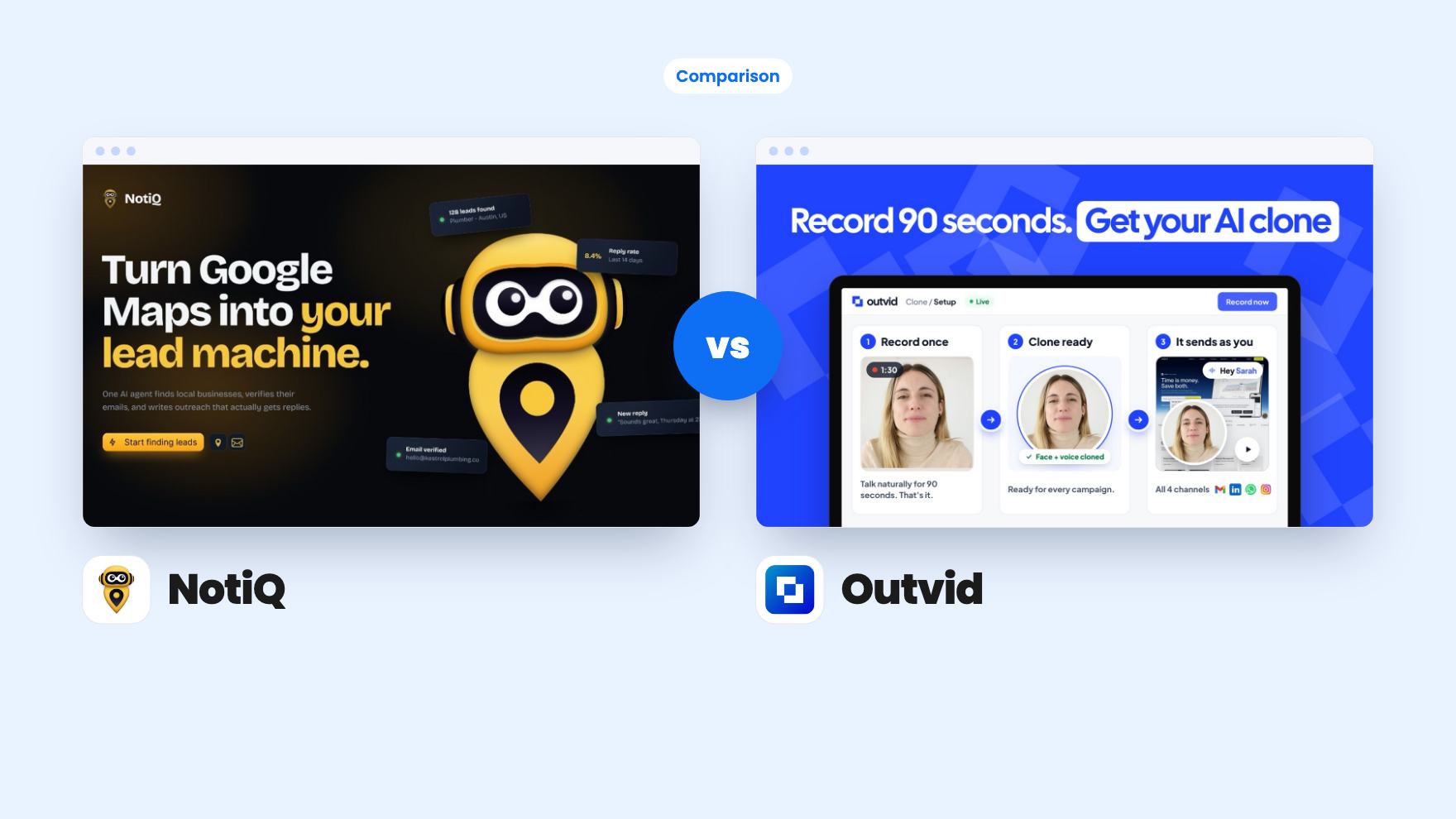
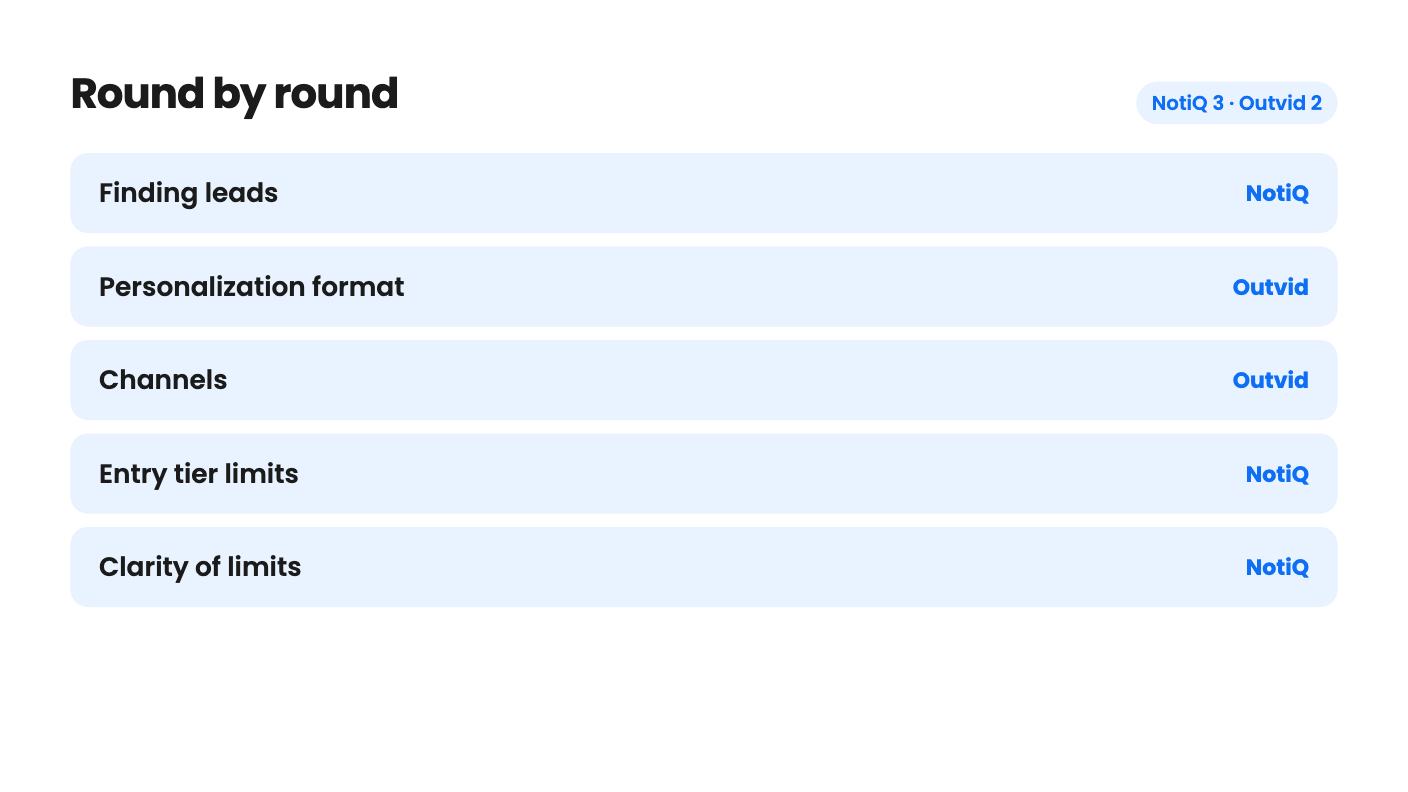
NotiQ takes 3 rounds, Outvid takes 2.
| Round | Winner | Why |
|---|---|---|
| Finding leads | NotiQ | NotiQ searches Google Maps and verifies emails itself, while Outvid's setup FAQ has you import your own prospect list. |
| Personalization format | Outvid | Outvid builds a video of you saying a script written per prospect, and NotiQ's video option is only a RepliQ integration with no detail. |
| Channels | Outvid | Outvid sends on email, LinkedIn, WhatsApp and Instagram from one campaign, while NotiQ's listing centres on email. |
| Entry tier limits | NotiQ | NotiQ's $69 tier states 200 verified emails a month, while Outvid's $99 tier shows a 5 cap on campaigns and contacts that the listing never explains. |
| Clarity of limits | NotiQ | NotiQ states its monthly verified emails per tier, but Outvid never says how many credits one video costs. |
| Agency features | Tie | NotiQ offers white-label from $549, and Outvid offers 25 workspaces and your own domain only at $469, with just 4 sending accounts. |
| NotiQ | Outvid | |
|---|---|---|
| Starts at | $69 | $99 |
| List price | $708 | $1188 |
| Plan | Lifetime Deal | Lifetime Deal |
| Deal ends | Not listed | Not listed |
| Best for | Marketing agencies, Small businesses, Web design agencies | Marketing agencies, Sales managers, Solopreneurs |
| Alternative to | Lemlist, Instantly | HeyGen, Lemlist, Loom |
You have a list problem and a budget problem, and these two tools answer them in opposite ways. NotiQ builds the list for you and sends personalized text emails. Outvid assumes you already have prospects and turns each one into a personal video. That split matters more than any feature table, so decide which problem you actually have before you look at prices.
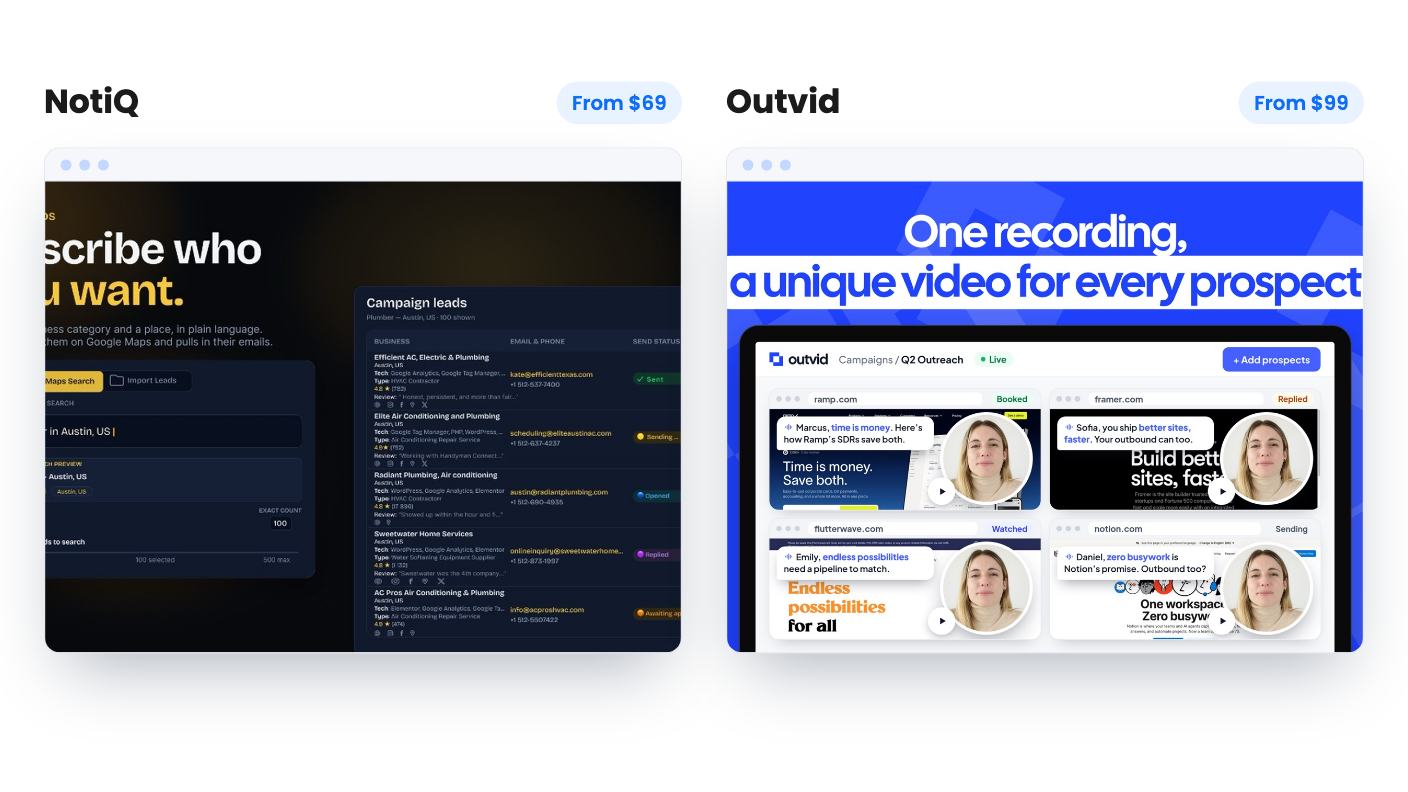
NotiQ is aimed at people who sell to local businesses. You describe a category and a place, it searches Google Maps, and it enriches each lead with a verified email and phone number. It then reads the lead’s reviews, ratings and website, writes a unique email, and runs follow-ups. AI agents can also answer replies.
Outvid starts later in the process. You record about 90 seconds of footage and it clones your face and voice. It researches each prospect’s website, news, hires, launches and tools, then writes a script and delivers a video of you saying it, often played over their own site.
Neither listing shows results. NotiQ’s video pitch has no reply rates or deliverability data, and Outvid’s listing came with no demo video at all. We haven’t used either tool, so everything here is a read of what the listings say.
This is the biggest practical gap. With NotiQ, the list is part of the product. You can filter by website, reviews, ratings and industry, catch bad and disposable addresses before you send, and sort leads with tags. If you’d otherwise pay for a scraper and a separate verifier, that’s real money saved.
The catch is the word local. Google Maps is the engine, so if you sell to funded startups or enterprise teams, NotiQ’s best feature points at the wrong crowd.
Outvid is the reverse. Its setup FAQ says you import a prospect list, so sourcing is your job. In return it doesn’t care where prospects live. Its research looks at websites, news and hires, which suits a B2B seller with a short, hand-picked list.
NotiQ is email-led. The listing mentions Gmail, rotating connected inboxes with sending limits, and a unified inbox. The agent categorises replies, answers questions, handles objections and steers interested leads toward a meeting.
That last part is the piece we’d treat as unproven. Letting software argue with a prospect for you can go wrong in ways a template never does. The video says you can approve messages yourself, so start there.
Outvid sends on email, LinkedIn, WhatsApp and Instagram from one campaign. Sequences branch and follow-ups stop the moment someone replies. You then answer from one inbox with a video or voice note. That’s more human and more work. The listing also doesn’t explain how the social accounts connect, and automating those channels can break platform rules, so read the terms first.
NotiQ has five lifetime tiers. The plan list shows $69, $159, $299, $549 and $999, though other parts of the page show slightly different middle figures, so confirm at checkout. Verified emails per month run like this:
API/MCP access starts at Tier 3, which is what lets you work with ChatGPT and Claude. White-label starts at Tier 4. The sending-account counts are listed as 1 / 3 / 5 / 25 / 10 in no clear order, so we can’t say what each tier gets. Credits refresh monthly, so lifetime access doesn’t mean unlimited use. Tier 1 is closer to a trial than a working plan.
Outvid has four tiers, and we’ve matched the columns to prices assuming the table runs from the largest plan down:
The number that decides everything is missing. The listing never says how many credits one video costs, or whether a voice note costs less. Without it, 50 credits a month could mean 50 videos or a handful.
The $99 tier also shows 5 for active campaigns and contacts where the others say unlimited. The listing doesn’t say what the 5 counts. If it’s contacts, that tier is a demo. The two lower tiers keep “Made with Outvid” branding too, which undercuts the whole idea of a video that feels made for one person. Branding comes off at $249.
Both tools court agencies, and both stop short in different places. NotiQ offers white-label from Tier 4 at $549, plus MCP access from Tier 3. Outvid gives you 25 workspaces and your own domain for video pages, but only at $469, and with 4 sending accounts that won’t stretch far across 25 clients.
The refund position also differs. NotiQ’s listing states a 60-day money-back window and a 60-day activation deadline. Outvid’s listing says nothing about refunds, so check the AppSumo page before you pay. NotiQ’s listed deal end date of 2026-10-29 has also passed, so confirm whether the deal is still live.
Pick NotiQ if you sell web design, local SEO or automation to nearby businesses and want one login for sourcing, verifying and sending. Buy a tier that matches your volume rather than the cheapest one. Then use the refund window properly: activate early, run a small campaign, and judge lead quality and reply handling before the 60 days run out.
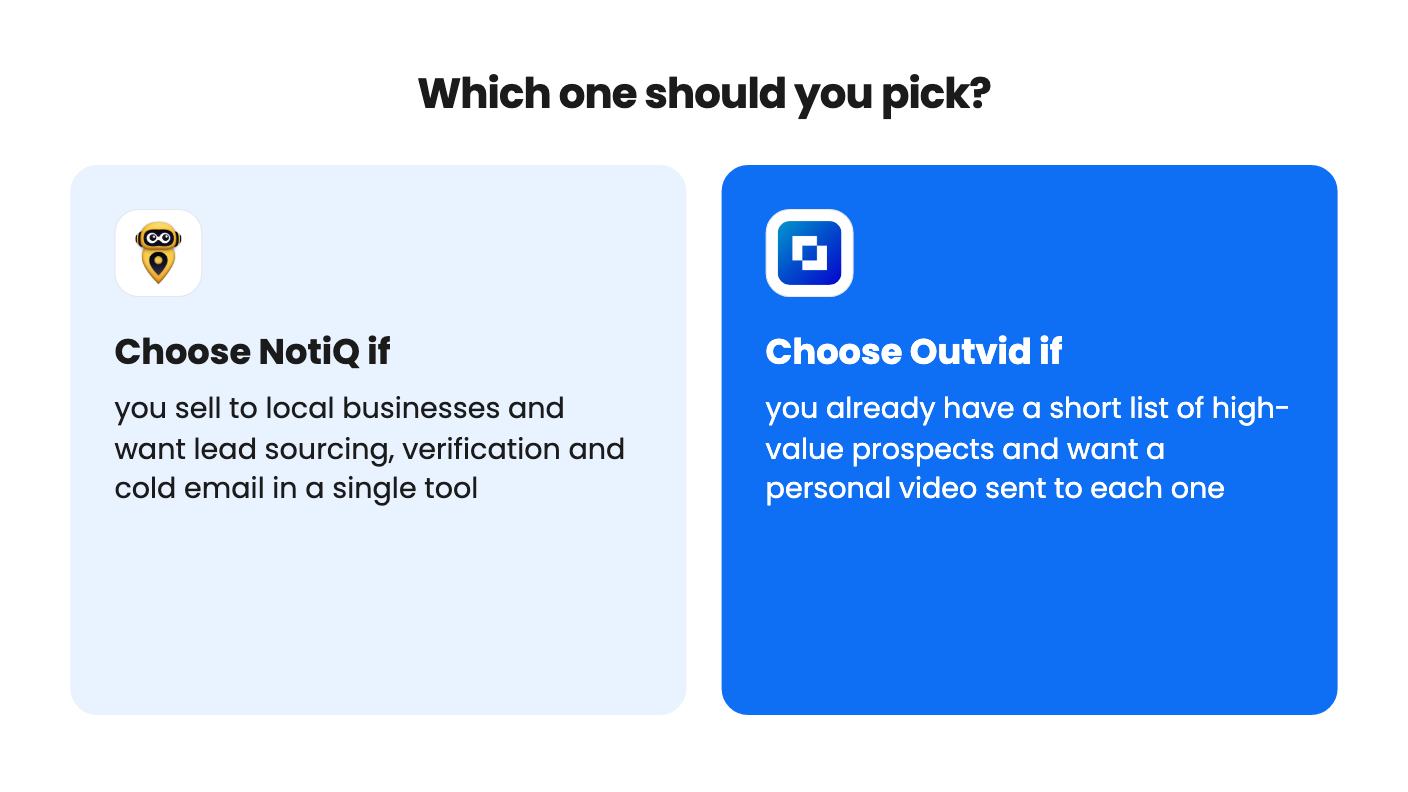
Pick Outvid only if you contact a few dozen high-value prospects a month, already have a list and an offer, and want to stand out in a crowded inbox. Before you spend anything, ask the vendor in the AppSumo Q&A what one video costs in credits. If the answer is one, $169 or $249 looks sensible. If it’s several, the monthly allowance is small enough that you should look elsewhere.
The listing doesn't say it does. Its setup FAQ describes importing a prospect list, so you'd need another source. NotiQ finds local businesses on Google Maps and verifies their emails.
NotiQ starts at $69 and Outvid at $99. The NotiQ tier gives 200 verified emails a month. The Outvid tier gives 50 monthly credits, and the listing doesn't say what one video costs.
NotiQ can, through an MCP connector on Tier 3 and above. Outvid's listing doesn't mention ChatGPT or Claude. Its listed integrations are Gmail, GoHighLevel, Google Calendar, LinkedIn and WhatsApp.
How this comparison was made: researched from both tools' official listings and demo videos, and written with help from AI. We have not tested NotiQ or Outvid hands-on yet. Prices and deal terms change, so check AppSumo before you buy. See our affiliate disclosure.
KingSumo runs viral email giveaways. Free tier has unlimited contests, and a one-time $49 Pro adds branding removal, tracking and Mailchimp, Kit and Klaviyo.
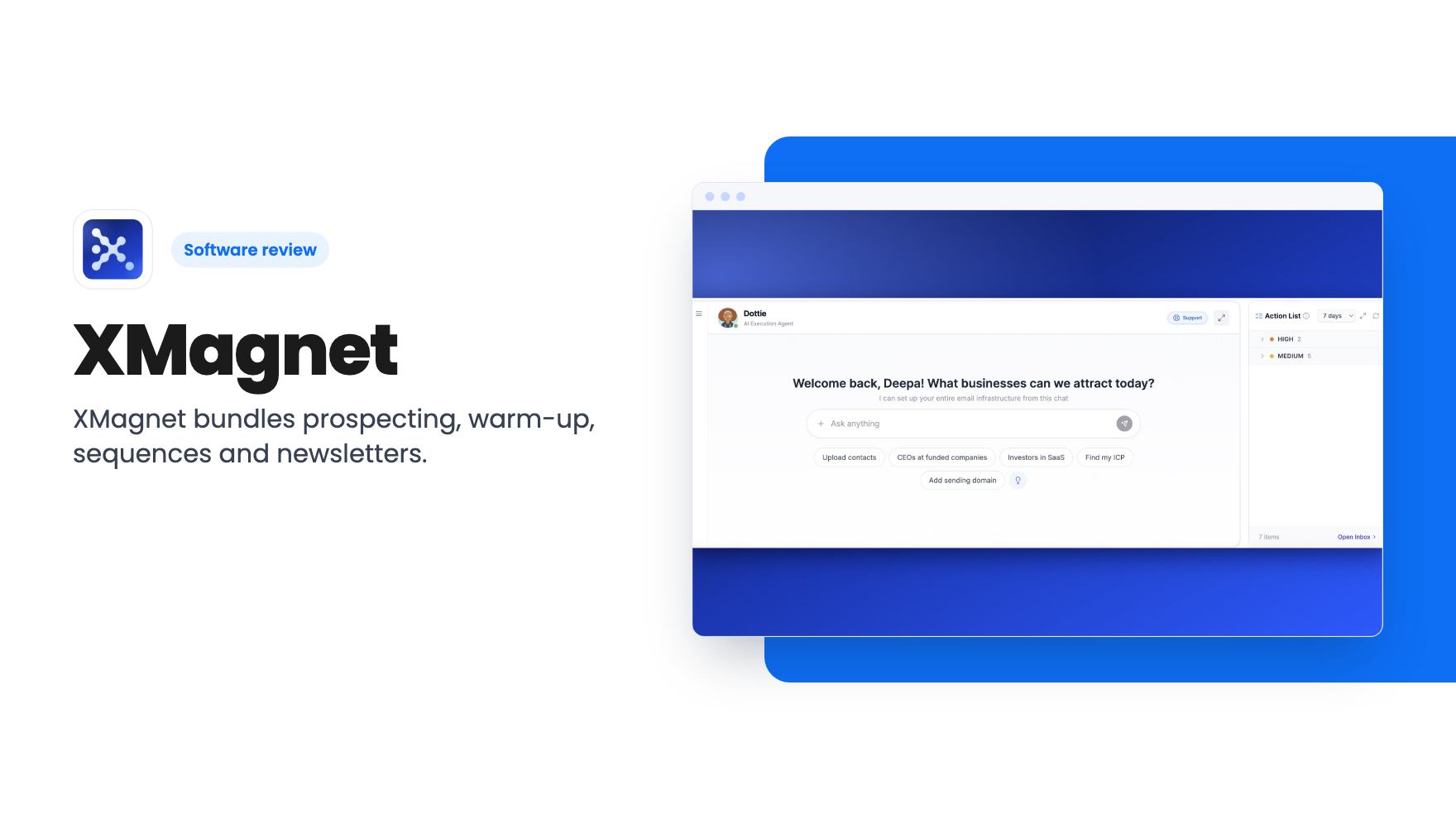
XMagnet bundles prospecting, warm-up, sequences and newsletters. The $59 to $539 AppSumo deal has one-time credits and mailbox caps worth checking first.
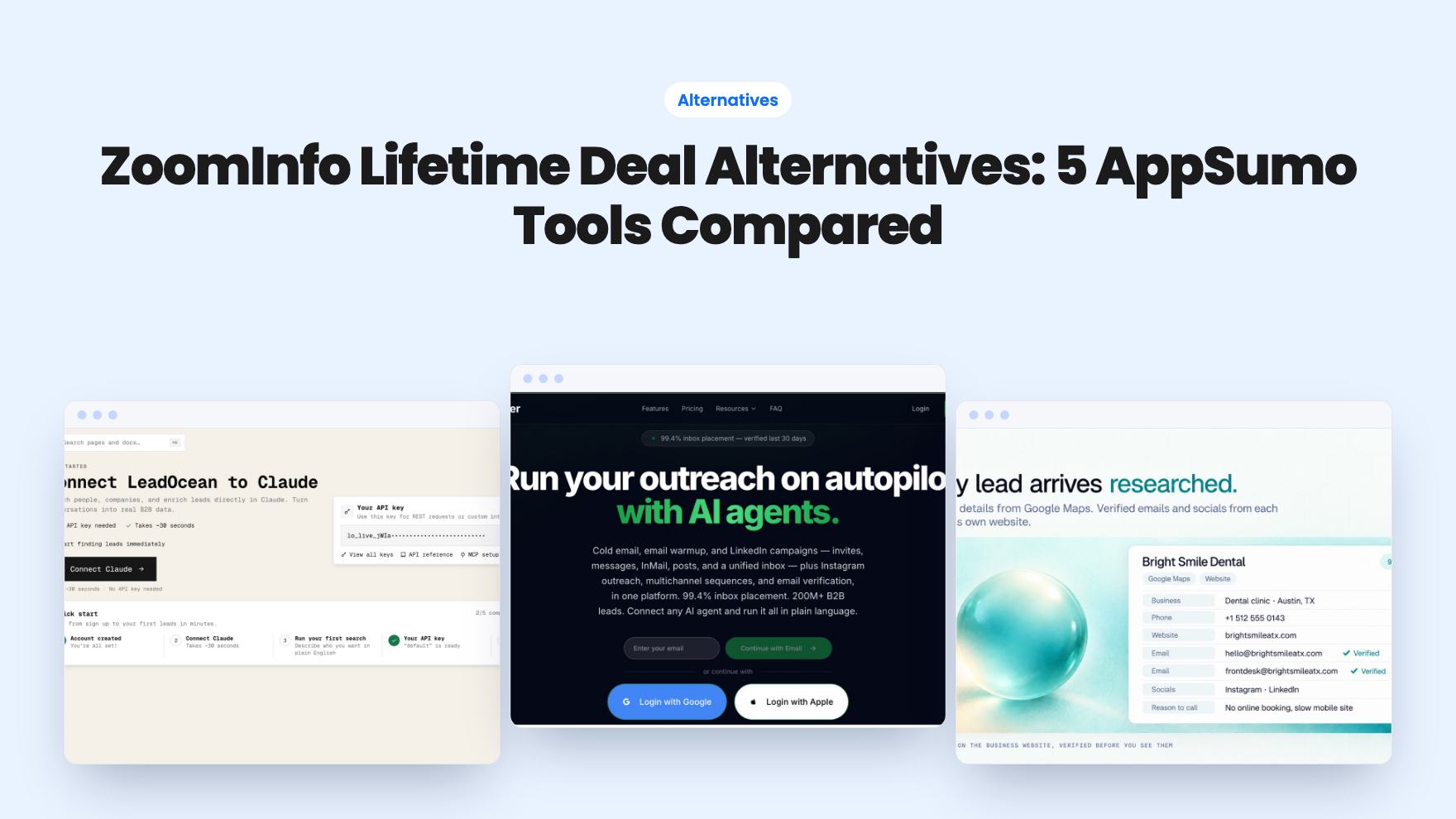
Five AppSumo lifetime deals that cover parts of what ZoomInfo does, from contact data to cold email and local prospecting, and who each suits.