SEO ToolsAlternatives
Linktree Alternatives on Lifetime Deal: 5 Tools Compared
Five AppSumo lifetime deals named as Linktree alternatives, from $19 to $59 entry prices. See who each suits and what the listings leave out.
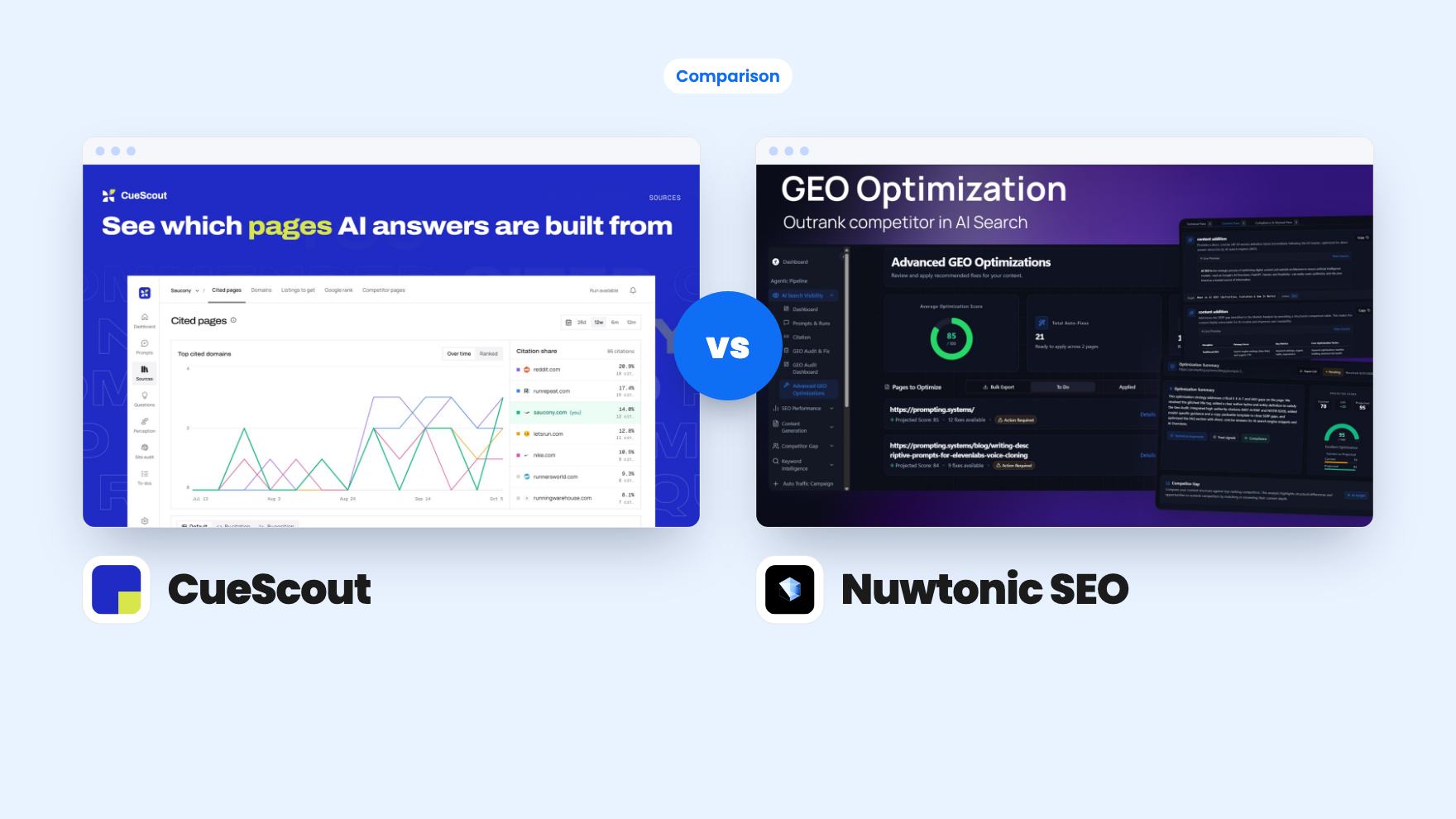
CueScout is a $59 weekly AI visibility tracker with a re-checked to-do list. Nuwtonic SEO is a $69 wider SEO and content platform with a 60-day refund.
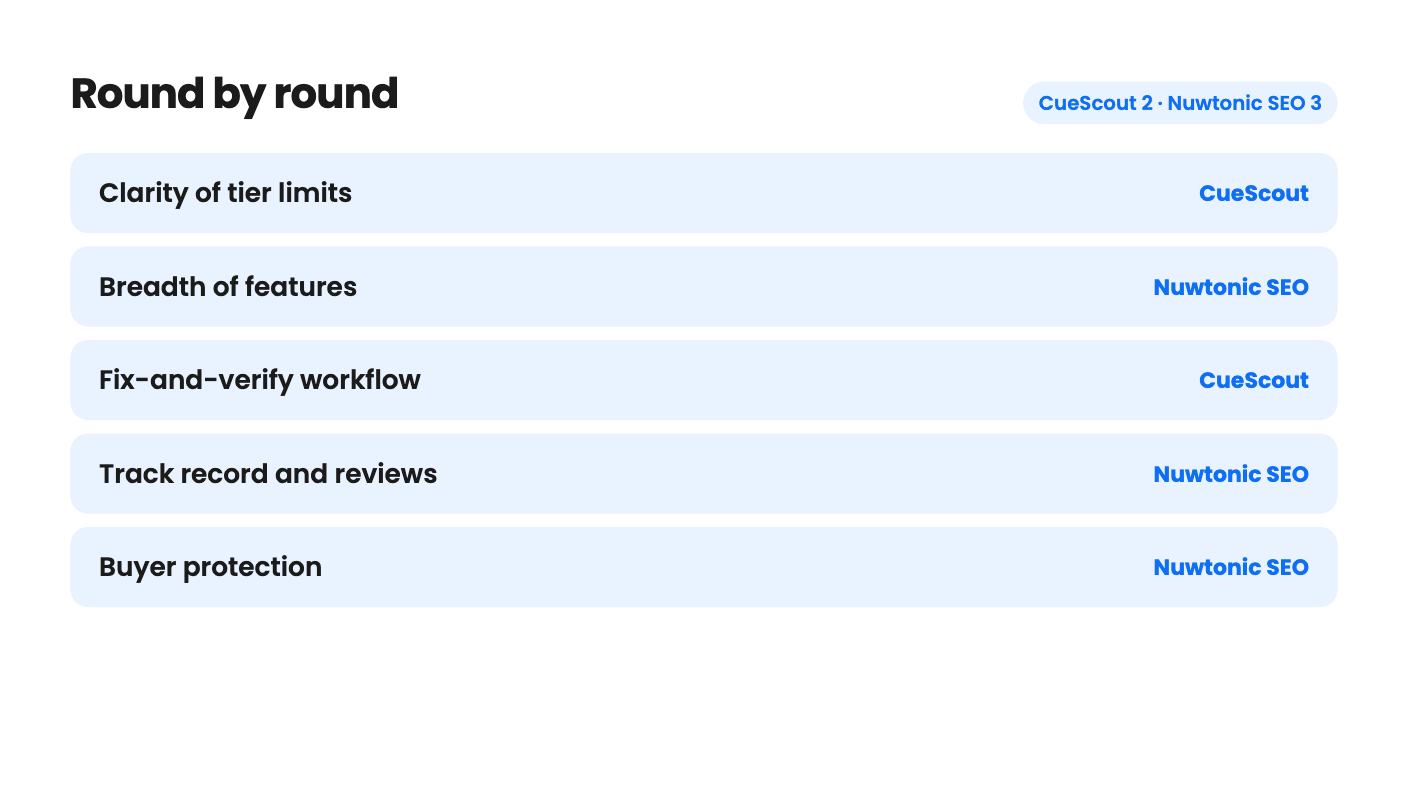
CueScout takes 2 rounds, Nuwtonic SEO takes 3.
| Round | Winner | Why |
|---|---|---|
| Clarity of tier limits | CueScout | CueScout's FAQ states 20 questions, 2 brands and 240 checks per code, while Nuwtonic's table has ten unlabeled columns for seven tiers. |
| Breadth of features | Nuwtonic SEO | Nuwtonic adds keyword tracking, competitor analysis, topical maps and bulk content generation, none of which CueScout attempts. |
| Fix-and-verify workflow | CueScout | CueScout re-checks each To-do after you mark it done, so a fix that changed nothing doesn't count as progress. |
| Track record and reviews | Nuwtonic SEO | Nuwtonic shows 108 AppSumo reviews averaging 4.82, while CueScout's listing offers no customer names, numbers or video. |
| Buyer protection | Nuwtonic SEO | Nuwtonic lists a 60-day money-back guarantee, and the CueScout material we have doesn't mention a refund. |
| AI engines and check cadence | Tie | CueScout covers three engines weekly, and Nuwtonic names more engines but never says how often it checks. |
| CueScout | Nuwtonic SEO | |
|---|---|---|
| Starts at | $59 | $69 |
| List price | $589 | $1200 |
| Plan | Lifetime Deal | Lifetime Deal |
| Deal ends | Not listed | Not listed |
| Best for | Marketers, SaaS, Solopreneurs | Marketers, Marketing agencies, SaaS |
| Alternative to | Ahrefs, SEMrush | Ahrefs, Profound, SEMrush |
Someone asks ChatGPT for the best tool in your category, and your competitors get named while you don’t. That’s the problem both of these lifetime deals are chasing, and they go about it in quite different ways. We haven’t used either one, so everything here comes from the listings.
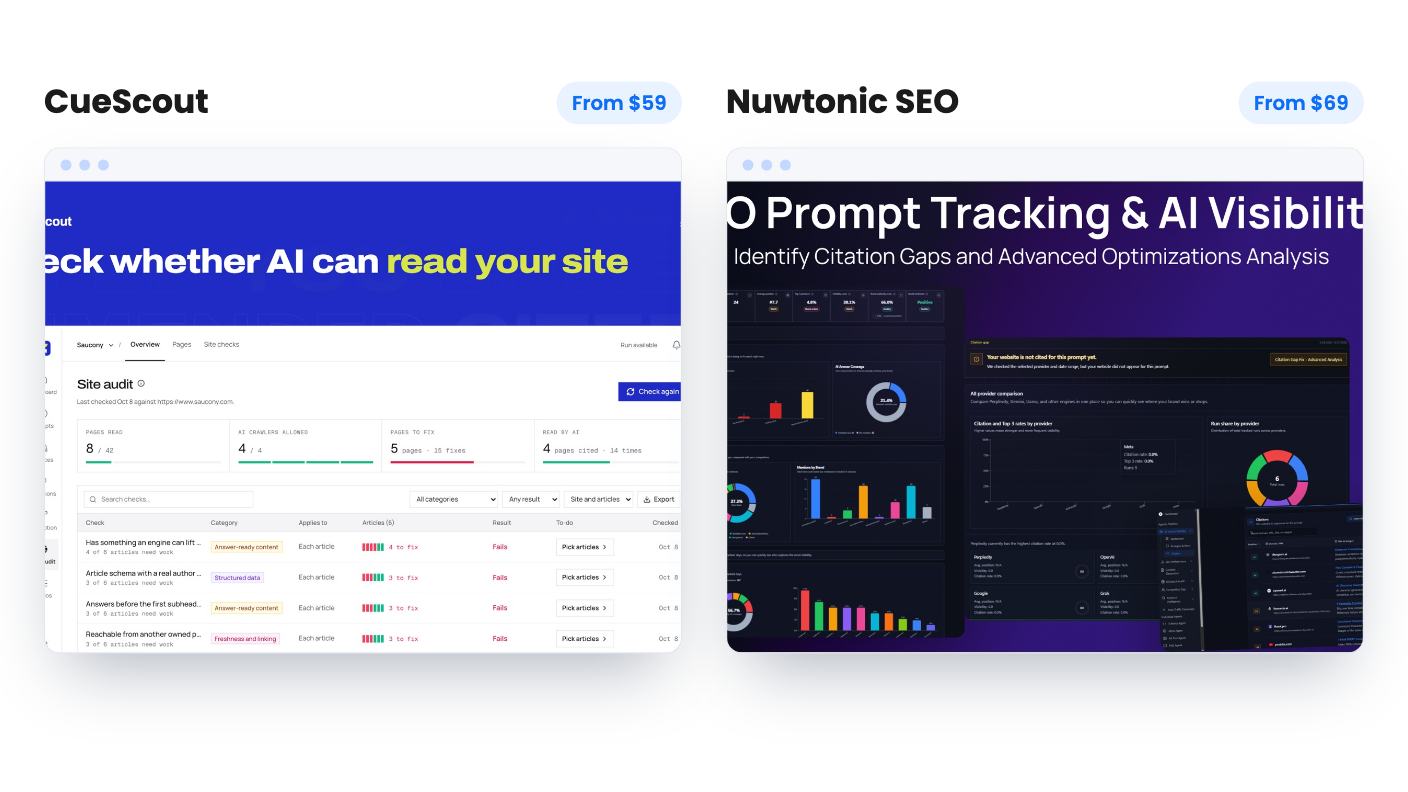
CueScout is the narrow one. It’s an AI visibility tracker with a to-do list attached. Nuwtonic SEO is the wide one, mixing Google Search Console data, AI citation tracking and content generation. If you’re only deciding between them on price, you’ll miss the real question, which is how much tool you want to learn.
CueScout asks your buyer questions on ChatGPT, Perplexity and Google AI Overviews, then keeps every page those answers cite. It sorts the pages into ones you own, ones where you could earn a mention, and lists you could get onto. That’s a short, practical output. You email an editor or ask to be added to a roundup.
Nuwtonic starts from a different place. It connects to Google Search Console, scores your existing pages for answer readiness and E-E-A-T signals, then helps you draft and optimise content. The listing calls it an AI-native SEO and agentic search platform. That’s a big phrase, and the listing gives us little to judge how well it works.
So one is a tracker that tells you where to show up, and the other is a workbench that wants to do more of the work with you. Which is better depends on whether you already have a content process.
CueScout’s cadence is plain. First results arrive within an hour of adding a question, and after that each question runs on all three engines once a week. The listing admits that moving the numbers takes weeks, because engines have to re-read your changed pages. We like that honesty, though weekly checks won’t suit anyone who wants daily movement.
CueScout also tracks share of AI voice against competitors you add, per engine and per question, and names the brand that got picked when you’re missing. Its Perception feature lists what answers praise and criticise you for, with the quote and engine, and checks price and feature claims against your own site. The listing doesn’t say how reliable that claim checking is.
Nuwtonic monitors citations across ChatGPT, Gemini, Perplexity and other platforms on one dashboard, with share of voice, prompt coverage and competitor visibility over time. The model list in the lowest column of its table is ChatGPT, Claude, Perplexity, Llama, Grok and Google AI. That’s a wider list than CueScout’s three. The listing doesn’t say how often Nuwtonic checks, which matters if you want to compare the two fairly.
This is where CueScout makes its best case. Its site audit checks whether AI bots can read your site, looking at robots.txt, llms.txt, JavaScript-only pages, structured data, canonicals and titles. It covers up to 50 pages. Each failed check becomes a To-do in one click, with steps, evidence and a date. After you mark it done, CueScout re-checks it.
That re-check is the detail we’d pay attention to. It means the list can’t quietly fill with fixes that did nothing. CueScout also never writes or posts for you. The founder says an early version posted on Reddit and got their accounts banned five times, which explains the design.
Nuwtonic goes the other direction. It builds topical maps and clusters, writes drafts, adds internal links and schema, and supports bulk article generation and scheduling on higher plans. Its agents are said to read Search Console data and produce prioritised fixes you can approve with one click. We can’t say how good those suggestions are, and neither can the demo video. It’s a founder introduction with no screens, so the interface and report quality go unseen.
If you want a tool to hand you drafts, Nuwtonic is the only one of the two that tries. If you’d rather write your own and just know where to aim, CueScout fits better.
CueScout costs $59, $118 or $177, which are really one, two or three stacked codes. According to the FAQ, one code gets you 20 questions, 2 brands and 240 checks a month. Two codes get 40, 4 and 480. Three get 60, 6 and 720. Each brand needs at least 10 questions, and you must redeem within 60 days.
There’s one oddity. The plan table lists 60, 40 and 20 against the tiers in that order, which looks backwards next to the FAQ. We’d trust the FAQ, but check checkout before paying. Also, checks pause after 30 days without a login and restart when you sign in.
Nuwtonic has seven lifetime tiers: $69, $179, $289, $399, $419, $799 and $1,499. The plan table shows ten values per row for seven tiers, with no labels, so you can’t reliably match a number to a price. Domains run from 1 to 120, prompt tracking from 20 to 1,000 a month, and AI credits from 1,200 to 40,000 a month.
The lowest column shows 1 domain and 20 prompts a month, and it probably belongs to the $69 tier, though the listing doesn’t say so. Several features, including bulk article generation and AI edit, are switched off in lower columns. Ask which column is yours before buying anything above the entry tier.
Nuwtonic also says access to future AI models may be discounted or may need an add-on, without saying which or what it would cost. In a product where model costs drive the economics, that’s the line that could change your lifetime math.
Nuwtonic has the stronger evidence. AppSumo shows 108 reviews averaging 4.82 out of 5, and a 60-day money-back guarantee gives you a real window to test it. AppSumo’s own summary, which is marketing copy, admits a learning curve and some interface complexity.
CueScout’s listing has no customer names, no numbers and no video, and the founder writes in the first person, which suggests a small team. The material we have doesn’t mention a refund either. A lifetime deal on a young product is a bet that it survives, and at $59 that bet is cheap. At $177 it gets bigger.
Pick CueScout if you run a small site or SaaS, can live with weekly data, and would actually work through a to-do list. Buy one code first and stack more only after you’ve seen fixes get re-checked and answers move. Agencies will outgrow it fast, since even three codes top out at six brands.
Pick Nuwtonic if you already use Google Search Console and want rankings, AI citation tracking and content work in one place. It suits a freelancer or small agency, as long as you confirm which tier gives you the domains and features you need. Skip it if you need deep keyword or backlink data, because the listing describes neither.
If you can only afford one test, the refund window makes Nuwtonic the safer one to try, while CueScout is the cheaper, more focused way to see where AI answers skip you.
They overlap on tracking how AI answers mention your brand. CueScout stays focused on that plus a site audit and to-dos. Nuwtonic also covers keyword tracking, competitor analysis and content generation.
CueScout. Its FAQ gives exact numbers per code, though its plan table looks reversed, so check checkout. Nuwtonic's table has ten unlabeled value columns for seven tiers, so ask which column matches your price.
Nuwtonic's listing mentions a 60-day money-back guarantee. The CueScout material doesn't mention a refund, so confirm on the AppSumo page before paying.
How this comparison was made: researched from both tools' official listings and demo videos, and written with help from AI. We have not tested CueScout or Nuwtonic SEO hands-on yet. Prices and deal terms change, so check AppSumo before you buy. See our affiliate disclosure.
Five AppSumo lifetime deals named as Linktree alternatives, from $19 to $59 entry prices. See who each suits and what the listings leave out.
Six AppSumo lifetime deals pitched as Google Analytics alternatives, grouped by the job you need done, with tier limits and gaps spelled out.
Ten AppSumo lifetime deals named as Ahrefs alternatives, grouped by job: keywords, site fixes, AI search tracking and competitor research. Limits included.