
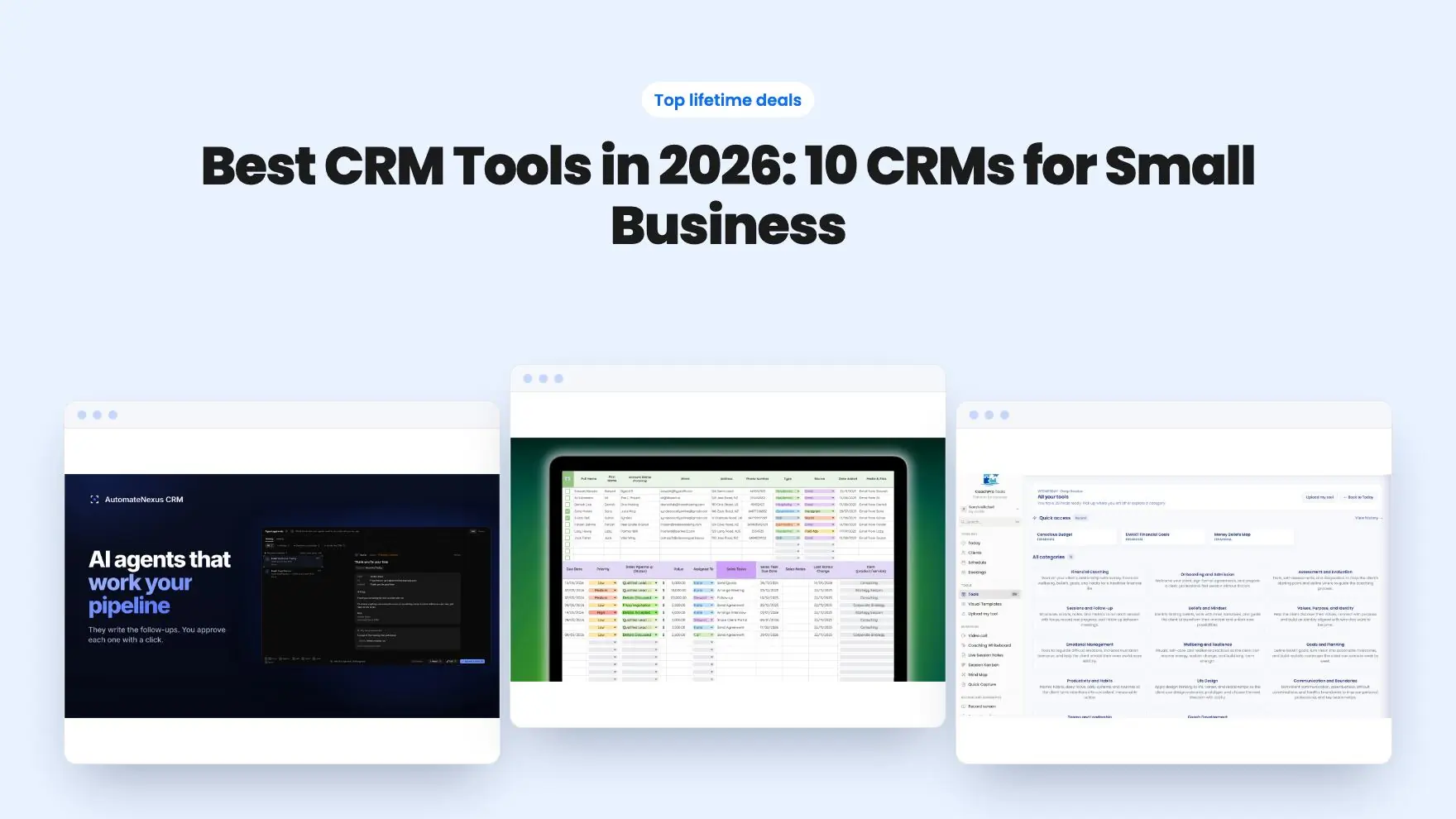


The deals at a glance
| Tool | Suits | Price |
|---|---|---|
| AutomateNexus CRM | Consultants and small agencies | $49 |
| Sheetify CRM | Teams that live in Google Sheets | $39 |
| CoachPro Tools | Coaches running client sessions | $69 |
A CRM only earns its keep if your team actually uses it. The most common mistake small businesses make is buying the CRM with the longest feature list, then going back to spreadsheets because it’s too much work to update. This guide picks the 10 best CRM tools in 2026 for small businesses: seven well-known CRMs you pay for monthly, several with free plans, and three lifetime deals for owners who’d rather pay once. Each one says who it fits and what the catch is.
Get AutomateNexus CRM for $49 on AppSumo →
Prices come from each vendor’s pricing page where we could read it, and otherwise from consistent 2026 pricing reports, checked on November 13, 2026. Most CRMs price per user, so multiply by your team size. We haven’t run these CRMs hands-on for this guide, and prices change, so confirm on the vendor’s site.
The 10 best CRM tools at a glance
| # | CRM | Best for | Starting price |
|---|---|---|---|
| 1 | HubSpot | Easiest start, free plan | Free (2 users), Starter $10/seat/month |
| 2 | Pipedrive | Sales pipeline focus | About $14/seat/month yearly |
| 3 | Zoho CRM | Most features per dollar | Free (3 users), Standard about $14/user yearly |
| 4 | Salesforce | Room to grow | Starter Suite $25/user/month |
| 5 | Freshsales | Cheap paid plans | Growth $9/user/month yearly |
| 6 | monday CRM | Teams already on monday.com | Basic $12/seat yearly, 3-seat minimum |
| 7 | Less Annoying CRM | Simplicity, one flat price | $15/user/month |
| 8 | AutomateNexus CRM | Consultants and small agencies | $49 one-time |
| 9 | Sheetify CRM | A CRM inside Google Sheets | $39 one-time |
| 10 | CoachPro Tools | Coaches and client sessions | $69 one-time |
1. HubSpot: the easiest place to start
HubSpot’s free CRM is the default first CRM for small businesses, and for good reason. It’s free for up to 2 users and 1,000 contacts with no time limit, and it’s simple enough that a non-technical team will actually use it. When you need more, the Starter plan normally lists at $20 a seat a month, and HubSpot was offering it to new customers at $10 a seat month to month, or $7 billed annually, when we checked.
The catch comes later. Marketing automation and advanced sales features sit in the Professional plans, which cost far more, and costs climb quickly as you add seats and tools. Start free, and budget carefully before you upgrade. See our HubSpot alternatives guide for cheaper options.
2. Pipedrive: built around the sales pipeline
Pipedrive is designed for teams whose day revolves around moving deals through stages. Its visual pipeline is the clearest of any of the best CRM tools here, and it nudges reps toward the next action on each deal. Plans are reported at about $14 a seat a month for Lite billed annually ($24 month to month), $39 for Growth and $59 for Premium. There’s no free plan, but there is a 14-day free trial.
It’s less suited to marketing or customer service, and add-ons cost extra on top of the seat price. For a small sales team, it’s hard to beat for day-to-day pipeline work.
3. Zoho CRM: the most features for the money
Zoho CRM packs automation, reporting and customization that rivals charge far more for. The free edition covers up to 3 users. Paid editions are reported at about $14 a user a month for Standard and $23 for Professional when billed annually ($20 and $35 month to month), with Enterprise around $40.
The trade-off is a steeper learning curve and an interface that can feel busy. If you’re willing to spend a little time setting it up, it’s the best value for a growing team, especially if you already use other Zoho apps.
4. Salesforce: the one you won’t outgrow
Salesforce is the CRM big companies run on, and its Starter Suite at $25 a user a month is its pitch to small businesses. Pro Suite is $100 a user a month billed annually, and the larger editions run from $195 to $550.
It scales further than anything else on this list, with a huge ecosystem of apps and partners. But most of that power lives in the expensive plans and takes real setup. Pick it if you expect to grow fast and have someone to own the CRM. Otherwise, a simpler tool will get your team using it sooner.
5. Freshsales: cheap paid plans
Freshsales, from Freshworks, has some of the lowest paid prices of the mainstream CRMs: $9 a user a month for Growth, $39 for Pro and $59 for Enterprise, billed annually. There’s a 21-day free trial of the full product, and Freshworks also advertises a free plan.
It includes built-in phone and email and AI help with deal insights on the higher plans. It’s a strong pick for a small sales team that wants a modern CRM without HubSpot’s upgrade costs.
6. monday CRM: if your team already uses monday.com
monday CRM builds a sales pipeline on top of the monday.com work platform, so it suits teams that already manage projects there. Plans cost $12 a seat a month for Basic, $17 for Standard and $28 for Pro billed annually ($18, $25 and $41 month to month), with a 14-day free trial.
The catch is the 3-seat minimum, so a solo owner pays for three seats. It’s very flexible, which means more setup to make it work like a CRM rather than a project board.
7. Less Annoying CRM: simple on purpose
Less Annoying CRM does exactly what its name says. It covers contacts, pipelines, tasks and a calendar, and nothing more, for one flat $15 a user a month. There are no tiers to compare, and there’s a 30-day free trial with no credit card needed. The vendor suggests staying under about 50,000 contacts.
It won’t do marketing automation or complex reporting. For a small business that has failed to stick with a bigger CRM, that simplicity is the point.
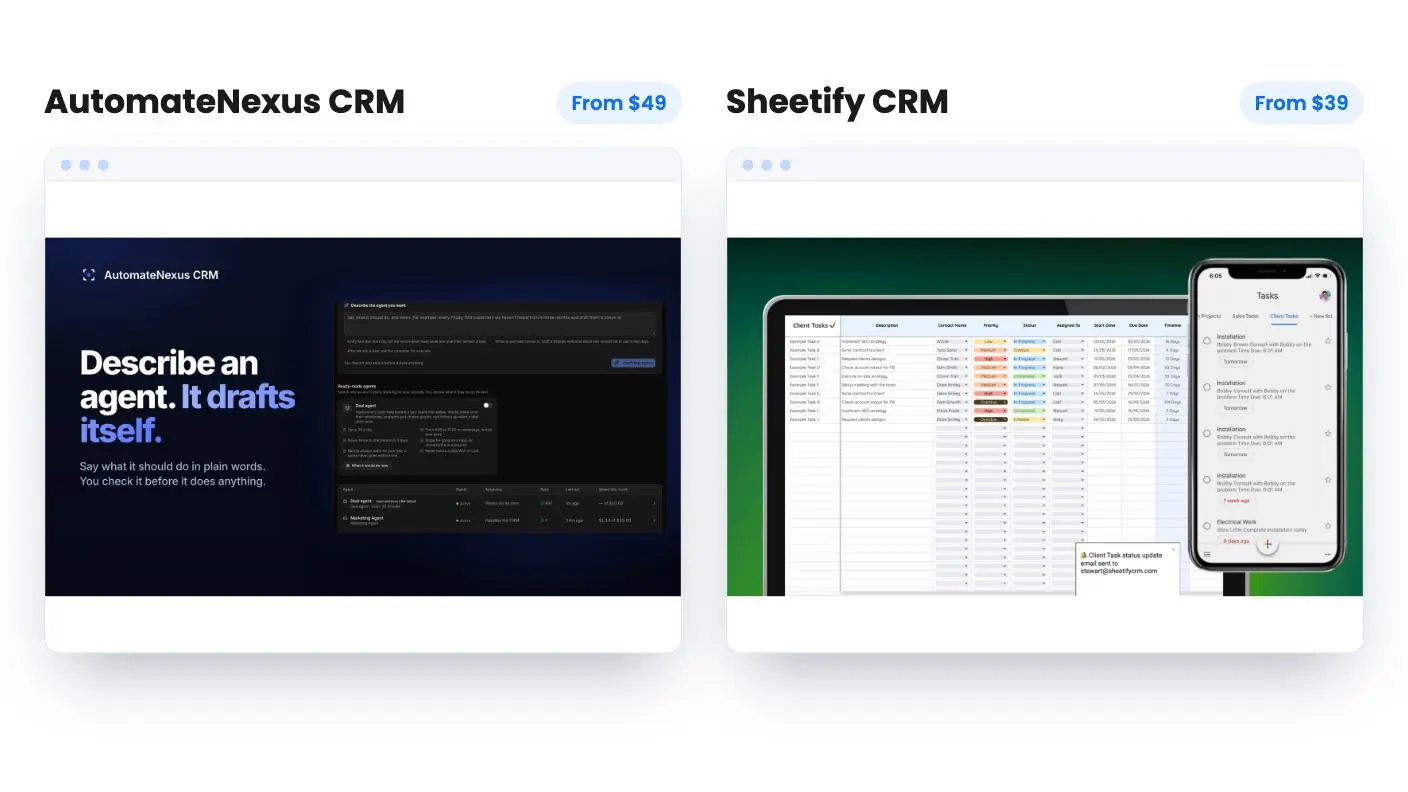
8. AutomateNexus CRM: a lifetime CRM for agencies
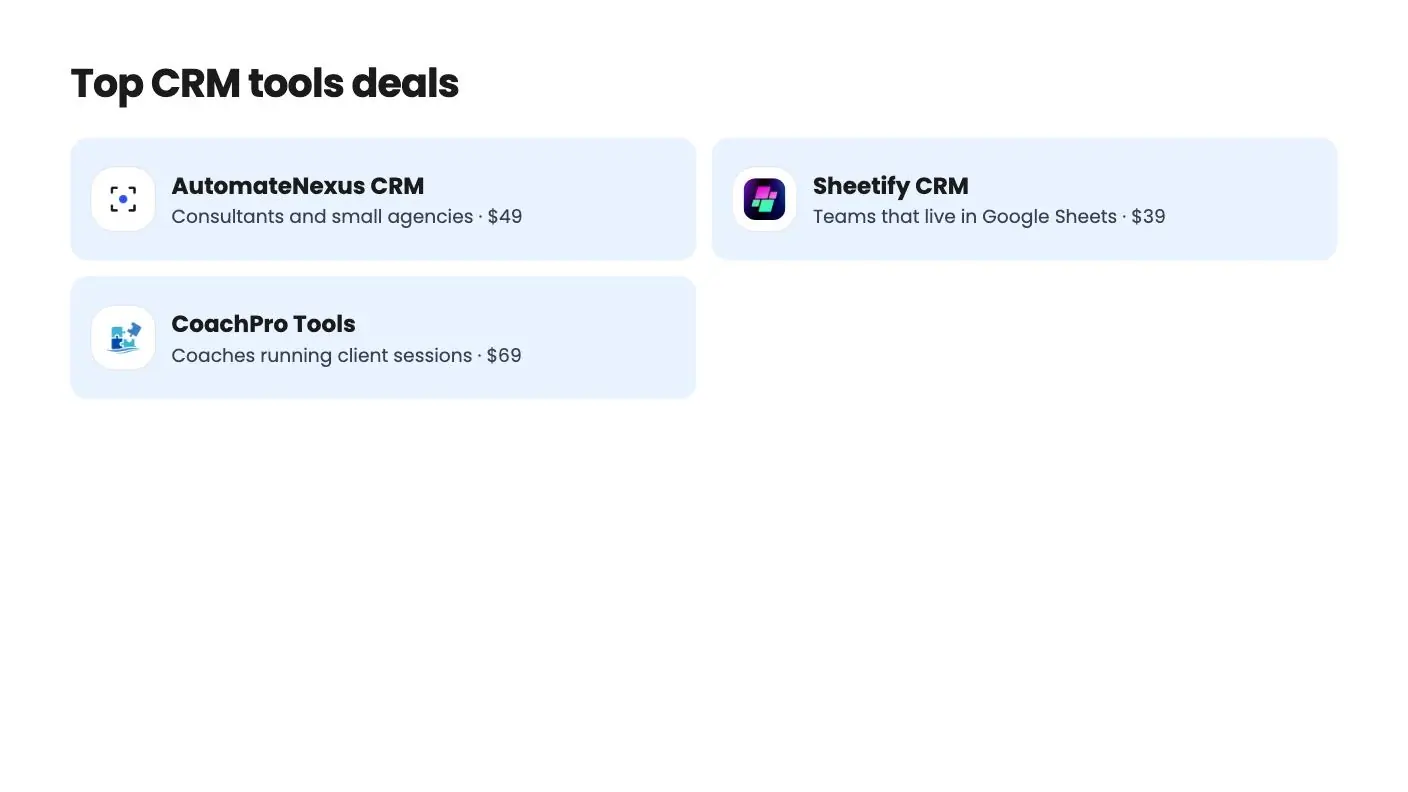
AutomateNexus CRM is a one-time alternative to GoHighLevel, HubSpot and Pipedrive for consultants and small agencies. Every tier has unlimited contacts, companies and deals, a white-label client portal where clients don’t take a seat, and quotes, e-signatures, invoices and Stripe payments tied to each deal. AI agents run on your own API key, and nothing reaches a customer without your approval.
It starts at $49. Hosted email sending, AI credits and extra storage are paid extras, calls and texts need your own Twilio number, and you can’t resell it to clients on the AppSumo deal. The listing also contradicts itself on how many businesses each tier covers, so confirm before you buy.
Get AutomateNexus CRM for $49 on AppSumo →
9. Sheetify CRM: a CRM in a Google Sheet
Sheetify CRM turns a Google Sheet into a CRM with a pipeline, tasks, inventory, tickets and Gmail campaigns, for a one-time $39. Your data stays in your own Google Drive, which some owners will like more than any feature.
It suits solo owners and tiny teams who already live in Sheets and Gmail. Gmail’s sending limits apply, with the vendor suggesting about 100 to 250 emails per sender, and deeper changes need Google Apps Script. There’s little demo material, so use the refund window to check it.
Get Sheetify CRM for $39 on AppSumo →
10. CoachPro Tools: client management for coaches
CoachPro Tools is a client-management tool rather than a sales CRM, built for coaches who run live sessions. For $69 one-time you get client profiles, agreements and a timeline, a booking page, video calls and a whiteboard, plus 285 plus interactive coaching exercises your clients use without logging in. Buyers rate it 4.92 out of 5.
White label is a separate paid add-on with no price listed, and the product is young, with little independent track record. It suits solo coaches. For a sales team, pick one of the CRMs above.
Get CoachPro Tools for $69 on AppSumo →
How to choose a CRM
Answer three questions before you look at features:
- How many people will use it? Most CRMs charge per user, so a $20 plan for 10 people is $200 a month. Free plans cover 2 to 3 users.
- What’s the main job? Moving deals (Pipedrive), marketing and sales together (HubSpot, Zoho), growing into an enterprise system (Salesforce), or simply keeping track of customers (Less Annoying CRM).
- Who will set it up and keep it clean? If nobody, choose the simplest tool your team will actually update.
Then run a real trial: import a few hundred real contacts and use it for two weeks before you decide.
Subscription or lifetime deal?
A CRM holds your customer history, so it’s the riskiest tool to buy from a young company. The subscription CRMs among the best CRM tools here are long-established, keep improving, and integrate with almost everything. The lifetime deals cost less over time and suit solo owners and small agencies with simple needs, but check that you can export your data before you commit.
For more options, see our CRM lifetime deals roundup and HubSpot alternatives guide. If you’re choosing the rest of your stack, our best AI writing tools and best SEO tools guides cover two more essentials, and the AppSumo Black Friday 2026 tracker lists this month’s deals.
Why each one made the list
- AutomateNexus CRM: From $49 lifetime with unlimited contacts and deals, a branded client portal and supervised AI follow-up, but email sending, AI and calls rely on paid extras or your own accounts.
- Sheetify CRM: A $39 one-time CRM inside a Google Sheet, with pipeline, tasks and Gmail campaigns and your data in your own Drive, though Gmail sending limits apply.
- CoachPro Tools: $69 one-time for client profiles, booking, video calls and 285+ interactive coaching tools, rated 4.92/5, but white label costs extra and the product is young.
Frequently asked questions
What is the best CRM for a small business in 2026?
For most small businesses, HubSpot is the easiest place to start, because its free CRM covers 2 users and 1,000 contacts and the Starter plan begins at $10 a seat a month for new customers. If your team lives in its sales pipeline, Pipedrive is the better fit. Zoho CRM is the best value for growing teams that want lots of features at a low per-user price.
What is the best free CRM?
HubSpot's free CRM, for up to 2 users and 1,000 contacts, and Zoho CRM's free edition, for up to 3 users, are the strongest free options. Freshsales also advertises a free plan. Free plans are fine to start, but expect to pay once you need automation or more users.
Is Salesforce good for small businesses?
Salesforce's Starter Suite at $25 per user a month is aimed at small businesses, and it scales further than any other CRM here. But most of its power sits in the $100+ plans, and it takes more setup. Small teams usually get going faster with HubSpot, Pipedrive or Zoho.
Are lifetime-deal CRMs worth it?
They can work for a solo owner or a small agency with simple needs, like the three on this list. But a CRM holds your customer history, so the vendor's long-term stability matters more than for most tools. Check how you'd export your data before you commit, and use the refund window to test it.
How much does a CRM cost?
From free to several hundred dollars per user a month. Most small businesses pay $10 to $40 per user a month: HubSpot Starter, Pipedrive Lite and Growth, Zoho Standard and Professional, Freshsales Growth and Pro, and monday CRM's Basic and Standard plans all sit in that range.