SEO ToolsAlternatives
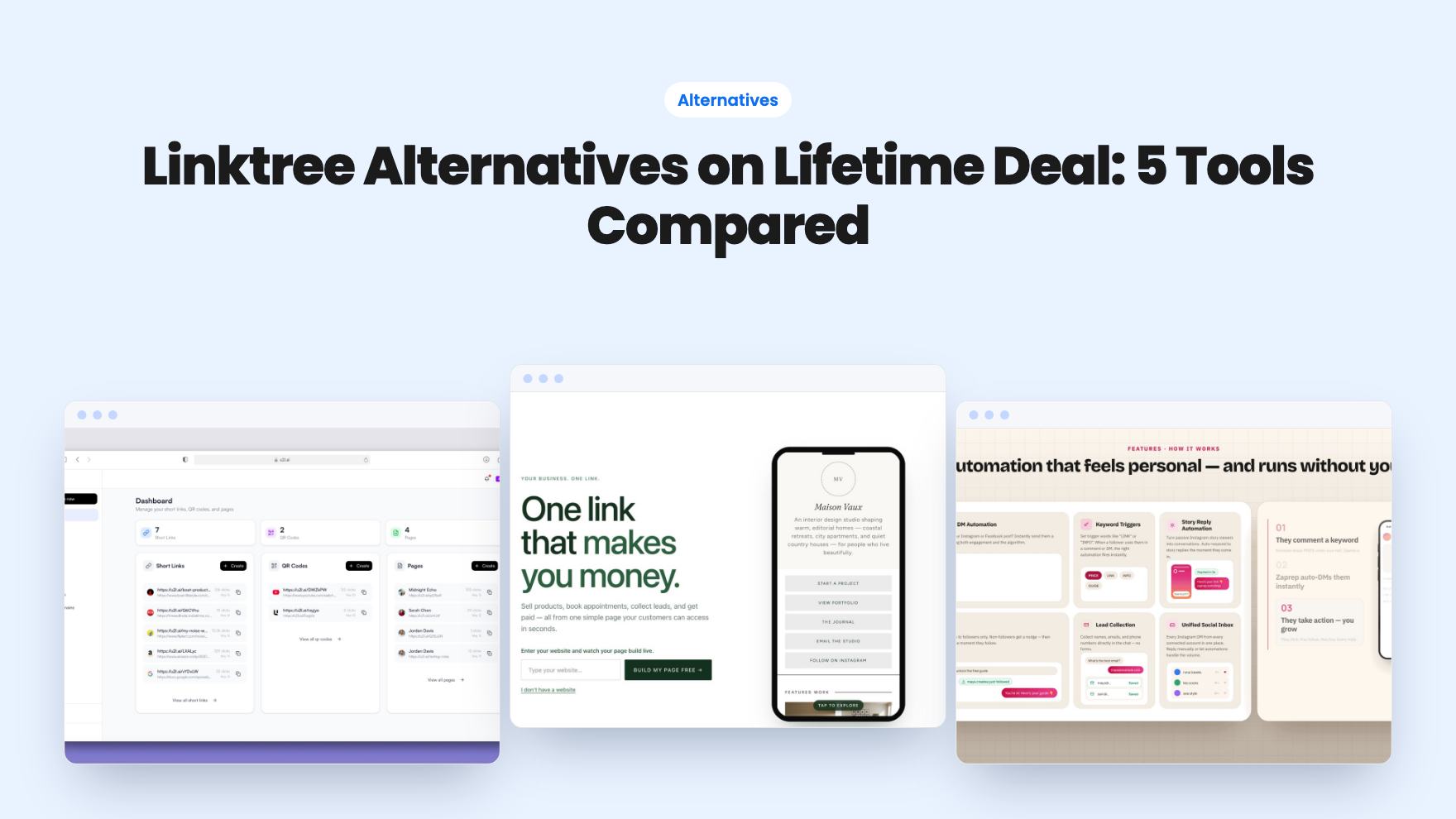
Linktree Alternatives on Lifetime Deal: 5 Tools Compared
Five AppSumo lifetime deals named as Linktree alternatives, from $19 to $59 entry prices. See who each suits and what the listings leave out.
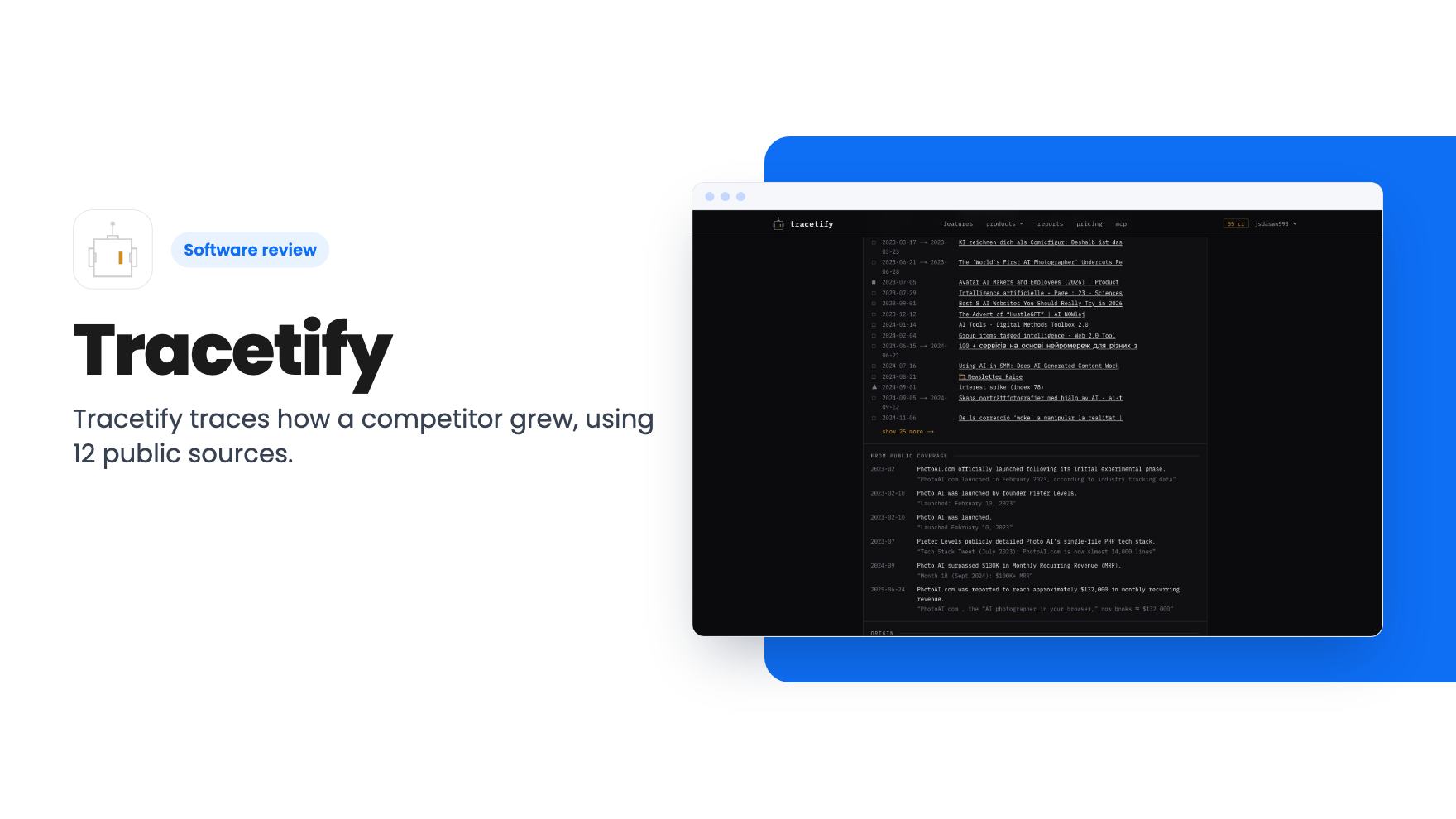
Tracetify traces how a competitor grew, using 12 public sources. The AppSumo lifetime deal starts at $49 but runs on one-time credits, so check the caps.
Lifetime deal price
$49$36987% off
Lifetime Deal
Our take: Buy the $49 tier if you're a founder or marketer who wants to study how competitors got their first users and you'll be happy with about ten fresh traces. Skip it if you need ongoing rank tracking or heavy daily SEO lookups, because everything runs on a fixed pool of credits and the product looks young.
You’ve just noticed a small competitor that seems to have appeared from nowhere. Their traffic looks healthy, they rank for terms you want, and you’d like to know how they got there. Open Ahrefs or SEMrush and you’ll see today’s numbers. What you won’t see is the story: who mentioned them first, which launch moved the needle, what happened in the quiet months.
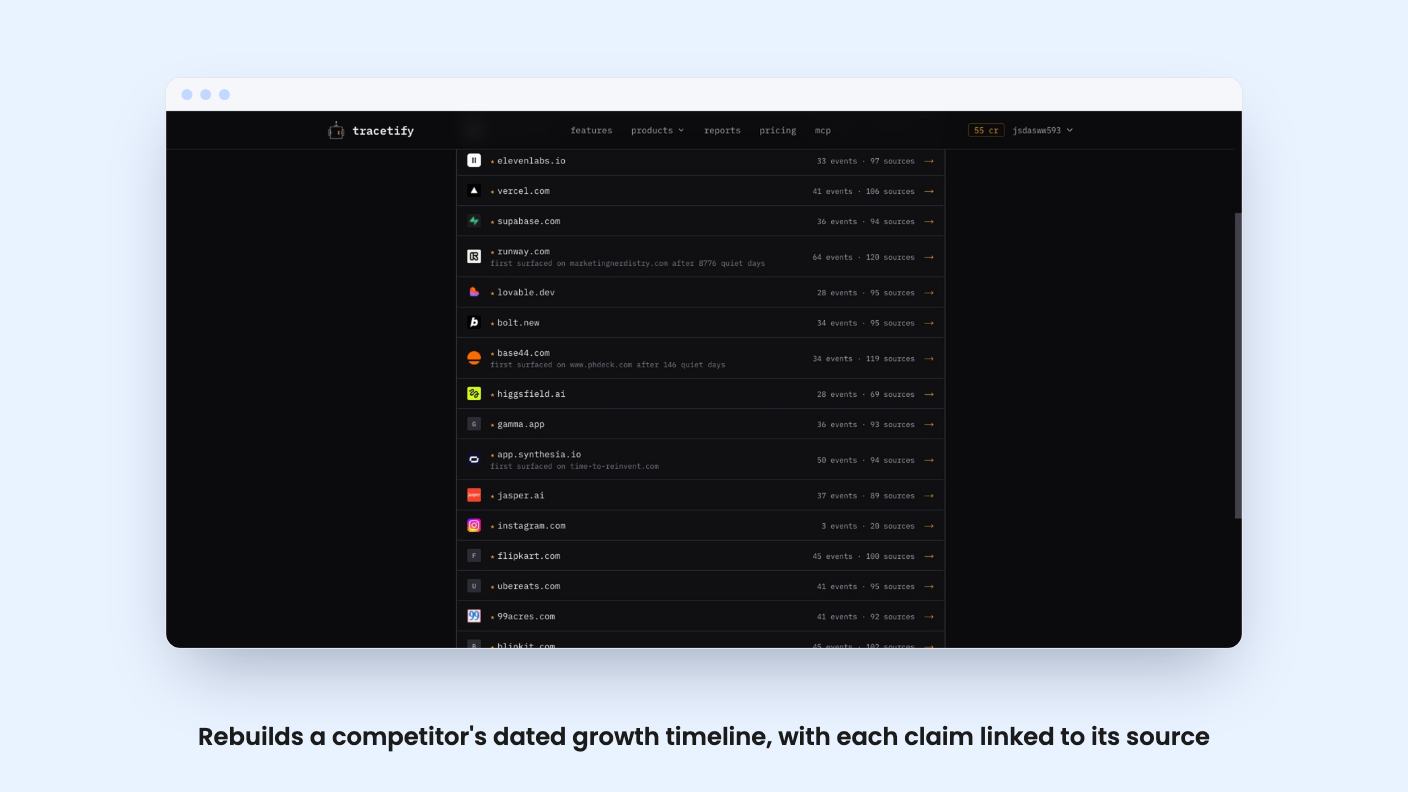
That gap is what Tracetify is built around. It’s an SEO and competitor research tool, currently a lifetime deal on AppSumo, and it takes a different angle from the big suites. Instead of a dashboard of current metrics, it tries to rebuild a timeline.
You paste a competitor’s URL. According to the listing, Tracetify pulls from 12 public sources in about a minute. Those include a backlink index covering 100+ billion links, SimilarWeb traffic estimates, Hacker News and Reddit archives, the Wayback Machine, Google Trends, SERP rankings across 8 markets and ad libraries. Where a founder has connected Stripe, it can also show verified revenue.
The output is a dated timeline of first mentions, launch events and growth spikes. Click a claim and you land on the page it came from. That’s a good design choice. Research tools that hand you a confident number with no trail are a pain, and a sourced timeline lets you check the work yourself.
The listing also says that when a source fails or a site blocks the crawler, the report says so rather than guessing. That’s the right behaviour, though we can’t say how often it happens.
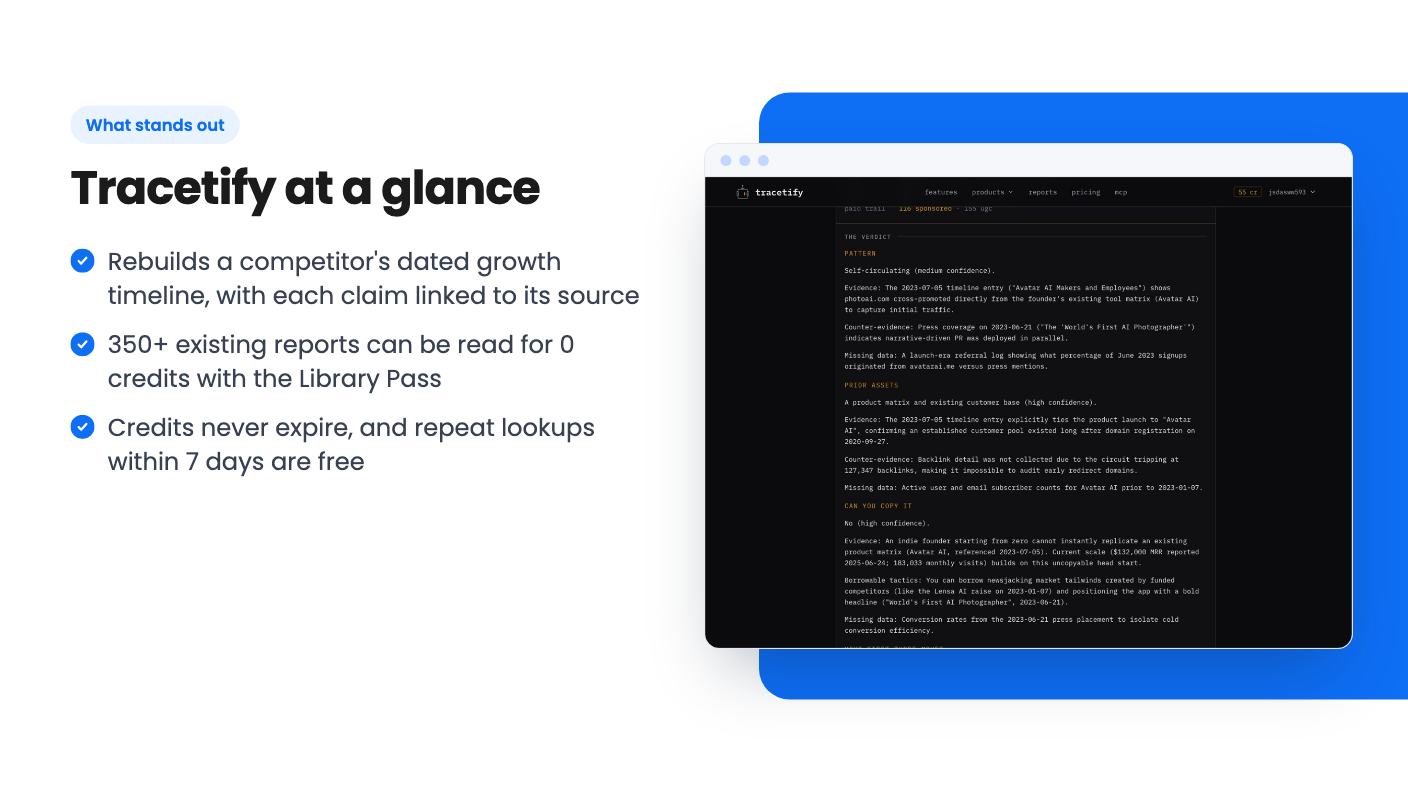
Each report ends with a verdict: three concrete moves you could copy, each tied to a dated event and a rough cost. It also states a confidence level and names the data that would change the call.
This is the part to treat with the most care. A three-move recommendation built from public data is a starting point for your own thinking, not a strategy. Public signals tell you what a company did. They’re much weaker at telling you why it worked. The confidence statement helps, but the listing shows no sample verdict, so we can’t judge how specific these moves are in practice.
Beyond traces, there’s a set of dashboard tools. You can ask an SEO agent questions in plain English, connect Google Search Console to find pages sitting one push from page one, and run site audits, domain overviews, backlink lookups and AI-mention checks.
All of these run on credits, and the listing is open about the prices:
Repeating the same cached lookup within 7 days costs nothing, and competitor lists and domain overviews share cached data. That softens the meter a little. Still, it’s a meter. If you’re used to running keyword checks all day on a normal SEO subscription, this will feel tight.
The Search Console connection is read-only, and the listing says imported data stays private to your account. Listed integrations are Chrome, Search Console, Shopify, Claude and Cursor. The listing doesn’t explain what the Claude and Cursor connections do, so ask before assuming.
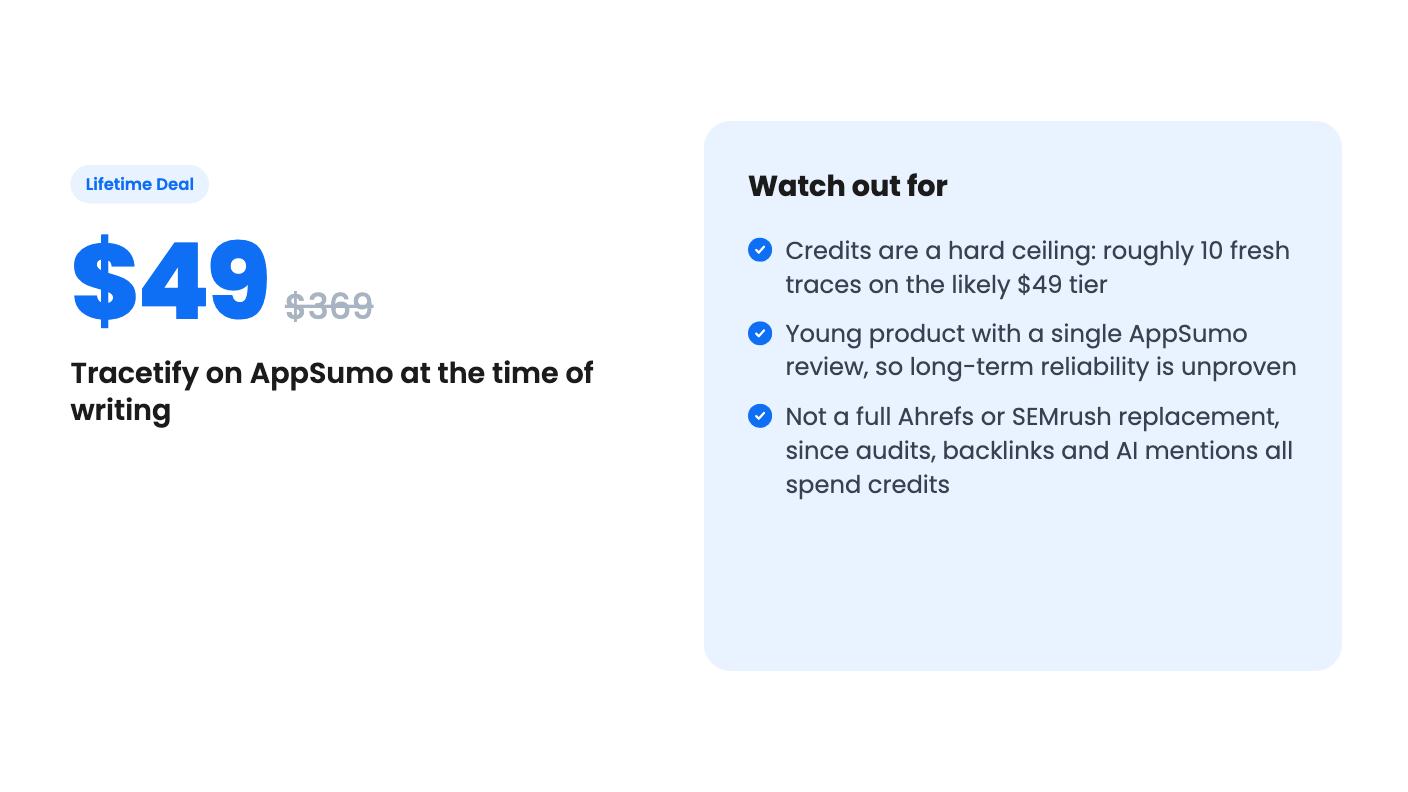
There are five tiers, each stackable up to five codes. Prices run $49, $98, $147, $196 and $245, against list prices of $369 to $422. Every tier gets lifetime access and all future plan updates, and you have 60 days to redeem your code.
The difference between tiers is credits. The listing shows one-time credits of 500, 400, 300, 200 and 100, and roughly 50, 40, 30, 20 and 10 fresh traces. It lists them in descending order, the opposite of the price order, which is confusing. The sensible reading is that the $49 tier is the 100-credit, 10-trace one. That works out to about $4.90 per fresh trace at every tier, so spending more doesn’t make each trace cheaper. Check the tier labels on the page before you pay.
The other piece is the Library Pass. With it, you can open any of the 350+ existing growth reports, timeline and verdict included, for 0 credits, and that carries over to reports added later. Every trace anyone runs adds to the library, so it should keep growing. It’s a decent perk, and it makes the lower tiers more reasonable than the raw trace count suggests.
There’s a flip side. The data layer is public, so anyone can read a report that’s already been traced. A trace you pay for is not a private advantage over your rivals. What stays yours is your own purchase history.
The listing also mentions a top Unlimited subscription tier. If you take it, your owned credits are frozen and resume when the subscription ends. That’s a fair detail, but the listing doesn’t state the subscription price.
There’s one AppSumo review so far, at 4.00 out of 5. That’s not enough to say anything about reliability, support or whether the data holds up over time. The product looks young, and a lifetime deal on a young product always carries the risk that the credit model changes or the company slows down.
Skip this if you want a daily-driver SEO suite. Rank tracking, large keyword research and heavy auditing would burn through 100 credits quickly, and the listing says nothing about rank tracking at all. Ahrefs and SEMrush, the alternatives it names, do those jobs on a different footing. Agencies running many client sites will hit the cap fastest.
It fits a narrower person: a founder or marketer doing positioning and channel research, who wants to study how three or four competitors got their first users and browse a library of other products’ growth paths. For that use, $49 is a low-risk bet. Buy one code, run your first traces on the competitors that matter most, and only stack more if you find yourself wishing you had credits left.
A fresh trace costs 10 credits. The listing gives roughly 10 to 50 traces across the five tiers, which matches 100 to 500 one-time credits. The credit figures appear in descending order without clear tier labels, so confirm what your tier includes on the AppSumo page before paying. Credits never expire.
With the AppSumo Lifetime Library Pass, opening any existing report, including its full timeline and verdict, costs 0 credits. That covers the 350+ reports in the library and ones added later. Only creating a new report costs credits.
Not on the evidence in the listing. It's pitched as showing how a product grew, while those tools show where it stands today. It does offer audits, backlink lookups and Search Console analysis, but each one spends credits from a fixed pool.
How this review was made: researched from Tracetify's official listing, and written with help from AI. We have not tested Tracetify hands-on yet. Prices and deal terms change, so check AppSumo before you buy. See our affiliate disclosure.
Five AppSumo lifetime deals named as Linktree alternatives, from $19 to $59 entry prices. See who each suits and what the listings leave out.
Six AppSumo lifetime deals pitched as Google Analytics alternatives, grouped by the job you need done, with tier limits and gaps spelled out.
Ten AppSumo lifetime deals named as Ahrefs alternatives, grouped by job: keywords, site fixes, AI search tracking and competitor research. Limits included.