SEO ToolsAlternatives
Linktree Alternatives on Lifetime Deal: 5 Tools Compared
Five AppSumo lifetime deals named as Linktree alternatives, from $19 to $59 entry prices. See who each suits and what the listings leave out.
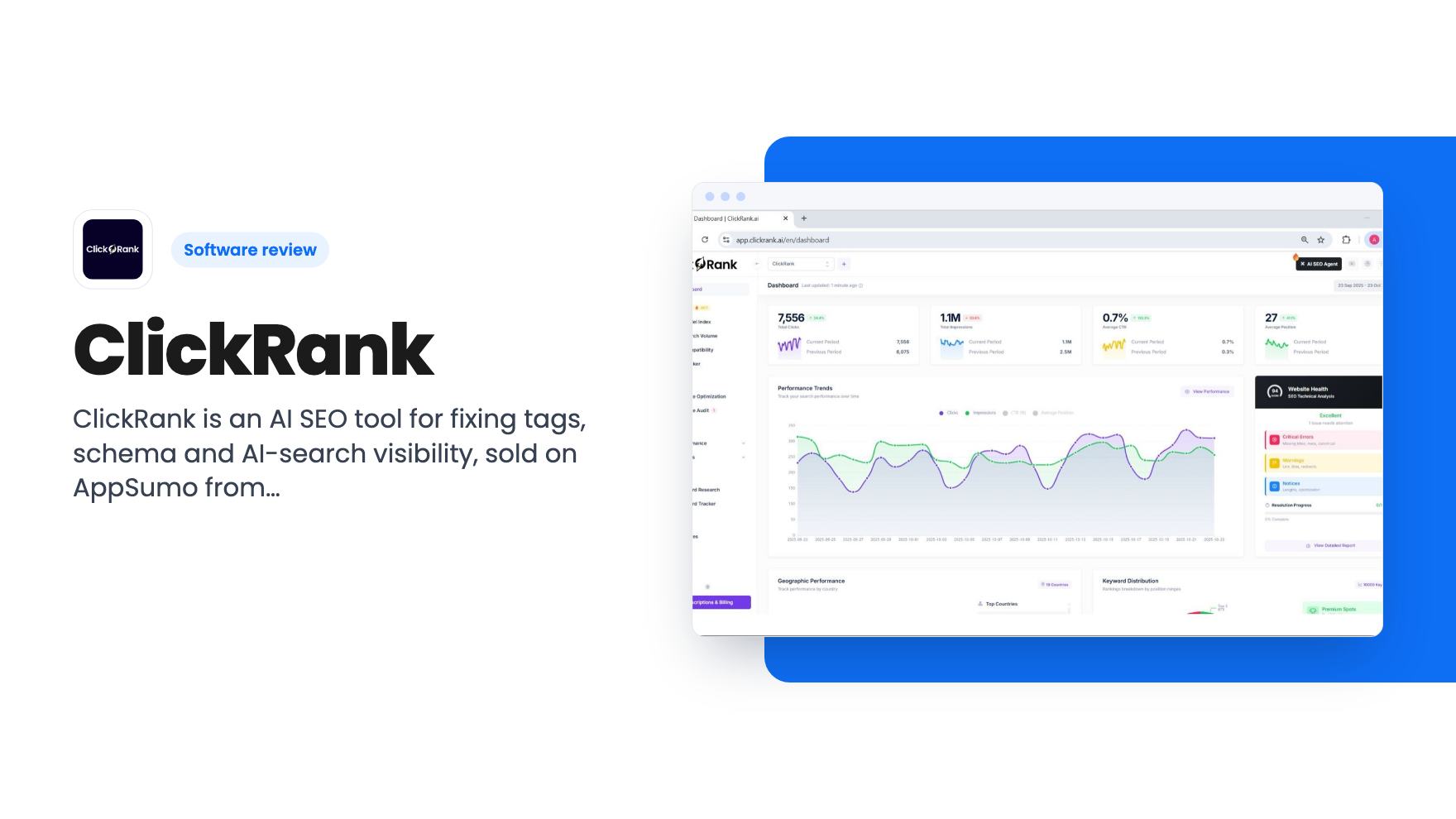
ClickRank is an AI SEO tool for fixing tags, schema and AI-search visibility, sold on AppSumo from $89. Here's what the crawl caps and young product mean for you.
Lifetime deal price
$89$69087% off
Lifetime Deal
Our take: Worth a look if you run one or two small sites, want titles, meta tags and schema fixed without hand-editing, and care about showing up in AI search. Skip it if you need deep backlink data like Ahrefs offers, run large sites, or want a proven tool with a long track record.
You’ve got a blog or a small shop with a few hundred pages. Half the title tags are too long, some meta descriptions are missing, and you suspect there’s duplicate content somewhere. You know it matters. You also know that fixing it by hand means a weekend you don’t have.
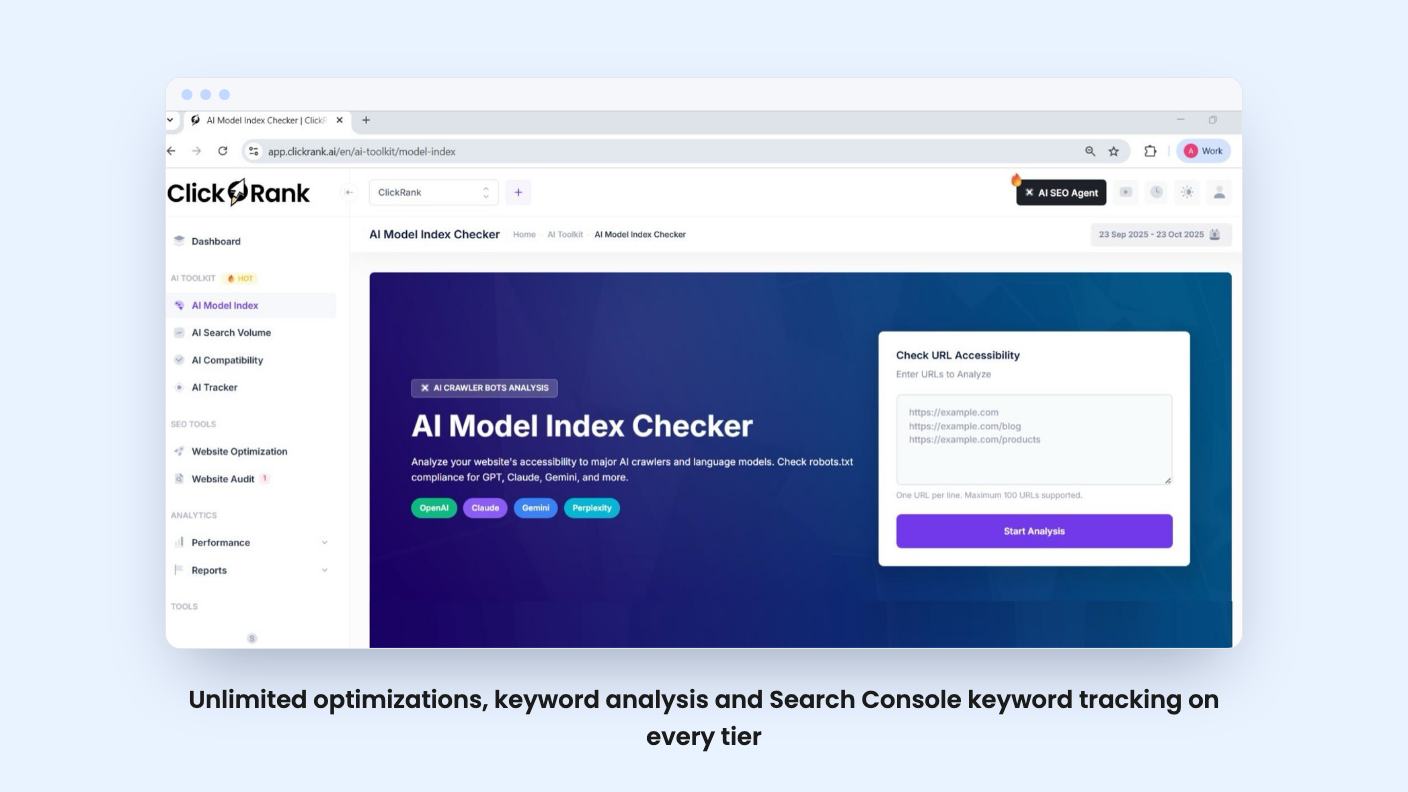
That’s the job ClickRank is built for. It’s an AI-driven SEO tool sold on AppSumo for $89 on its entry tier, with a list price of $690. It audits your site, then applies fixes for you. It also adds a newer angle: checking whether AI search engines can actually see and understand your content.
We haven’t used it ourselves, so everything below comes from the AppSumo listing. Treat the claims accordingly.
The core is a site audit plus automated fixes. According to the listing, it finds broken links, duplicate content and missing tags, then repairs them. There’s an AI SEO Agent that takes plain-English commands, so you type what you want changed instead of digging through settings.
The listing’s FAQ names a few specific automations: title tag optimization, AI-written meta descriptions, automatic schema markup, internal link suggestions and what it calls auto content optimization. A “Resolve All” button is supposed to fix every detected technical issue on a page in one go, working in the background and emailing you when it’s done.
That last feature is the one to think about before you buy. One-click fixes are convenient. They also mean a tool is rewriting your titles and tags, and the listing doesn’t say whether you can review changes before they go live. Ask about that during the 60-day window.
Most of the newer marketing is about AI visibility. ClickRank says it checks whether crawlers from ChatGPT, Claude, Perplexity and Gemini can reach your site, and its AI Model Index Checker looks at your robots.txt setup and page response status. That’s a practical check. Plenty of sites block AI crawlers by accident.
The listing also promises separate scores for how different AI models understand your content, tracking of whether you’re cited in Google AI Overviews, and an AI Search Volume Analyzer for keyword demand.
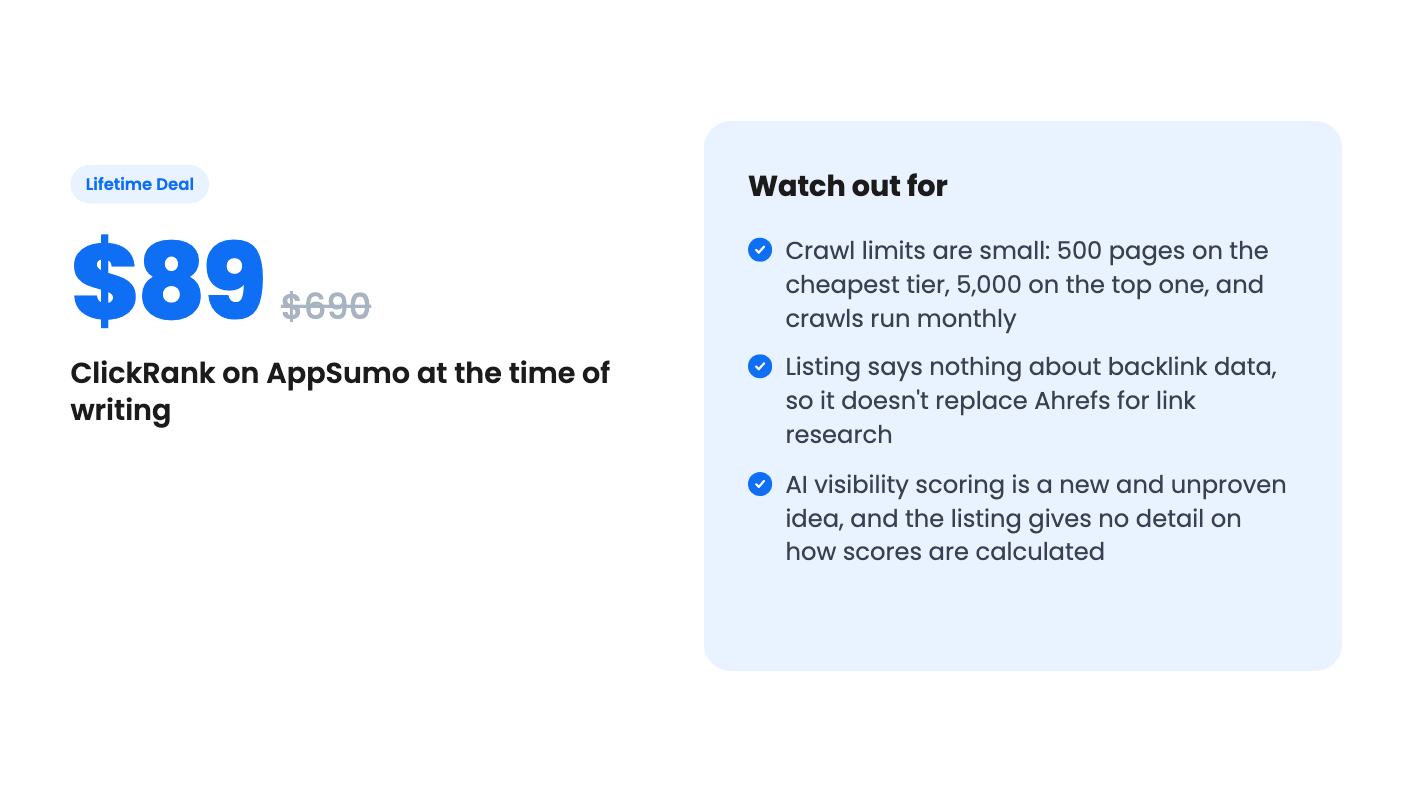
Here we’d be cautious. Robots.txt checks are straightforward and easy to verify. Per-model scores and AI search volume are much harder to measure reliably, and the listing doesn’t explain the method. Nobody has a settled playbook for ranking in AI answers yet, so a score is only as good as the logic behind it. The listing doesn’t show that logic.
Setup looks light. On WordPress you install the ClickRank.ai plugin, copy an activation key from your dashboard and paste it into the plugin settings. On any other CMS you drop a JavaScript snippet into your header. Google Search Console is the only integration listed, and it feeds the keyword recommendations.
AppSumo tags it as best for bloggers, ecommerce stores and marketing agencies, and calls it an alternative to Ahrefs, Screaming Frog and Yoast SEO. That comparison is generous. It overlaps with Screaming Frog on crawling and with Yoast on tags and schema. The listing doesn’t mention backlink analysis or competitor research, which is a big part of what Ahrefs is for. Think of ClickRank as an on-page fixer, not a full research suite.
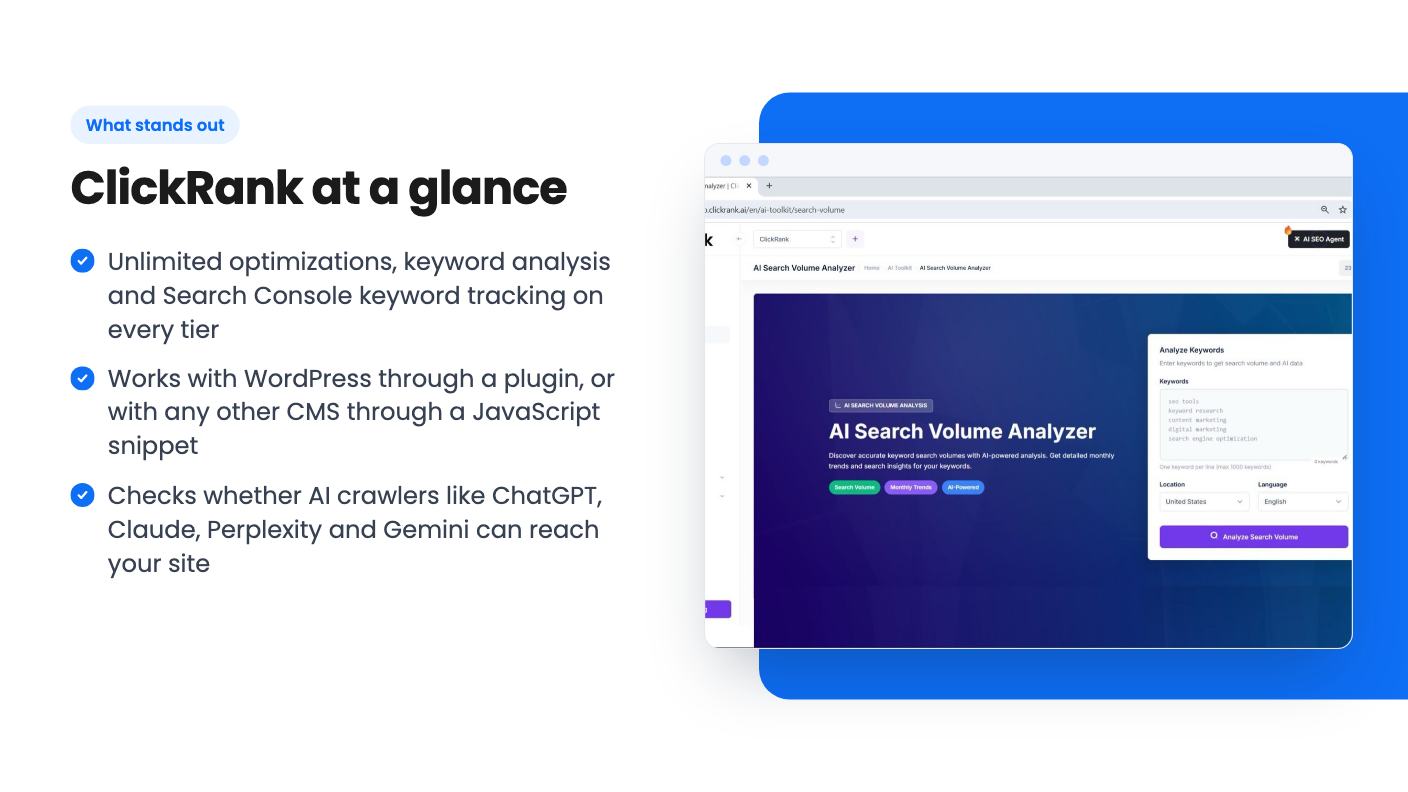
There are four tiers: $89, $178, $267 and $356. They list at $690, $1,380, $2,070 and $2,760, and I wouldn’t read much into those crossed-out prices. Every tier gets unlimited optimizations, unlimited keyword analysis and unlimited Search Console keyword tracking. The differences are in sites, users and crawl size:
The listing’s rows aren’t labeled by tier, and that website row is out of order, so confirm the exact numbers on the checkout page before paying. Going by the order of the users and crawl rows, the $89 tier appears to give you one user and 500 pages. That’s tight. A 500-page crawl cap won’t cover a blog that’s been running for a few years or a store with many product pages.
The monthly crawl interval matters too. If you publish often or change your site a lot, a monthly audit means problems can sit for weeks.
A few terms are more reassuring. You get all future Solo Plan updates, and if the plan gets renamed, your deal maps to the new name. You must redeem within 60 days, and the 60-day money-back guarantee gives you time to find out whether the limits suit you. You can stack up to four codes, and earlier buyers can add codes to raise their limits.
This is a young product, and the listing says so indirectly. AppSumo’s own summary mentions “minor issues with language support and localization.” If you run a site in a language other than English, check this before buying.
The 4.51 average across 488 reviews is a decent sign, but AppSumo’s summary is marketing copy, and early reviewers often rate on first impressions rather than a year of use. Lifetime deals also depend on the company staying around. The listing gives no company size, roadmap or support details.
The feature list is long, and some of it is vague. Phrases like “auto content optimization” and “future-proof your SEO” don’t tell you what the tool changes on your page. Until you see real output on your own site, assume the quality of the AI-written titles and descriptions is unknown.
One site or two, mostly WordPress, a few hundred pages, and no budget for a monthly SEO subscription: the $89 or $178 tier is a low-risk bet, because the refund window covers you. Use the first weeks to run a crawl, look at what it changes and compare it with what you’d have written yourself.
Agencies and bigger stores should look hard at the crawl caps before spending more. The top tier’s 5,000 pages sounds like plenty, but a catalogue site can pass it. And if you want backlink data, rank tracking across competitors or content gap research, this listing doesn’t promise any of it, so keep your existing tool.
If your biggest SEO problem is that you never get around to fixing the basics, ClickRank is aimed at you. Buy it, test the fixes in the first month, and request a refund if they aren’t good enough.
Yes. According to the listing, you add a small JavaScript snippet to your site's header and it applies the optimizations without a plugin. WordPress users can install the ClickRank.ai plugin and paste in an activation key.
The listing says it's designed to work alongside them without conflict, but recommends using ClickRank as your only SEO plugin if you want its full feature set.
It depends on the tier. The listing's figures run from 500 pages on the $89 tier up to 5,000 pages on the $356 tier, with monthly crawls. Stacking up to four codes raises your limits.
How this review was made: researched from ClickRank's official listing, and written with help from AI. We have not tested ClickRank hands-on yet. Prices and deal terms change, so check AppSumo before you buy. See our affiliate disclosure.
Five AppSumo lifetime deals named as Linktree alternatives, from $19 to $59 entry prices. See who each suits and what the listings leave out.
Six AppSumo lifetime deals pitched as Google Analytics alternatives, grouped by the job you need done, with tier limits and gaps spelled out.
Ten AppSumo lifetime deals named as Ahrefs alternatives, grouped by job: keywords, site fixes, AI search tracking and competitor research. Limits included.